

If you are searching for SAP Business One alternatives, the system's long-term version cycle is likely the trigger. SAP's March 2026 Road Map confirms continued feature pack delivery to SAP Business One Version 10, with scheduled releases including FP 2608, SP 2611, and FP 2702 running into 2027. The next-generation Version 11 is expected to launch in 2027 as well.
This upcoming generational shift is prompting Canadian SMBs to ask a fair question: should we plan for the major cloud-centric upgrade to Version 11, or is it time to switch platforms entirely?
The seven SAP Business One alternatives below fit the SMB tier, with honest notes on pricing, Canadian partner availability, and where each one wins or loses.
Talk to a Microsoft ERP Partner in Canada
Get a no-pressure conversation with a Gestisoft expert who has helped Canadian SMBs evaluate ERP options since 1997. Bilingual, B Corp certified, and Microsoft Solutions Partner.
 Free discovery call
What Are The 7 Best SAP Business One Alternatives for Canadian SMBs in 2026?
Here are the seven SAP Business One alternatives Canadian SMBs are most often shortlisting in 2026, ranked by fit for the typical 5 to 100 user business.
1. Microsoft Dynamics 365 Business Central
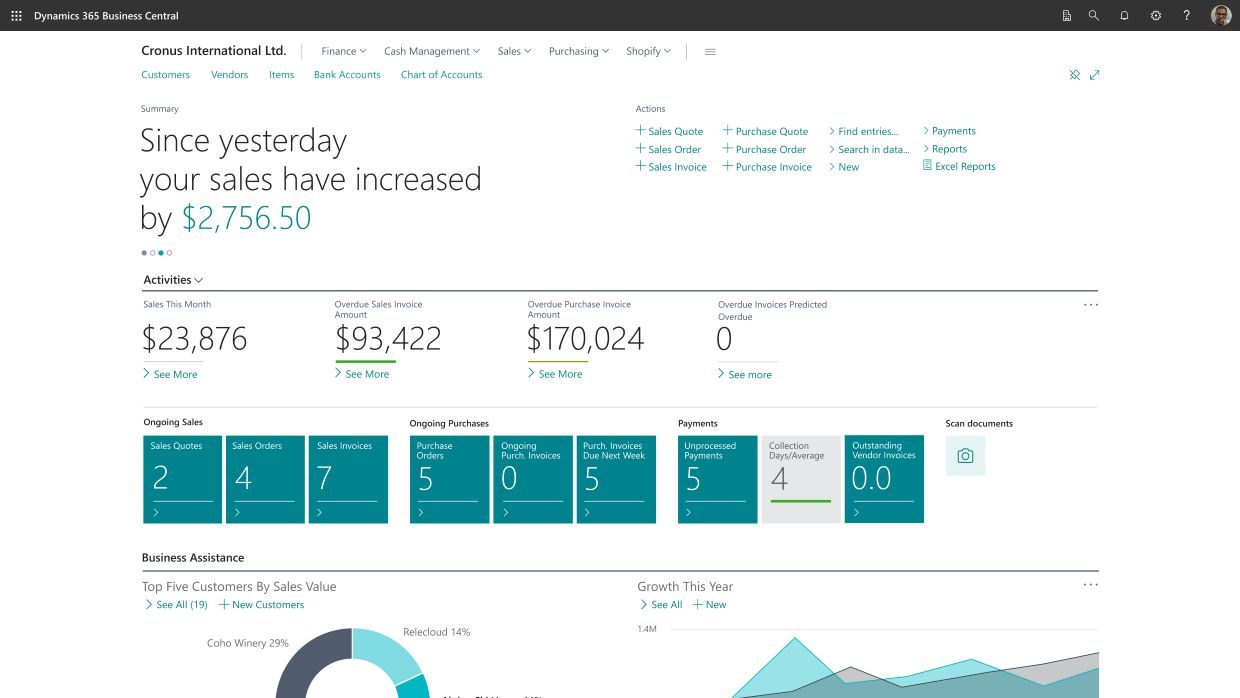
Microsoft's SMB ERP is the closest functional match to SAP Business One, with a deep partner bench across Montreal, Toronto, Ottawa, and Quebec City. Business Central covers finance, sales, purchasing, inventory, warehousing, assembly, and project accounting in one cloud system.
Best for: Canadian SMBs already running Microsoft 365 who want native integration with Teams, Outlook, and Excel, plus Copilot AI in daily workflows.
Strengths: Strong Canadian localization for GST, HST, and QST. Bilingual EN and FR interface. Essentials pricing starts around CAD $108.50 per user, per month.
Limitations: Essentials does not include production manufacturing. Companies needing routings, work centers, or capacity planning require the Premium tier at CAD $149.20 per user, per month. See our SAP vs Dynamics 365 breakdown for a direct comparison.
2. Oracle NetSuite
NetSuite was built cloud-native in 1998 and remains a strong choice for businesses with multi-entity, multi-currency operations or fast-growth ambitions that may push past the SMB tier.
Best for: Services, software, and product businesses with multiple legal entities or international subsidiaries that need consolidation out of the box.
Strengths: Mature financial consolidation. Strong reporting and dashboards. Broad ecosystem of SuiteApps for vertical needs. Used widely by venture-backed companies preparing for scale, IPO readiness, or rapid international expansion.
Limitations: Total cost ramps fast once you add users, modules, and customization through SuiteScript. Implementation timelines often stretch longer than equivalent Business Central projects. Canadian partner depth is solid but smaller than Microsoft's. For a side-by-side, our NetSuite vs Business Central comparison covers the key trade-offs.
3. Acumatica Cloud ERP
Acumatica has built a name on resource-based pricing, which charges for system resources rather than per-user seats. That model can work well for businesses with many light users.
Best for: Distribution, field service, and discrete manufacturing SMBs with seasonal or variable headcount.
Strengths: Cloud-native and modern UI. Strong xRP development platform for custom workflows. Generally faster to implement than legacy SAP. Mobile-first design works well for field teams and warehouse users.
Limitations: Smaller Canadian partner footprint than Microsoft. Resource-based pricing is harder to model in early budgeting conversations. Some Canadian payroll and tax features still rely on third-party connectors. Buyers comparing SAP Business One alternatives in the cloud ERP space often shortlist Acumatica alongside Business Central, so getting a real partner conversation on both is worth the time.
4. Odoo
Odoo is the open-source option on this list. Its paid Standard and Custom plans bundle access to all Odoo apps for a per-user fee, with a free Community Edition for businesses that can self-host.
Best for: Smaller SMBs, startups, and businesses comfortable with a more hands-on ownership model who want flexibility without enterprise pricing.
Strengths: Low entry cost. Wide module library covering CRM, accounting, e-commerce, manufacturing, and HR. Active developer community. Useful for technical teams that want full control over customization and hosting choices.
Limitations: Less polished for Canadian compliance and bilingual rollouts than Microsoft. Heavier responsibility on the buyer or partner to maintain customizations across upgrades. Support quality depends heavily on the implementer you choose. Our Odoo vs Business Central comparison walks through where each one fits best.
5. Sage Intacct
Sage Intacct is a finance-led cloud platform with a strong reputation for general ledger and reporting depth. It is more of a financial management system than a full operations ERP.
Best for: Services firms, nonprofits, and finance-driven organizations that prioritize reporting, multi-entity accounting, and audit trails over inventory or production.
Strengths: Dimensional reporting that scales with complexity. Strong multi-entity consolidation. Easy to integrate with operational tools like Salesforce or HubSpot. Popular with CFOs who want clean monthly close cycles and audit-ready trails.
Limitations: Lighter on supply chain, inventory, and manufacturing than the others on this list. Businesses with physical product flows usually need a second system or heavy add-ons. Among SAP Business One alternatives, Sage Intacct is the best pick if accounting depth matters more than operations breadth.
6. Epicor Kinetic
Epicor Kinetic is built for manufacturers. It covers discrete, make-to-order, engineer-to-order, and mixed-mode production with shop floor connectivity that few generalist ERPs match.
Best for: Canadian manufacturers in metals, machinery, electronics, and aerospace who need real production depth.
Strengths: Deep MES and shop floor data. Strong configurator and quoting tools. Built-in IoT and analytics for plant operations. Handles complex routings and engineering changes that lighter SAP Business One alternatives often struggle with. If you are weighing ERP plus MRP or both, our ERP vs MRP guide breaks it down clearly.
Limitations: Implementation tends to run longer than Business Central or Acumatica projects. The UI can feel dense for finance users who do not live on the shop floor. The Canadian partner footprint is solid but smaller than Microsoft's.
7. SYSPRO
SYSPRO is a mid-market favourite in manufacturing and distribution, especially in food and beverage, electronics, and industrial machinery.
Best for: Mid-market manufacturers and distributors with serial or lot traceability, recipe management, or complex inventory needs.
Strengths: Vertical depth in food, beverage, and industrial verticals. Reasonably quick to deploy for a manufacturing ERP. Solid global presence and 40-plus years of focused investment in manufacturing workflows. Strong fit for businesses with traceability and compliance pressure.
Limitations: Smaller ecosystem than Microsoft or Oracle. Native Canadian sales tax (GST/HST/PST) is robust, but Canadian payroll processing typically requires ecosystem connectors. Reporting tools often need supplementation with Power BI or similar. Among SAP Business One alternatives, SYSPRO is a strong pick when industry vertical fit matters more than ecosystem breadth.
Why Canadian SMBs Are Reviewing Their SAP Business One Alternatives in 2026
Three triggers are pushing Canadian SMBs to evaluate SAP Business One alternatives this year.
The 2027 Version 11 Transition
SAP's March 2026 Road Map maps feature pack deliveries for SAP Business One Version 10 into 2027, with FP 2702 scheduled for early next year. Version 11 is set to launch later in 2027 as a major architectural shift, with native cloud management for partners, hyperscaler deployment options, and the Web Client positioned as the primary interface.
Businesses on Version 10 face a choice: plan for the Version 11 upgrade and the re-platforming work it brings, or evaluate SAP Business One alternatives now.
Either path means a project. The question becomes: if we are doing a project anyway, are we doing it on the system we already have, or the one we should have?
When SAP Business One Alternatives Make More Sense Than Staying
SAP Business One still fits some businesses well. If your operations are stable, your customization light, your partner relationship strong, and your industry depth covered, staying may be the right call.
But the math shifts when you hit any of these:
- You need bilingual EN and FR rollouts across a Quebec or pan-Canadian workforce.
- Your partner is hard to reach or recently changed hands.
- Your customization debt has piled up across versions.
- Or your team needs modern AI features that Business Central, NetSuite, and others ship today.
The Canadian Partner Availability Gap
SAP Business One's Canadian partner footprint is thinner than its US footprint. For Microsoft, the opposite is true. Canada has a deep bench of Microsoft Solutions Partners, including Gestisoft, with offices in Montreal, Toronto, Ottawa, and Quebec City.
That gap matters most during go-lives and when something breaks. Local partner availability shows up in support response times, project cost predictability, and the ability to find a second opinion if your first partner is not the right fit.
Here is a quick look at how Business Central actually feels for day-to-day users, which helps if you are coming from SAP Business One and trying to picture the move…
How to Choose Among SAP Business One Alternatives: A 5-Point Framework
Most SAP Business One alternatives comparisons stop at feature lists. Here are five criteria that predict whether a switch lands well, in the order they should drive your decision.
Industry Depth First, Brand Name Second
The most expensive ERP project is the one where the system never quite fits your industry. Before you compare brand names, list the five processes that must work on day one: production routing, lot traceability, multi-warehouse picking, project accounting, whatever your business actually runs on.
Then ask each shortlisted vendor to demo those five workflows with your data, not a generic walkthrough.
The One Question Most SAP Business One Alternatives Comparisons Skip
How many partners in Canada can implement and support this product, and how many are within a two-hour drive or video call of your operations?
Partner depth is the single biggest predictor of project success and the single most ignored factor in vendor comparisons. A great product with one Canadian partner is riskier than a good product with twenty.
Five-Year Total Cost, Not Sticker Price
Per-user pricing pages are designed to look favourable. Real cost includes implementation, customization, integrations, training, support, internal IT time, and the cost of changing partners if it goes sideways. Model the full five years, not the first invoice.
Configuration Over Customization
Every line of custom code is a future upgrade tax. Among SAP Business One alternatives, the ones that let you configure what you need with low-code tools tend to age better than the ones that need developer hours for every change.
Ask each shortlisted vendor what percent of your top processes can be handled with configuration, extensions, or app marketplace solutions, versus what truly needs custom code. Our guide on personalized ERP versus standard ERP walks through how to draw that line.
AI and Copilot Readiness
AI is no longer a future-state feature. Microsoft has Copilot built into Business Central. NetSuite, Acumatica, and others are shipping their own AI features for forecasting, reconciliation, and document handling.
Ask what is live today, what is on the roadmap with a date, and what is still marketing. The gap between vendors here is wider than most buyers realize.
Get a Side-by-Side ERP Comparison
Have a Gestisoft expert build a tailored comparison of the top SAP Business One alternatives against your real requirements. Bilingual support, no obligation.
 Book a free consultation
The Hidden Costs Buyers Miss When Evaluating SAP Business One Alternatives
The sticker price is rarely where ERP projects go off the rails. The real cost lives in the parts of the project most SAP Business One alternatives comparisons never mention.
Customization Debt and the Version Trap
Every customization is a future upgrade tax. SAP Business One users moving to version 11 in 2027 know this well: each custom screen, report, and integration has to be retested, sometimes rebuilt. The same is true on any ERP. Choose a system where your top use cases can be configured, not coded.
Data Migration Realities
Master data is almost always messier than the buyer thinks. Item masters, customer records, open orders, and historical transactions need to be cleansed, mapped, and validated. A typical Canadian SMB migration runs four to twelve weeks of focused effort. Plan for it explicitly, with internal owners named.
Training, Change Management, and Process Redesign
The system goes live in a day. People adapt to it over months. The businesses that get the most value from their new ERP are the ones that treat training and process redesign as part of the project, not as a step they will figure out after go-live.
Integration costs are another quiet line item. Connecting your new ERP to your CRM, e-commerce, EDI, or shop floor systems is rarely free, and the cheapest sticker price among SAP Business One alternatives is not always the cheapest project once integrations are added.
If you are still weighing whether you need a full ERP or could get by with accounting software, our piece on accounting software vs ERP covers when each one is the right call.
10 Key ERP Selection Criteria
Our free guide walks through the ten criteria that experienced ERP buyers use to compare ERP options.

-
For most Canadian SMBs, the strongest SAP Business One alternatives are Microsoft Dynamics 365 Business Central, Oracle NetSuite, Acumatica Cloud ERP, and Odoo. Business Central typically wins on Canadian partner availability, Microsoft 365 integration, and bilingual EN and FR support.
Why Gestisoft Is the Right Partner for Your SAP Business One Alternatives Decision
Gestisoft has been helping Canadian SMBs make ERP decisions since 1997. We are a Microsoft Solutions Partner, B Corp certified, and Great Place to Work certified, with offices in Montreal, Toronto, Ottawa, and Quebec City serving clients across Canada and North America.
We specialize in Microsoft Dynamics 365 Business Central, one of the strongest SAP Business One alternatives for Canadian SMBs. That focus means we have implemented Business Central across manufacturing, distribution, services, and association management, in both English and French.
Here’s what one of our long-term clients said after working with us:
“As a customer since 2015, I would like to highlight the quality of support and expertise provided by Gestisoft for our Business Central application. Their competence is notable and has greatly contributed to the success of my business. I highly recommend them as a service provider for Business Central.”
The right ERP is only half the decision. The right partner is the other half, and that conversation is best started in person.
Start the ERP Conversation
Get a 1-on-1 conversation with a Gestisoft Business Central expert. We will help you scope your requirements, compare your shortlist, and plan a realistic path forward.
 Free discovery call
Liked what you just read? Sharing is caring.

June 22, 2026 by Muhammad Ali Iqbal by Muhammad Ali Iqbal SEO Content Strategist & Copywriter
Driven by a passion for search engine optimization, strategic content, and conversion-focused writing. A copywriter and content strategist who lives for content that ranks, engages, and delivers real business results.
