

Key Takeaways:
- An ERP for manufacturer connects finance, inventory, production, and reporting into one live system, so the shop floor, warehouse, and accounting work from the same data. See Microsoft's Production BOM and routing docs for the underlying setup.
- Discrete versus process manufacturing is the single decision that changes your shortlist the most.
- Most manufacturing ERP projects underdeliver because the shop was not ready with clean data, not because the software was wrong.
- Gestisoft is a Microsoft Solutions Partner and B Corp certified Canadian firm serving manufacturers from offices in Montréal, Toronto, Ottawa, and Québec City.
An ERP for manufacturer connects production, inventory, finance, and reporting into one live platform, so the plant floor, warehouse, and accounting work from the same numbers. This guide covers the 7 problems it solves, whether you are ready to buy, and how to shortlist without regret.
But before the frameworks and checklists, it helps to hear what the payoff actually sounds like from a Canadian plant that made the switch.
“The solution delivered to us has significantly improved our production visibility. We are now able to track our production in real time, and have more accurate data on the costs of each production run.”
That is what a good ERP delivers. Let's start with what it actually fixes on the floor.
Figure Out What Fits Your Plant
Every plant is different. Talk to a Microsoft Solutions Partner and B Corp certified Canadian firm that has helped manufacturers pick the right fit.
 Free discovery call
What Production Problems Does An ERP For Manufacturer Actually Solve?
Vendors love feature lists. Plant managers care about pain. Here are 7 real problems the right system solves, based on what Canadian manufacturers deal with day to day.
Problem 1: Inventory Ghosts On The Shelf
Your ERP says you have 240 of Part A. The warehouse has 187. Nobody knows where 53 units went.
An ERP for manufacturer with real-time inventory kills this by capturing every receipt, pick, and move at the point it happens, through a bar-code scan or shop-floor terminal. Month-end recon becomes a 20-minute check, not a Tuesday-morning ritual.
Problem 2: Costing You Can't Trust
You quote a job at $8,400. It closes at $11,900. Nobody can tell you why.
When routings, labor time, and material consumption post to the GL live, you see the real cost per job the day it closes. That is the difference between a spreadsheet estimate and a manufacturing ERP built to close the loop.
Problem 3: MRP Runs In Someone's Head
Your planner leaves for two weeks and the plant panics. That is a sign MRP is happening in a spreadsheet, or worse, in one person's brain.
A modern ERP for manufacturer bakes MRP into the same system as sales, inventory, and purchasing. New to the distinction? Our what is MRP and ERP explainer breaks it down.
Problem 4: Shop Floor Runs On Paper Travelers
Paper travelers and whiteboards are still how a lot of shops track WIP. Live shop-floor terminals kill that: WIP stops hiding, cycle times get honest, and the plant manager can answer "where is my order?" without walking the floor.
Problem 5: Month-End Close Takes 15 Days
If your accountant is still keying manual journal entries for production, close will always drag. A modern platform posts inventory movements, production costs, and revaluations automatically, so finance closes in days.
Problem 6: Quality Issues Only Surface At The Customer
Nothing hurts a brand faster than a defect that clears the plant and lands at the client. In-line inspection, non-conformance tracking, and CAPA workflows catch issues at the workstation, not at the return.
Problem 7: Bilingual And Multi-Province Reporting Is A Nightmare
A Canadian-configured ERP for manufacturer handles GST, HST, and QST at the line level, applies the right rate by province, and lets your team work in French or English without duplicating master data.
Are You Actually Ready To Buy An ERP For Manufacturer?
This is the question no vendor will ask you. Buying an ERP for manufacturer before your shop is ready is the single biggest reason projects underdeliver.
The Readiness Self-Check
Answer these 5 yes-or-no questions. Three "no" answers mean fix data before you shortlist.
- Do you have a single, accurate bill of materials (BOM) for every product you make?
- Can one person tell you what is on hand today without calling the warehouse?
- Do you know your top 10 SKUs by margin, not just by revenue?
- Is there one named person accountable for the ERP project, not a committee?
- Does leadership agree on the top 3 outcomes the ERP has to deliver in year one?
If you got a mix of yes and no, your ERP decision is still valid, but budget 4 to 8 weeks of data cleanup before go-live.
What Actually Changes On The Shop Floor In The First 30 Days
Picture a mid-sized metal fab shop, 80 employees, moving from spreadsheets and QuickBooks to a live ERP.
- Day 1: operators scan into work orders instead of logging paper time.
- Day 7: the planner works from a real MRP suggestion, not a copy-pasted Excel.
- Day 14: the plant manager pulls a WIP report in 30 seconds instead of walking the floor.
- Day 30: the accountant closes the month in 4 days instead of 12.
What To Fix Before You Shortlist Any ERP For Manufacturer
- Clean your item master. Duplicate SKUs and inconsistent units of measure follow you into any system.
- Standardize your BOMs. Multi-level BOMs need version control before production.
- Pick an owner. If it's "everyone's job," it's nobody's job.
- Decide the top 3 KPIs the ERP has to move, and write them down.
What Separates A Smart ERP For Manufacturer Shortlist From A Regret Waiting To Happen?
Most buyers pick badly because they shop for features. The harder question is what happens if the choice is wrong.
An ERP for manufacturer is a 5 to 10 year commitment. The real cost of wrong-fit is the switch two years in, when the plant outgrows a light tool or drowns in an enterprise one.
Three Wrong-Fit Signals To Catch Before You Sign
- You are grading vendors on features you might use, not features you use this quarter.
- Your top two contenders sit on opposite sides of the mid-market vs enterprise line, meaning someone is guessing at scale.
- Nobody on your side can name the top 3 outcomes the ERP has to move in year one.
Wrong-fit shows up as scope creep, adoption failure, or a sunk cost written off in year three.
The Mindset Shift That Changes Every ERP For Manufacturer Shortlist
Stop asking which platform is best. Start asking which one your team will actually adopt in 90 days. Adoption compounds, features nobody uses are a rounding error.
Modern platforms are also closing the gap on plain-English querying. Microsoft 365 Copilot for business is bringing conversational AI into daily work, so people ask questions in a chat window instead of building a report.
Bring A Canadian Partner In At Shortlist, Not At Build
The most expensive mistake is picking a platform first, then looking for a partner to make it fit.
That is how a US-designed ERP ends up needing six figures of custom work for GST, HST, QST, French UI, and bilingual training. A partner who knows the Canadian floor tells you which platforms need that work and which come with it native.
That is the exact conversation Gestisoft runs with Canadian manufacturers at the shortlist stage, before a license is signed and the wrong scope is baked in.
Narrow The Shortlist With Confidence
Get a straight, no-pressure read on which platforms fit your production model, from a Microsoft Solutions Partner working with Canadian manufacturers.
 Free discovery call
What Does A Monday Morning Look Like Once An ERP For Manufacturer Is Live?
The best way to see what an ERP for manufacturer actually changes is to walk through one Monday with the two people it touches most: the planner and the receiver.
Monday, 6:00 AM: The Planner
On a paper plant, the planner arrives, prints yesterday's WIP report, calls the warehouse to confirm weekend shipments, then rebuilds the week in a spreadsheet. Two hours gone before the first coffee.
On a modern ERP for manufacturer, the same planner opens one screen. MRP ran overnight, purchasing suggestions are queued for approval, WIP is live from the floor. That is 90 minutes back in the day.
Solid ERP in inventory management is what makes that morning possible.
Monday, 2:00 PM: The Receiver At The Dock
A truck arrives with a partial delivery. In a paper plant, the receiver signs, walks the pallets to a shelf, and the paperwork gets keyed in on Wednesday. Three days of stale data.
With bar-code receiving inside the ERP, the pallet is scanned at the dock, the PO closes automatically, and the item is available on the picker's screen in under a minute.
That single delay disappearing is what a planner will tell you changes their week.
What This Buys You Over A Quarter
Not magic. Just less rework.
- Fewer stockouts, because the buyer sees real inventory.
- Fewer expedites, because MRP catches shortages a week earlier.
- Fewer month-end surprises.
That flow also feeds better supply chain management software decisions upstream, once procurement has clean data.
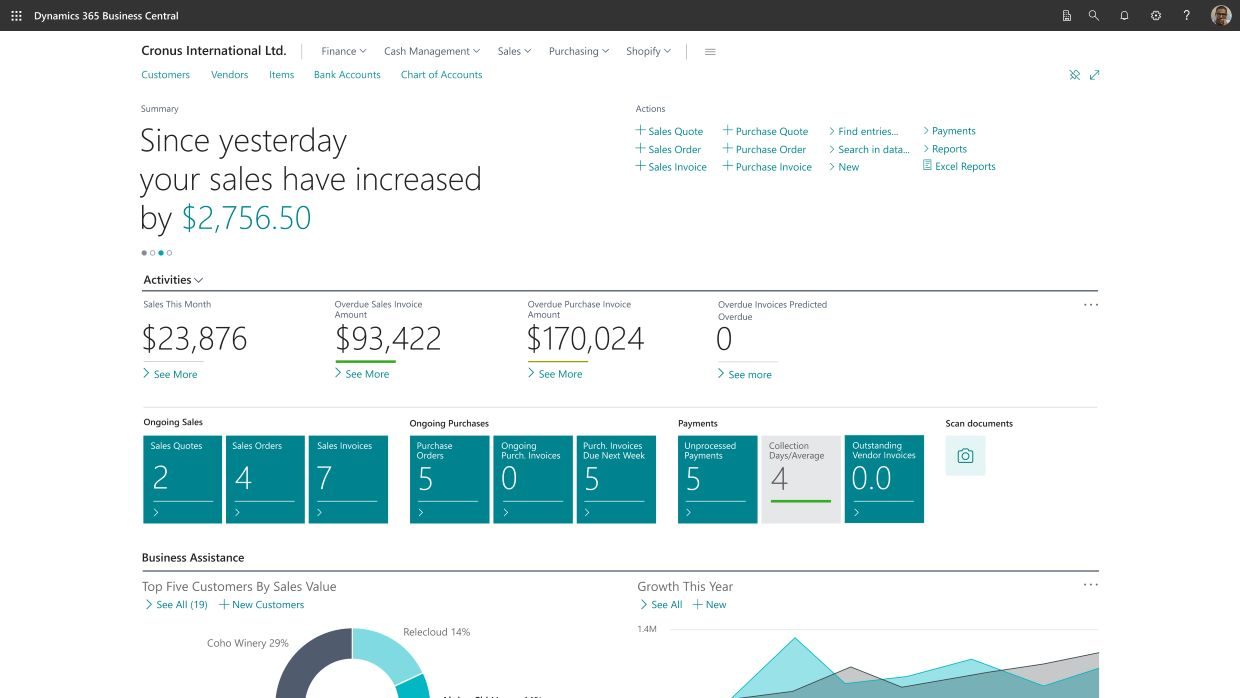
If you have not seen Business Centra up close, this short walkthrough shows the interface, how role-based navigation works for a planner or an accountant, and where Copilot fits into daily work:
What Questions Should Your ERP For Manufacturer Answer In Under A Minute?
Reporting is where an ERP for manufacturer either earns its price tag or turns into an expensive filing cabinet. The wrong question is "what dashboards do we need?" The right one is "what should the plant manager answer in under a minute?"
Three Questions Your System Should Answer Fast
Grade any shortlist candidate on these. If a live demo can't handle them in a minute each, the plant won't either.
- "Is order #4271 shipping this week?" A 30-second click, not a phone call to the floor.
- "Which SKUs lost money last month?" Real cost per SKU, not standard cost. This is what tells you where to renegotiate a supplier or drop a product line.
- "Where is the constraint on line 2 right now?" Live shop-floor status. Not "as of yesterday." Not "let me check with the supervisor." Right now.
Why Live Beats Weekly For A Modern ERP For Manufacturer
A weekly report tells you what already happened. A live view lets you change what is about to happen.
That is why teams connect Power BI to Business Central so leaders see the same numbers in Teams as their planners see on the floor.
One version of the truth, no debate in the Monday meeting about whose spreadsheet is right.
5 Reasons to Adopt a Cloud ERP
A short eBook that walks through the real benefits of adopting a cloud ERP, such as Business Central, for businesses.

What Are The Hidden Costs Of An ERP For Manufacturer In Canada?
Vendors quote licenses and implementation. Both are real. Neither is the full cost.
The gap between the quoted number and the real number is where an ERP for manufacturer project lands on budget or blows past it by 30%.
Our broader piece on Canadian ERP software covers pricing. The honest work is knowing what does not show up on the quote.
Three Costs Vendors Rarely Put On The Proposal
- Data cleanup. Duplicate SKUs, inconsistent units of measure, stale BOMs. Budget 4 to 8 weeks of internal time on top of the vendor's number.
- Change management after go-live. The vendor's 3-day training is not change management. The real work is 6 to 12 weeks of hand-holding on the floor, especially for operators moving off paper.
- Scope creep. A small request from finance in month 3, a custom report in month 5, an extra integration in month 7. Each is fine alone. Together they add 15 to 20% to budget.
What A Realistic Total Actually Looks Like For An ERP For Manufacturer
For a Canadian mid-market plant, the 3-year cost pattern is roughly 40% licenses, 40% implementation, 20% internal (cleanup, training, backfill).
Based on Nucleus Research on cloud ERP payback, cloud deployments recover that investment about 43% faster than on-premise, largely because scope stays tighter.
The single move that keeps a project on budget is a fixed-scope proposal with clear change-order pricing, not open-ended T&M.
What Are The Warning Signs Of A Bad ERP For Manufacturer Partner?
An ERP for manufacturer project fails on the partner more often than on the software.
Same platform, same industry, two partners: one lands on time, one drags into year two. Watch for the warning signs, then look at what the good ones do in the first month.
Three Signs You Are Talking To The Wrong Partner
- A sales rep runs the technical demo. If nobody in the room can answer live questions about BOM setup, routings, or scrap posting, the delivery team is not who you were sold. Ask for the consultant by name and look them up.
- The proposal is time-and-materials with no cap. T&M is fine for post go-live support, not for implementation. A partner who will not commit to a scope knows something about your project you don't.
- No Canadian manufacturing reference in your vertical. Metal fab is not food. Food is not fashion. A partner who has never done your vertical is learning on your budget.
What A Real Partner Does In The First 30 Days
They map your process before they touch software. They build a data cleanup plan short enough for your team to actually execute. They name one delivery lead who owns the project end to end from day one.
If you are shopping in Ontario, our regional guides on choosing a Business Central partner in Ottawa or a Business Central partner in Toronto cover what local plant leaders actually asked before they signed.
The 4 Platforms Canadian Manufacturers Usually Shortlist
Most Canadian mid-market manufacturers end up comparing four platforms:
- Business Central, the mid-market default with the strongest Microsoft 365 tie-in.
- SAP S/4HANA, for large global operations with the IT depth to run it.
- NetSuite, a solid cloud pick if you also run e-commerce or distribution.
- Epicor Kinetic, purpose-built for complex discrete production.
The best manufacturing ERP for your plant depends on the discrete-vs-process question and your production scenario.
For the full 8-vendor comparison with pricing and industry fit, see our sibling ERP solutions for manufacturing piece. Smaller shops under 30 employees should check our ERP system for small business comparison.
-
Check three things: is your bill of materials clean, is one person named as project owner, and can leadership agree on the top 3 outcomes for year one? If any answer is no, budget 4 to 8 weeks of prep work before you shortlist anything.
What Makes Gestisoft The Right Long-Term Partner For Your ERP For Manufacturer?
Every ERP partner will tell you they can do manufacturing. The harder question is who can tell you what changes on the shop floor at 2 PM when a work order goes down. That is where the right partner earns their fee on an ERP for manufacturer project.
The vertical depth is what makes Gestisoft's manufacturing focus different. The team has run implementations across metal fabrication, fashion and apparel, distribution, and industrial equipment.
Each has its own scheduling reality, quality workflow, and cost structure. A generalist team learns those on your budget. A vertically-experienced one shows up with the pattern already in hand. Our manufacturing industry page covers how the practice is set up.
Gestisoft has been a Microsoft partner since 2004, working with Canadian mid-market plants. Credentials behind that:
- Microsoft Solutions Partner (since 2004).
- B Corp certified.
- Great Place to Work Canada certified (February 2024 to February 2025).
- Canada's Most Admired Corporate Cultures 2023.
- Bilingual EN/FR delivery from Montréal, Toronto, Ottawa, and Québec City.
Credentials get a partner into the room. What keeps them there is how they run the work: fixed scope, a named delivery lead, bilingual training on the floor, and support built for the day after go-live.
One Canadian manufacturing client's words after project close.
“Always attentive to our needs, the dedicated team never hesitated to take the time to review points generating concern in order to ensure a project that would meet our expectations from A to Z.”
That is what an ERP for manufacturer project should feel like at the end. A team that showed up, stayed close, and delivered what they said.
Get Straight Answers On Your ERP For Manufacturer Options
Get a straight recommendation on the right ERP fit for your plant, from a Microsoft Solutions Partner with bilingual EN/FR delivery across Canada.
 Book a free consultation
Liked what you just read? Sharing is caring.

September 16, 2026 by Muhammad Ali Iqbal by Muhammad Ali Iqbal SEO Content Strategist & Copywriter
Driven by a passion for search engine optimization, strategic content, and conversion-focused writing. A copywriter and content strategist who lives for content that ranks, engages, and delivers real business results.

