

The line between discrete vs process manufacturing decides almost everything about how your plant runs, from the way you cost a unit to the way you track a recall. Get it wrong on paper and the software you buy will fight you on the floor every day.
Most Canadian SMBs we talk to do not run a clean version of either. They build parts and mix formulas. They ship serialized units and track batch expiry. They need a setup that handles both without taping two systems together.
This guide walks through what discrete vs process manufacturing actually means in practice, where the differences hit your operations, and how to pick the right software for the workflow you already have.
Find The Right Manufacturing Setup For Your Business
Walk through your workflow with a Gestisoft specialist and get a clear read on whether discrete, process, or hybrid software fits how you actually produce.
 Book a free consultation
What Discrete vs Process Manufacturing Actually Means
At the simplest level, discrete vs process manufacturing splits on one question: can you take the finished product apart again and recover the inputs?
How Discrete Manufacturing Builds Products
Discrete manufacturing assembles distinct, countable units from parts you can list, count, and often reuse. Think of a laptop, a refrigerator, a hydraulic pump, or a car door. Each item is built from a bill of materials (BOM) that names every screw, board, and bracket.
If a finished unit fails QA, you can usually take it apart, salvage the working components, and rework the rest. Unit counts and serial numbers drive the whole operation, which is why discrete shops live and die by accurate BOMs and routing data.
How Process Manufacturing Creates Products
Process manufacturing transforms raw inputs into a finished product that cannot be returned to its original ingredients. Once you blend, react, ferment, or extrude, there is no going back.
Paint, salad dressing, pharmaceuticals, fertilizer, and cheese all live on this side. The work is governed by recipes or formulas, measured in volume or weight, and yields shift with temperature, humidity, and ingredient quality. Lot tracking and expiry dates matter more than serial numbers.
Discrete vs Process Manufacturing: The Differences That Actually Change Your Operations
Definitions are the easy part. What matters is how discrete vs process manufacturing changes the daily work in your plant, your warehouse, and your finance team.
BOMs vs Recipes In Discrete vs Process Manufacturing
A discrete BOM is a parts list with a hierarchy: assemblies made of sub-assemblies made of components. Quantities are usually whole numbers. Swapping one component for another is a controlled engineering change.
A process recipe is a formula: ingredients expressed as percentages or weights that must sum to a target batch size. Substitutions need a chemist or food scientist to sign off, because changing one input changes the reaction. The two structures look similar on a screen, but the rules underneath are completely different.
Inventory, Lot Tracking, And Traceability
Discrete shops track items by serial number when they need to. Each finished good has an identity. Returns, warranty claims, and field service all hang off that serial.
Process shops live in lots and batches. If contamination shows up in a single drum of solvent, you need to trace every batch it touched, in both directions, in minutes. Health Canada and the CFIA expect this for food, beverage, cosmetics, and pharma. A general inventory module will not cut it.
Quality Control And Yield Variability
In discrete manufacturing, a unit either passes inspection or it does not. Defects are countable. You aim for zero ppm.
In process manufacturing, every batch yields something slightly different. A 1,000-litre target might produce 985 litres of usable product after losses to evaporation, filtration, or off-spec material. You plan for variance, capture it in costing, and analyze trends over months. Software that cannot record yield variance accurately will hide losses your CFO needs to see.
Real-World Examples Of Discrete vs Process Manufacturing In Canada
Abstract definitions only get you so far. Here is how discrete vs process manufacturing shows up across actual Canadian plants we encounter.
Discrete Manufacturing Examples From Canadian Plants
Aerospace machine shops in the Montreal corridor cutting, milling, and assembling parts for Bombardier and Airbus suppliers run on tight BOMs, traveler routings, and serialized parts. Same for electronics assemblers in the Greater Toronto Area and industrial equipment builders across Southern Ontario.
Furniture makers in Quebec and Manitoba, fabricators serving the oil and gas sector in Alberta, and machine builders in BC all fit the discrete pattern. The shared thread is countable units, configurable products, and a need for engineering-to-order or make-to-order flexibility.
Process Manufacturing Examples From Canadian Plants
Dairy processors in Ontario and Quebec, craft brewers from Halifax to Victoria, vitamin and supplement formulators in BC, cannabis processors regulated by Health Canada, and chemical blenders serving the mining sector all run on recipes.
So do bakeries scaling beyond a single shop, cosmetics manufacturers in the Boucherville area, and pet food makers across the Prairies. Their day-to-day is governed by batch sheets, yield reports, expiry windows, and traceability obligations the CRA and Health Canada take very seriously.

Can You Run Both Discrete vs Process Manufacturing In One Plant?
Yes, and most Canadian SMBs do. Pure discrete or pure process is rarer than the textbook suggests, and the discrete vs process manufacturing divide blurs faster in real plants than in vendor decks. The interesting question is which side dominates.
Common Hybrid Manufacturing Scenarios
A cosmetics company mixes formulas (process) and then fills, caps, labels, and cartons them (discrete). A coffee roaster blends and roasts beans by weight (process) and packages them into countable retail bags (discrete). A nutraceutical maker compounds capsules (process) and bottles them in serialized lots (discrete).
Food contract manufacturers, beverage producers, paint and coatings companies, and even some industrial assemblers that involve a chemical step all sit in this hybrid zone. The plant floor often feels like two operations bolted together, because that is exactly what the software underneath assumes.
Why Hybrid Operations Need A Flexible ERP
Running a hybrid plant on a pure-discrete ERP forces your team to fake recipes inside item cards. Running it on a pure-process ERP forces your team to fake packaging operations as production orders. Both approaches create reconciliation work nobody asked for.
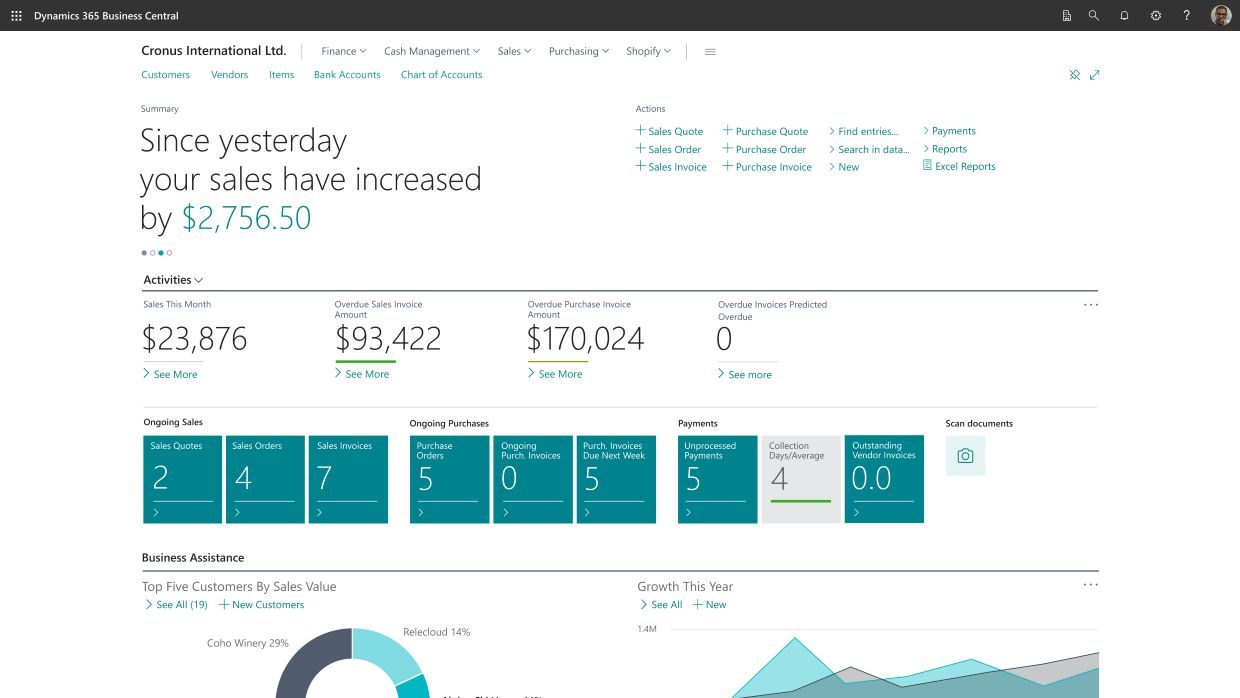
A platform built to handle batch production and assembly side by side, with one set of inventory, costing, and reporting rules, removes that tax. Microsoft Dynamics 365 Business Central was designed for exactly this kind of mixed operation, which is part of why it shows up so often in Canadian hybrid shops.
Before getting into the ERP feature comparison, this short interface walkthrough shows how a single Business Central screen handles production, inventory, and finance side by side.
What ERP Software Needs Different For Discrete vs Process Manufacturing?
The features your shop needs depend on which side dominates. The features your finance and compliance teams need overlap more than people expect.
What Discrete Manufacturing Demands From Your ERP
Discrete shops need strong BOM and routing management, engineering change order workflows, MRP that respects lead times across multi-level assemblies, capacity planning by work centre, shop floor data collection, and serial number tracking from raw component through to warranty claim.
Costing has to support standard, average, and FIFO, plus job costing for any custom or made-to-order work.
For a deeper look, our guide on discrete manufacturing ERP software breaks down the BOM, traceability, quality, and shop-floor features that separate purpose-built discrete systems from generic ERP. It also covers the warning signs that signal it is time to move off spreadsheets or basic accounting software.
What Process Manufacturing Demands From Your ERP
Process shops need formula and recipe management with scaling, by-product and co-product handling, batch yield reporting, expiry-date-driven picking, lot genealogy in both directions, and quality management tied to test results per batch.
Costing has to handle variable yield, ingredient substitution, and absorbed overhead per batch rather than per unit. Compliance modules need to support Health Canada and CFIA traceability rules out of the box, not as a custom build.
Shared ERP Capabilities For Discrete vs Process Manufacturing
Both sides need real-time inventory visibility, accurate landed cost, multi-warehouse and multi-location support, integrated financials, demand planning, and reporting that does not require an external BI tool to be useful.
They also both benefit from AI assistance for forecasting, anomaly detection, and routine data entry, which is where tools like Copilot in Business Central are starting to make a real difference.
Inventory accuracy is the universal foundation for discrete vs process manufacturing alike, and our deep dive on ERP software inventory management explains how to get there.
See How Business Central Handles Production From Floor To Finance
Walk through Business Central's manufacturing features and see how the platform fits discrete, process, and hybrid Canadian plants in one connected system.

How To Choose Between Discrete vs Process Manufacturing Software For Your Plant
The choice between discrete vs process manufacturing software is less about a label and more about how your shop actually behaves on a Tuesday afternoon. Here is how to cut through the marketing.
Questions To Ask Before You Pick A System
Ask your operations lead these five questions. Each one signals which side of discrete vs process manufacturing you actually run.
- How do you measure raw materials? Weight or volume signals process. Count signals discrete.
- How is the finished item identified? Serial number means discrete. Lot number plus expiry means process.
- Can the finished good be disassembled? If yes, you are likely discrete. If the transformation is chemical or final, you are in process.
- What does QA sign off on? A batch certificate points to process. A unit inspection points to discrete.
- What do customers ask for? A certificate of analysis is process language. A serial-number warranty record is discrete language.
If your answers lean toward weight, lots, chemical transformation, batch certificates, and certificates of analysis, you are running process. If they lean the other way, you are running discrete. If you got a mix, you are hybrid, and you need software that can do both without compromise.
Signs You're Running A Process Workflow Even If It Feels Discrete
Plenty of shops think they are discrete because they ship countable units, then discover their costing is off every month. The tell is usually one of these:
- Yield variance shows up every batch. If a production order regularly produces more or less than the BOM predicts because of physical losses, you have a process component buried in your workflow.
- Expiry dates drive your picking order. If shelf life decides what ships first, you are running process logic, even if the finished package is countable.
- Allergens or cross-contamination are a daily concern. Equipment cleaning, line scheduling, and ingredient segregation all sit on the process side.
- Raw materials have variable potency or grade. When a 50 kg bag of input does not behave identically batch to batch, your costing model needs process-grade tracking.
For broader selection criteria, our piece on how to choose an ERP software using 10 criteria walks through needs assessment, integration capabilities, scalability, cloud and security, support quality, and user experience, with a method for ranking each criterion as critical, important, or secondary.
Discrete vs Process Manufacturing In Canada: What Compliance Demands From Each
Canadian operations carry obligations that US-focused software often handles awkwardly or not at all. Choose software that treats these as core, not as add-ons.
Traceability Rules That Affect Process Manufacturers
The Safe Food for Canadians Regulations require one-up, one-down traceability for food and beverage producers. Health Canada quality manufacturing rules apply to natural health products, pharmaceuticals, and cannabis, with batch records that must be reconstructable on demand. Cosmetics fall under the Food and Drugs Act and Health Canada oversight. A recall triggered at the CFIA level expects lot-level data immediately.
Process manufacturers on spreadsheets routinely fail this test. ERPs with native lot genealogy pass it without drama.
Bilingual And Tax Requirements Across Discrete Operations
Quebec operations need French-language documentation under the Charter of the French Language, including invoices, purchase orders, and safety records. Federal contracts often require bilingual delivery. Provincial sales tax handling varies across GST, HST, QST, and PST, and a misconfigured tax engine creates monthly reconciliation pain.
Discrete manufacturers serving Canadian distributors or government also face CRA documentation expectations on inventory valuation that get harder to defend as the business grows.
Software with native Canadian tax handling and bilingual capability saves a lot of avoidable work, which is one reason Microsoft Dynamics 365 Business Central is a default choice for many Canadian SMBs.
Map Your Workflow To The Right Manufacturing Platform
Sit down with a Gestisoft specialist and get a clear, no-pressure read on which Business Central setup fits your production reality.
 Book a free consultation
Common Mistakes To Avoid In Discrete vs Process Manufacturing System Selection
A few selection mistakes show up over and over in discrete vs process manufacturing projects. They are easy to avoid once you know where to look.
Picking The Wrong Software Category From The Start
Buying a discrete-first ERP for a food or chemical shop because it had the slickest demo is the most expensive mistake on this list. The software will not handle expiry dates, recipe scaling, or batch yield natively, and your team will spend years patching around the gap. The reverse is just as painful for true discrete operations forced into a recipe model.
Underestimating Hybrid Workflow Needs
Many SMBs evaluate vendors based on the side of the operation that feels biggest today, then discover six months in that the other side is the one creating the costing headaches.
If any part of your operation involves a chemical or physical transformation that changes inputs into something new, evaluate platforms that handle both discrete and process workflows in one ERP from day one.
Treating hybrid capability as a "we'll figure it out later" decision usually means re-implementing it within two years. The cost of getting discrete vs process manufacturing wrong at selection compounds with every quarter you delay the fix.
If your business is engineered-to-order specifically, the dynamics shift again, and our breakdown of ETO manufacturing covers that path in detail. For shops weighing between an MRP-only tool and a full ERP, the ERP vs MRP comparison is worth a read before you decide.
-
Discrete manufacturing builds countable units from parts that can be assembled and disassembled, like cars or electronics. Process manufacturing transforms raw materials through mixing, blending, or chemical reactions into finished goods that cannot be reversed, like beverages or paint. The first is governed by BOMs and serials, the second by recipes and lots.
Why Gestisoft For Discrete vs Process Manufacturing Implementations
Gestisoft is a Canadian Microsoft Solutions Partner with nearly three decades of experience implementing business applications across Canada and North America. The team supports Microsoft Dynamics 365 Business Central deployments in both English and French, with deep work across manufacturing, distribution, fashion, and regulated industries.
The practical edge is operational. Gestisoft consultants come from finance, supply chain, and production backgrounds, which means conversations stay grounded in shop-floor reality rather than software theory. The result is platforms that handle real Canadian manufacturing complexity without months of custom work.
The solution delivered to us has significantly improved our production visibility. We are now able to track our production in real time, and have more accurate data on the costs of each production run.
John Franceschini, CPA General Manager & President
That production visibility is what most discrete vs process manufacturing decisions come down to. Pick the platform and partner that gives it to you in one place.
Talk To A Manufacturing ERP Specialist About Your Plant
Get a focused conversation about your workflow, your compliance obligations, and how Business Central can support both sides of your operation.
 Book a free consultation
Liked what you just read? Sharing is caring.

July 17, 2026 by Muhammad Ali Iqbal by Muhammad Ali Iqbal SEO Content Strategist & Copywriter
Driven by a passion for search engine optimization, strategic content, and conversion-focused writing. A copywriter and content strategist who lives for content that ranks, engages, and delivers real business results.
