

Choosing accounting software for enterprise in 2026 is a decade-long decision dressed up as a software purchase. The platform you pick now will close your books, consolidate your subsidiaries, and feed your board reports until at least 2035. Get it right, and finance becomes the easiest department in the company to scale. Get it wrong and you'll spend the next five years duct-taping spreadsheets between the system and reality.
This article is written for Canadian CFOs, controllers, FP&A leads, and finance directors evaluating accounting software for enterprise this year. It covers what enterprise requires beyond the marketing pages, the leading platforms operating in Canada in 2026, the implementation traps that quietly inflate budgets, and a decision framework you can take into your next steering committee meeting. We've helped Canadian organizations deploy and migrate accounting software for enterprise for over twenty years as a Microsoft Partner headquartered in Québec.
Stuck between accounting software platforms?
Our certified consultants have implemented Dynamics 365 Finance and Business Central across dozens of Canadian enterprises. Get an unbiased fit assessment in 30 minutes.
 Book a free consultation
What "enterprise" Means in Accounting Software for Enterprise
The word "enterprise" is used so loosely. Some vendors slap the label on tools designed for fifty-person companies. Accounting software for enterprise means a platform built to handle multi-entity consolidation, multi-currency operations, complex chart-of-account structures, statutory reporting in more than one jurisdiction, and audit-grade controls at the transaction level.
If your finance organization manages hundreds of millions in annual revenue, multiple legal entities, intercompany eliminations, segment reporting, and a controllership team rather than a single accountant, you're squarely in enterprise territory. Most QuickBooks-class tools and even mid-market platforms like Xero or FreshBooks lose their structural integrity at this scale. We've covered the transition from accounting software to ERP in depth elsewhere.
The other defining trait is integration density. An enterprise platform sits at the centre of a finance stack that includes treasury, FP&A, AP automation, expense management, payroll, tax engines, EDI, and revenue recognition tools. The platform's openness to those systems is at least as important as its native feature list.
Signs You've Outgrown Accounting Software for Enterprise
A few patterns repeat across every Canadian enterprise we work with that's preparing to replace its accounting platform.
- The first is month-end close stretching past ten business days, with controllers re-keying data between sub-ledgers and the GL.
- The second is a steady accumulation of side spreadsheets that hold logic the system can't capture (intercompany allocations and multi-tier consolidation are the usual suspects).
- The third is the audit becoming louder every year because the existing platform can't produce the segregated reports auditors expect from a company your size.
- The fourth, often the most painful: finance has stopped trusting the numbers and built shadow reports in Excel that nobody can reproduce.
If two or more of those describe your current state, you don't have a process problem. You have a platform problem, and accounting software for enterprise is the right category to evaluate.
Core capabilities every accounting software for enterprise must offer
Forget feature checklists for a moment. The capabilities below are the ones that separate real from inflated mid-market platforms.
Multi-entity and multi-currency consolidation
The platform should consolidate any number of legal entities, in any combination of currencies, with FX revaluation and elimination journals handled inside the system. If consolidation requires exports to Excel, the platform isn't enterprise-grade.
Configurable chart of accounts with dimensions
Modern enterprise platforms have moved past rigid GL segments and use dimensional accounting (cost centres, projects, departments, products) so that a single transaction can be analyzed across many slices. Microsoft Dynamics 365 Finance and Business Central both lean heavily on this model.
Audit and compliance controls
SOC 1 and SOC 2 reporting, segregation of duties enforced by the platform, full audit trail at the transaction level, and the ability to lock periods cleanly are non-negotiable for any enterprise finance system running in Canada.
Statutory and tax reporting flexibility
A Canadian enterprise typically files in multiple provinces, sometimes US states, and often in EU jurisdictions if exports are involved. The platform must handle GST, HST, QST, PST, US state and local sales tax, and VAT within one configuration without bolt-ons.
Open APIs and an integration platform
No enterprise finance platform lives alone. Whichever you choose, it needs first-class APIs and a documented integration model with a published catalogue of connectors for the rest of your finance stack.
AI-augmented close and reporting
This was a nice-to-have in 2023. By 2026 it's a baseline expectation. AI-driven anomaly detection, automated bank reconciliation, late payment prediction, and copilots that answer natural-language questions about the GL are all in production use today.
Want a second set of eyes on your evaluation?
Book a free consultation today! Our finance solution architects can review your shortlist and pressure-test fit against your real workflows, surfacing the questions vendors won't volunteer.
 Book a free consultation
The leading platforms for accounting software for enterprise in 2026
The Canadian market for accounting software for enterprise has consolidated around five serious contenders, plus one hybrid model you should know.
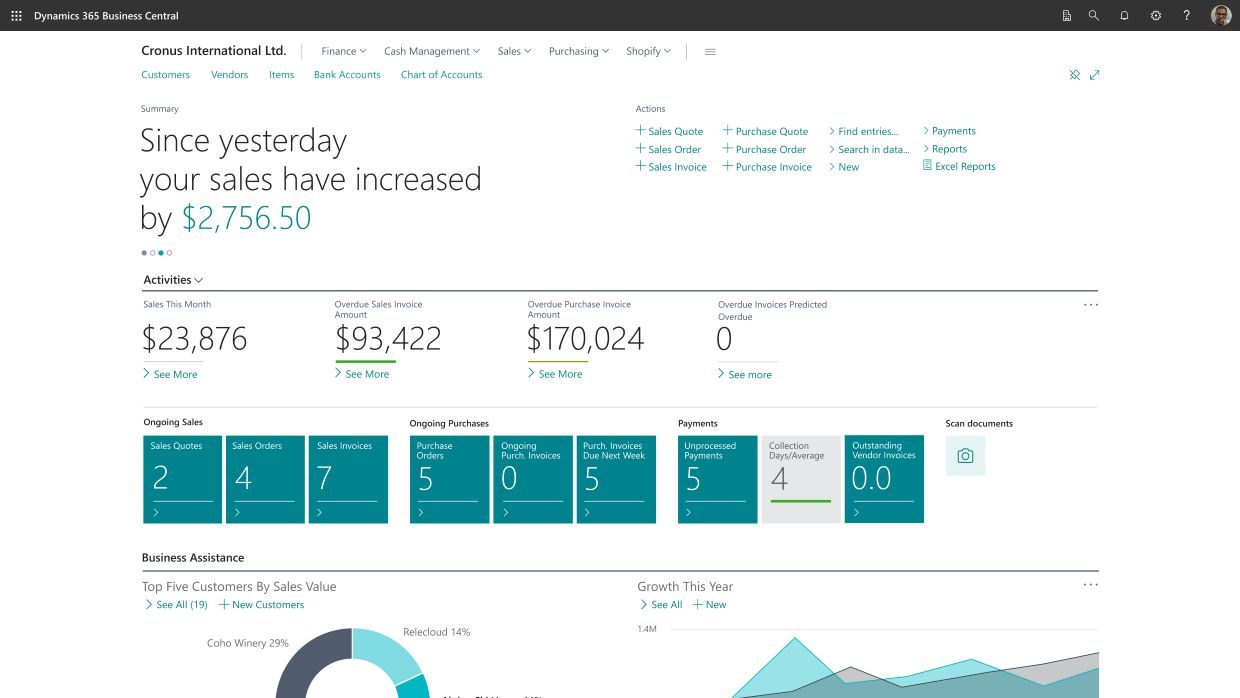
- Microsoft Dynamics 365 Business Central sits one tier below D365 Finance. While not technically enterprise-class on its own, Business Central is widely deployed in a hybrid pattern across Canadian enterprises: D365 Finance at the parent, Business Central at subsidiaries, all consolidating through Microsoft's reporting layer. This pattern preserves agility at the operating-unit level while keeping enterprise rigor at HQ.
- Oracle NetSuite remains the most-marketed cloud option for accounting software for enterprise in North America. Its strength is breadth (NetSuite has been in cloud finance for two decades) and its weakness, in our experience implementing alongside it, is rigidity around customization and a pricing model that escalates aggressively as users and modules accumulate. We compared NetSuite and Business Central in depth elsewhere, and the same comparison logic applies one tier up against D365 Finance.
- Sage Intacct is well-regarded for not-for-profit and professional services verticals where multi-dimensional reporting is core. Sage Intacct is lighter than D365 Finance and NetSuite on operations, so it tends to fit service-driven enterprises rather than manufacturing-heavy ones.
- SAP S/4HANA sits at the very top of the market. It's the platform of choice for very large Canadian enterprises (revenue north of $1 billion) with heavy manufacturing, global tax complexity, multi-language operations, and existing SAP investment. Implementation timelines and cost are an order of magnitude larger than the other options.
- Workday Financials has gained ground in services-heavy enterprises and is often paired with Workday HCM. Its consolidation and reporting are strong; its tax engine and Canadian compliance footprint remain narrower than D365 Finance or NetSuite.
“Gestisoft was able to adjust its approach to help us navigate a complex transition phase.”
Why Canadian enterprises have requirements US-focused buyers' articles ignore
Most accounting software for enterprise comparisons published online are written from a US perspective and skip the practical details that decide deployments in Canada.
Bilingual reporting is the first. Any Canadian enterprise with operations in Québec must produce documentation, customer artifacts, internal communications, and sometimes financial statements in French. The platform must support French and English at the UI and reporting layer simultaneously, not as a secondary translation.
Provincial sales tax is the second. GST, HST, QST, and PST each have different rules and reporting cadences. QST in particular is a separate tax administered by Revenu Québec, and not all US-built platforms handle it cleanly out of the box. We've seen accounting software for enterprise projects fail UAT because the QST configuration was an afterthought.
Reporting framework choice is the third. Public Canadian enterprises report under IFRS while many private companies use ASPE, and some operate dual-ledger to satisfy both. The accounting software for enterprise you pick must support the framework your auditors require without forcing a re-implementation later.
Canadian payroll integration is the fourth. Payroll in Canada involves federal and provincial deductions, EI, CPP/QPP, WSIB/CNESST, and employer health taxes that vary by jurisdiction. The platform should integrate cleanly with a Canadian payroll engine like ADP Workforce Now or Ceridian Dayforce rather than relying on a US-built retrofit.
Accounting Software for Enterprise: The cost of ownership most buyers underestimate
Subscription pricing is the easy part. The real cost of enterprise finance software is everything around the licence.
Implementation services typically run between one and three times the first-year licence cost for D365 Finance, NetSuite, Sage Intacct, and Workday, with SAP S/4HANA running considerably higher. Data migration alone can consume 20% of an implementation budget when legacy data is messy, which it almost always is in companies upgrading from fifteen-year-old systems.
Integration costs are the second underestimated layer. Connecting your accounting software for enterprise to AP automation, expense, treasury, EDI, and CRM tools rarely happens through a single button click. Plan for 100 to 400 hours of integration work depending on how many systems sit around the platform.
Training and change management is the third. Finance teams resist platform changes more than any other function in the business because their workflows are deeply muscle-memory. Budget at least 5% of the total project cost for change management, and double that figure if you're moving from a 15-year-old system.
Ongoing customization is the fourth. Every accounting software for enterprise platform requires year-over-year tuning as your business grows. Most enterprises retain a partner on a managed-services basis to handle this load. Our complete breakdown of the true cost of accounting software implementation covers the line items in detail.
10 Key ERP Selection Criteria
Use the same evaluation framework our consultants run with Canadian enterprises evaluating accounting software for enterprise. Score every vendor on the same ten criteria and turn vendor demos into apples-to-apples comparisons.

Implementation: where every accounting software for enterprise project succeeds or stalls
Implementation is where the buyer's guide ends, and reality begins. Four implementation choices have an outsized impact on whether your accounting software for enterprise rollout lands on time and on budget.
The first is your phasing decision. Big-bang go-lives where every module activates on the same day are higher-risk and compress training. Phased approaches give the team time to absorb each capability (start with GL and AP, then layer on consolidation and project accounting). Most successful Canadian enterprise projects we've delivered phase across six to twelve months.
The second is partner quality. Accounting software for enterprise platforms are sold by software vendors and implemented by partners, and the partner determines 70% of the project outcome. The implementer's experience with Canadian tax, bilingual configuration, multi-entity consolidation, and provincial reporting weighs far more than their general platform certifications. We outlined what to look for in a Business Central partner and the same selection logic applies one tier up.
The third is the data migration plan. Master data needs cleansing before it touches the new system; open transactions need a clear cutover strategy, and historical balances need to load in a way that supports comparative reporting alongside reconciled intercompany balances. Skipping these decisions until the last sprint is the single most common cause of go-live delays in Canadian enterprise projects.
The fourth is the testing strategy. UAT is where every gap between design and reality surfaces, and Canadian enterprises that compress UAT to a two-week window almost always go live with known defects. Plan for at least four weeks of structured UAT for any multi-entity, bilingual deployment, with finance team members owning the test scripts rather than IT.

How AI is reshaping accounting software for enterprise in 2026
By 2026, AI has stopped being a feature and has become a layer woven through every serious accounting software for enterprise platforms.
In the Microsoft stack, Copilot for Finance draws data from Excel, Outlook, Teams, and the underlying ERP to produce variance commentary, customer reconciliation drafts, audit prep packages, and cash flow forecasts in minutes. NetSuite has rolled out comparable capabilities through its Analytics Warehouse and AI assistant. SAP has Joule. Sage has Sage Copilot. The trend is universal.
What changes for finance teams using AI-augmented accounting software for enterprise in practice: month-end variance reviews compress from days to hours, audit responses go from manual document hunts to automated package assembly, AP teams stop manually coding invoices because document capture tools read and post them, and CFOs get straight answers to GL questions in plain language instead of waiting for a controller to pull a report. Our broader take on AI in ERP goes deeper into what's production-ready versus still experimental.
The Canadian enterprises we see getting the most value out of AI in their accounting software for enterprise aren't replacing finance staff. They're redirecting controller time away from data wrangling and toward the analysis the business has been asking finance for all along.
A decision framework for choosing accounting software for enterprise
When the shortlist has two or three vendors, the question is rarely which platform is best. The question is which platform fits this enterprise.
Score every vendor on these dimensions, in order:
- Architectural fit. Does the platform's data model support your entity structure, currency mix, reporting framework, and dimensional analysis as-is?
- Canadian readiness. Bilingual UI and reporting, QST handling, ASPE/IFRS flexibility, payroll integration. Score harshly here.
- Integration ecosystem. Are your AP automation, expense, treasury, and CRM tools first-class integrations, or will every connection be a custom build?
- Implementation partner depth in Canada. How many Canadian enterprise deployments has the partner led, and can they reference three projects of your size?
- Five-year TCO, not first-year licence. Add up subscription, services, integration, training, and managed services across five years.
- AI roadmap. What's in production today and what's still vapourware on the next twelve-month roadmap?
- Exit strategy. If you ever need to leave the platform, how does the data come out?
The vendor with the highest combined score on these seven dimensions is rarely the cheapest or the loudest. It's the platform that survives the next decade of growth without forcing you back into a re-evaluation cycle.

Accounting Software for Enterprise: Bringing it all together
Accounting software for enterprise is the foundation underneath every CFO's reporting and capital allocation decisions for the next decade. The decision deserves the rigor of any other ten-year capital investment. Canadian enterprises that get this right to treat the selection as an architecture decision first and a software purchase second, then partner with implementers who have delivered the platform inside organizations of similar shape and size.
If your team is mid-evaluation or about to start one, we'd be happy to walk through your shortlist with you. If you’re ready to choose your next accounting software for enterprise, book a free consultation today!
-
Accounting software for enterprise is a finance platform built to handle multi-entity consolidation, multi-currency operations, dimensional charts of accounts, statutory reporting across jurisdictions, and audit-grade controls at the transaction level. It's the category large organizations rely on once mid-market tools like QuickBooks or Xero structurally cannot keep up.
Explore More
- Microsoft Dynamics 365 Finance and Operations vs Business Central: key differences. The deep comparison between Microsoft's two enterprise finance platforms.
- Understanding the True Cost of Accounting Software Implementation. The full line-item breakdown of what enterprise finance projects really cost.
- Accounting Software vs ERP: Key Differences for Growing Businesses. The transition framework for organizations outgrowing standalone accounting tools.
- The ultimate guide to using Copilot for Finance in Dynamics 365. How Microsoft's AI layer is changing enterprise accounting workflows.
- NetSuite vs. Dynamics 365 Business Central. Side-by-side comparison of two leading mid-market and enterprise platforms.
Liked what you just read? Sharing is caring.

May 19, 2026 by Conni Guido by Conni Guido Copywriter and Brand Strategist
I started with a degree in Professional Communications and never looked back. Now, I'm a professional storyteller who believes every brand has a story to tell, and every good story should leave you wanting more. You can find me lost in a book club or a writing sprint, baking words into pies...probably both.
