

Running a nonprofit means every dollar carries a promise. Whether it comes from a government grant, a corporate sponsor, or a community fundraiser, that money must be tracked, reported, and spent in a way that honors donor intent and satisfies regulators. Standard business accounting software was never designed for this level of accountability.
Nonprofit accounting software solves this challenge by supporting fund accounting, donation tracking, grant management, and compliance-ready reporting — capabilities that general-purpose tools either lack entirely or handle through clumsy workarounds.
This guide compares the top accounting software for nonprofits, covering everything from free tools for grassroots organizations to full-scale ERP platforms for growing Canadian nonprofits. Whether you manage a small community charity or a multi-program national organization, you will find a solution that fits your size, budget, and mission.
Need Help Choosing the Right Accounting Solution for Your Nonprofit?
Every nonprofit's financial needs are different. Our team of Microsoft-certified experts can help you evaluate your options and find a solution that supports your mission — not just your books.
 Free discovery call
What Makes Nonprofit Accounting Different from For-Profit Accounting?
Before exploring specific platforms, it helps to understand why nonprofits cannot simply rely on a standard accounting tool.
Fund accounting is the foundation. Unlike for-profit businesses that track a single bottom line, nonprofits must segregate funds by purpose. A restricted grant for youth programming cannot cover office rent, and your software needs to enforce that distinction automatically. Fund accounting lets organizations track restricted, temporarily restricted, and unrestricted resources separately — and report on each in real time.
Compliance requirements are more complex than most people realize. In Canada, registered charities must file the T3010 annual return with the Canada Revenue Agency (CRA), detailing revenues, expenditures, and charitable activities. In the United States, nonprofits file IRS Form 990. Both require specific financial statement formats that general accounting tools do not produce natively. The right software generates these reports without manual re-entry.
Donor transparency drives trust. Nonprofits depend on ongoing donor support, and donors expect to see exactly how their contributions were used. Accounting software with program-level and fund-level reporting helps boards, auditors, and supporters see the full picture — building the kind of credibility that keeps funding flowing.
Canadian nonprofits face additional layers of complexity. Organizations operating in both English and French Canada need bilingual financial reports. Provincial sales tax rules vary (GST/HST in most provinces, QST in Québec), and payroll regulations differ by jurisdiction. Accounting software that handles these Canadian-specific requirements eliminates a significant source of errors and manual work.
Key Features to Look for in Nonprofit Accounting Software
Not every platform labeled "nonprofit accounting software" delivers the features that actually matter. Here is what to prioritize when evaluating options:
- True fund accounting — the ability to track restricted, temporarily restricted, and unrestricted funds as separate entities, with automatic enforcement of spending restrictions
- Grant management — tracking of individual grants from award through disbursement, with budget-to-actual comparisons and funder-specific reporting
- Donation tracking and tax receipts — automated recording of individual and recurring donations, with the ability to issue CRA-compliant donation receipts (in Canada) or IRS-compliant acknowledgment letters (in the US)
- Financial reporting for compliance — pre-built templates for Statement of Activities, Statement of Financial Position, Statement of Functional Expenses, T3010 (Canada), and Form 990 (US)
- Budget management— program-level and organization-wide budgeting with real-time variance tracking
- Audit trail — a tamper-proof record of every transaction, adjustment, and approval for audit readiness
- Integration with donor CRM and fundraising tools — seamless data flow between your accounting system and donor management platforms
- Multi-currency and multi-entity support — essential for nonprofits that receive international donations or operate multiple chapters
- Scalability — a system that grows with your organization as you add programs, staff, and funding sources
The Top Accounting Software for Nonprofits
Now, let’s take a look at the top 10 accounting software for nonprofits that you can start using as from today.
1. Microsoft Dynamics 365 Business Central — Best for Growing and Mid-Size Canadian Nonprofits

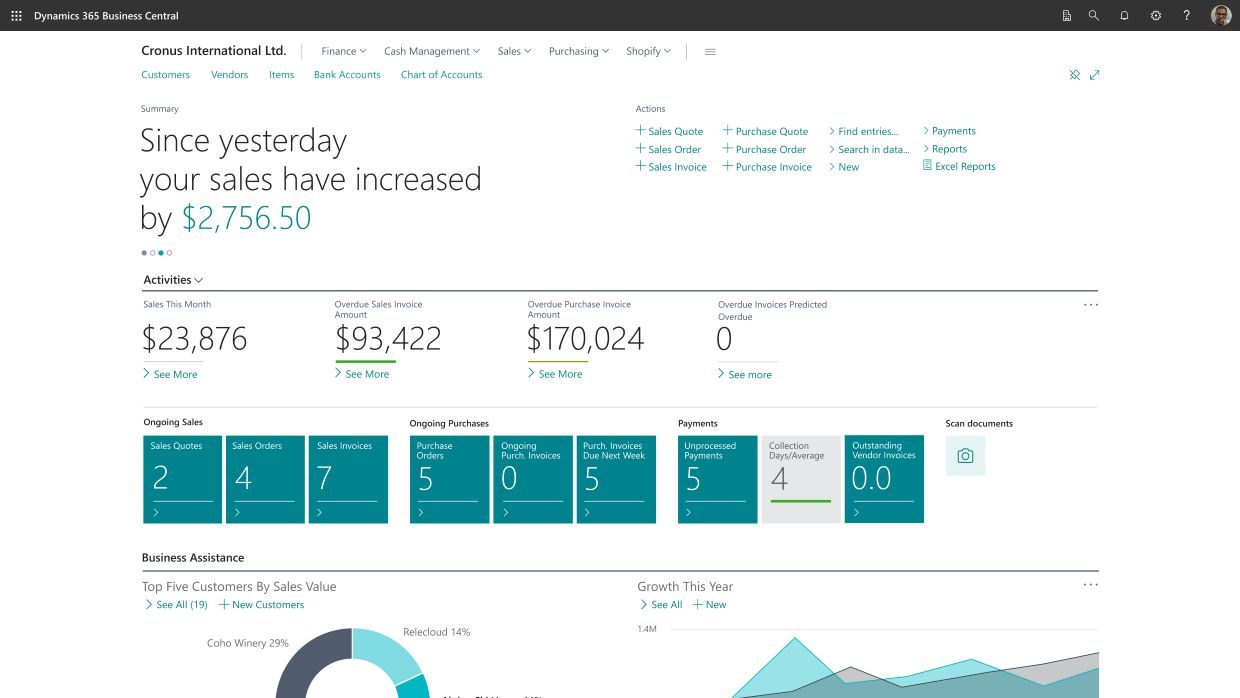
Microsoft Dynamics 365 Business Central is a cloud-based ERP that goes well beyond basic accounting. For nonprofits that have outgrown entry-level tools like QuickBooks or Wave, Business Central provides the financial depth, automation, and scalability needed to manage multi-program, multi-fund operations without adding headcount.
Why nonprofits choose Business Central:
- Dimensional accounting replaces messy sub-accounts. Instead of creating dozens of G/L accounts for every grant and program, Business Central uses dimensions to tag transactions by fund, program, project, and location. This keeps your chart of accounts clean while enabling detailed reporting across any combination of dimensions. Canadian nonprofits implementing Business Central typically consolidate four to six disconnected financial tools into a single platform.
- Real-time visibility through Power BI. Built-in integration with Power BI transforms raw financial data into visual dashboards that boards and funders can actually understand — cash flow trends, grant utilization rates, and budget variance by program, all updated in real time.
- Native Microsoft 365 integration. Staff and volunteers already work in Outlook, Excel, and Teams. Business Central connects natively with these tools, so invoices can be sent from email, financial data can be edited live in Excel, and finance teams can collaborate on budgets directly in Teams.
- Copilot AI for automation. Microsoft Copilot, embedded in Business Central, automates repetitive tasks like bank reconciliation, cash flow forecasting, and late payment prediction — freeing finance staff to focus on mission-critical work rather than data entry.
- Canadian compliance built in. Business Central handles GST/HST, QST, provincial payroll deductions, and bilingual reporting natively. It also supports multi-currency transactions for organizations receiving international donations.
- Discounted nonprofit licensing. Through the Microsoft Cloud for Nonprofit program, eligible organizations receive significantly reduced licensing costs — making enterprise-grade ERP accessible even on a nonprofit budget.
Best for: Canadian nonprofits with annual revenue above $500K, multiple programs or funding sources, and teams that already use Microsoft tools.
Watch how Gestisoft's team uses Business Central for budgeting and financial forecasting:
This walkthrough demonstrates how finance teams can build multi-dimensional budgets, compare actuals against plans, and generate board-ready variance reports — all within Business Central.
2. QuickBooks Online — Best for Small Nonprofits Getting Started

QuickBooks Online is one of the most widely used accounting platforms for small organizations, and its nonprofit configuration allows small charities to track income and expenses, manage basic fund categories using class and location tracking, and generate standard financial reports.
Strengths:
- Affordable starting price and familiar interface
- Integration with popular payment platforms like PayPal and Stripe for donation processing
- Basic fund tracking through classes and locations
- Wide availability of QuickBooks-trained bookkeepers
Limitations:
- No true fund accounting — class tracking is a workaround, not native fund segregation
- Limited grant management capabilities
- CRA-compliant donation receipting requires third-party add-ons
- Quickly becomes cumbersome as transaction volume, programs, or reporting requirements grow
Best for: Small nonprofits with annual revenue under $500K, simple fund structures, and limited reporting requirements.
3. Sage Intacct — Best for Large, Complex Nonprofits

Sage Intacct is a cloud-based financial management solution with deep nonprofit-specific functionality. It is the AICPA-preferred accounting platform and is particularly strong in multi-dimensional fund accounting, grant compliance, and functional expense allocation.
Strengths:
- Purpose-built fund accounting with native support for restricted/unrestricted fund segregation
- Advanced grant management with award tracking, budget monitoring, and funder compliance reports
- Automated functional expense allocation across program, management, and fundraising categories
- ASC 958-compliant financial statements and Form 990-ready reporting
- Multi-entity consolidation for organizations with chapters or affiliates
Limitations:
- Higher price point than most alternatives — better suited for larger organizations
- Implementation requires specialized Sage consultants
- Canadian tax and payroll features are less native than in Microsoft-based alternatives
Best for: Large nonprofits with annual revenue above $5M, complex grant portfolios, and multi-entity structures
Want to See How Business Central Compares to Your Current System?
Whether you are using QuickBooks, Sage, or spreadsheets, our consultants can map your current processes to a Business Central environment and show you what changes — and what gets easier.
 Book a free consultation
4. Aplos — Best for Small to Mid-Size Nonprofits and Faith-Based Organizations

Aplos is a purpose-built nonprofit accounting platform designed for organizations that need true fund accounting without the enterprise price tag. It includes donor management, online giving forms, contribution statements, and board-ready financial reports in an interface accessible to non-accountants.
Strengths:
- True fund accounting designed specifically for nonprofits
- Integrated donor management and online giving tools
- Contribution statements for tax-receipt compliance
- Affordable pricing starting around $79/month
Limitations:
- CRM features are limited compared to enterprise platforms
- Fewer integration options with external tools
- Less suited for organizations with complex operational needs beyond accounting
Best for: Nonprofits and faith-based organizations under $5M in annual revenue that want a nonprofit-first platform without enterprise complexity.
5. Blackbaud Financial Edge NXT — Best for Enterprise Nonprofits with Fundraising Integration

Blackbaud Financial Edge NXT is a cloud-based fund accounting platform designed for large nonprofit organizations. Its deep integration with Raiser's Edge NXT (Blackbaud's fundraising platform) makes it a strong choice for organizations that want a unified financial and fundraising ecosystem.
Strengths:
- Enterprise-grade fund accounting with strong compliance reporting
- Tight integration with Blackbaud's fundraising and donor management suite
- Grant tracking with donor restriction enforcement
- Strong in the US nonprofit market with extensive Form 990 support
Limitations:
- Premium pricing that may be out of reach for smaller organizations
- The Blackbaud ecosystem can feel "locked in" — migrating away later is complex
- Canadian-specific compliance features (CRA, provincial tax) are less robust than Microsoft-based alternatives
Best for: Large national or international nonprofits already using Blackbaud fundraising tools.
6. Xero — Best Budget Option for Small Teams

Xero is a cloud-based accounting platform popular with small businesses and increasingly used by smaller nonprofits. It offers a clean interface, strong bank reconciliation, and tracking categories that can approximate basic fund accounting.
Strengths:
- Affordable pricing with unlimited users in most plans
- Intuitive interface that non-accountants can navigate
- Strong bank feed integrations for automatic transaction matching
- Good invoicing and expense tracking for basic operations
Limitations:
- No native fund accounting — tracking categories are a workaround
- No grant management or donation receipting functionality
- Limited nonprofit-specific reporting
- Less suitable as complexity grows
Best for: Very small nonprofits or fiscally sponsored projects that need clean, simple bookkeeping.
7. Wave — Best Free Option for Grassroots Organizations

Wave is a free, cloud-based accounting tool that works for all-volunteer organizations, early-stage nonprofits, or very small charities that need basic bookkeeping without paying for software.
Strengths:
- Completely free for core accounting features
- Unlimited income and expense tracking with bank account sync
- Basic invoicing and receipt scanning
Limitations:
- No fund accounting, no grant management, no donation receipting
- No CRA or Form 990 reporting tools
- Cannot handle restricted vs. unrestricted fund segregation
- Once you manage more than one or two funding sources, Wave becomes insufficient
Best for: All-volunteer organizations or pre-revenue nonprofits that need a stepping stone before investing in dedicated software.
Business Central ROI Calculator — See the Financial Impact
Wondering what switching to Business Central could save your nonprofit? Use our free ROI calculator to estimate the cost savings, efficiency gains, and reporting improvements you could achieve.

How to Choose: A Decision Framework by Organization Size
Selecting the right accounting software depends on where your nonprofit is today and where it is headed. Here is a practical framework:
All-volunteer or pre-revenue (under $100K/year): Start with Wave for free bookkeeping. It handles the basics while you focus on building your programs.
Small nonprofit ($100K–$500K/year): QuickBooks Online or Aplos. If you need integrated donor management and true fund accounting, Aplos is the better fit. If you prefer a widely supported platform with a large ecosystem of bookkeepers, QuickBooks works.
Growing nonprofit ($500K–$5M/year): This is the transition point where entry-level tools start breaking. Microsoft Dynamics 365 Business Central provides the dimensional accounting, automation, and real-time reporting needed to manage multiple programs and funding sources without adding finance staff. For organizations already in the Microsoft ecosystem (Outlook, Teams, Excel), the transition is especially smooth.
Large or complex nonprofit ($5M+/year): Sage Intacct or Blackbaud Financial Edge NXT for purpose-built fund accounting at scale. If you need a unified ERP that also covers operations, inventory, and project management, Business Central remains a strong contender — especially with its discounted nonprofit licensing.
The Canadian Compliance Advantage
For nonprofits operating in Canada, compliance is not optional — it is the cost of maintaining charitable status. Here is what Canadian organizations should specifically look for in their accounting software:
- CRA T3010 reporting support. The annual information return requires detailed breakdowns of revenues, expenditures, and activities. Your software should generate these figures without manual compilation.
- Bilingual financial reporting. Organizations operating in both English and French Canada need the ability to produce financial statements, donor reports, and board materials in both official languages.
- Provincial tax handling. GST/HST varies by province, and Québec adds QST. Your accounting software must handle these differences automatically — especially if your nonprofit operates across provincial lines.
- Canadian payroll compliance. CPP, EI, and provincial tax withholdings must be calculated correctly. Platforms like Business Central handle Canadian payroll natively, while others require third-party payroll integrations.
- Donation receipting. CRA requires specific information on official donation receipts. Your software should generate compliant receipts automatically or integrate tightly with a donor CRM that does.
Microsoft Dynamics 365 Business Central, implemented by a Canadian Microsoft Partner like Gestisoft, is built to handle all of these requirements natively — including bilingual interfaces, Canadian tax configurations, and provincial payroll rules.
-
For small Canadian nonprofits with simple fund structures and annual revenue under $500K, QuickBooks Online or Aplos are solid starting points. Both offer basic fund tracking and integrations with donation platforms. However, if you expect to grow beyond two or three funding sources, it is worth planning for a scalable solution like Business Central from the start.
Make the Right Choice for Your Mission
The right accounting software does more than track numbers — it protects your nonprofit's reputation, simplifies compliance, and gives your leadership team the financial clarity to make better decisions. Whether you are starting with a free tool like Wave or ready to implement an enterprise ERP like Business Central, the key is matching your software to your organization's current complexity and growth trajectory.
For Canadian nonprofits evaluating Business Central, Gestisoft provides bilingual implementation, Canadian compliance configuration, and ongoing support from a team that understands the nonprofit sector. Discover how Gestisoft helps organizations implement Business Central with a process built around your specific needs.
Ready to Modernize Your Nonprofit's Financial Operations?
From fund accounting to grant management to CRA compliance, our Microsoft-certified team can help you implement a solution that supports your mission — not just your books. Let us show you what Business Central can do for your organization.
 Free discovery call
Explore More:
- What Is an ERP System in Accounting? — Understand how ERP platforms like Business Central transform financial management beyond basic bookkeeping.
- Top 10 Free Accounting Software in Canada for Small Businesses — A closer look at free and low-cost accounting options for organizations just getting started.
- How to Choose an ERP Software Using 10 Criteria — A practical evaluation framework for nonprofits comparing ERP platforms.
- Financial Automation Software: The Complete Guide — Explore how automation tools reduce manual accounting work and improve accuracy.
- Accounting Online: Complete Guide for Modern Finance Teams — Learn how cloud-based accounting is reshaping financial operations for organizations of all sizes.
Liked what you just read? Sharing is caring.

June 08, 2026 by Kooldeep Sahye by Kooldeep Sahye Inbound Marketing Manager
Specializing in SEO-driven pipeline growth, I combine keyword strategy, content optimization, and inbound tactics to turn organic search into a reliable source of qualified leads. I work at the intersection of traditional SEO and AI search — optimizing for LLMs and AI Overviews alongside Google — pairing data-informed strategy with sharp, story-led copywriting.
