

Key Takeaways
• For Canadian mid-market industrial shops, Microsoft Dynamics 365 Business Central runs production, inventory, and finance in one bilingual EN/FR platform.
• Industrial ERP projects fail on the shop floor first. Adoption, not features, decides year one.
• Gestisoft is a certified Microsoft Solutions Partner with a published Engineer-to-Order specialization and real industrial clients.
An industrial manufacturing ERP is the version of ERP built for discrete, complex-assembly shops: metal fabricators, machine builders, custom equipment OEMs, and industrial contract manufacturers. It handles multi-level BOMs, routings with subcontract operations, serialized traceability, and live shop-floor capture that generic ERPs cannot. For mid-market Canadian plants, that usually means Business Central Manufacturing.
Picture it: 6 AM Monday, your planner arrives, prints Friday's WIP list, calls the warehouse to confirm the weekend's shipments, then rebuilds the week in a spreadsheet because MRP lives in one person's head.
Two hours of guesswork before the first coffee. That is the moment this guide is written for.
Before the questions, hear one from a client who has done this four times:
“I don't want to say it's idiot-proof, but it's idiot-proof. If you scan the wrong thing, it will tell you you're scanning the wrong thing." - Chris Miller , Director of Operations, Elemental Container”
That line is the whole promise in one sentence. Stop the wrong move at the point it happens, not three days later at the dock.
Scope Your Industrial Manufacturing ERP Fit
Get a straight read on fit, cost, and timeline from Gestisoft, a certified Microsoft Solutions Partner.
 Free Discovery Call
Here are the questions buyers ask on scoping calls, in their own words, with straight answers.
1- "What Makes An Industrial Manufacturing ERP Different From A Generic ERP?"
It posts production reality to the general ledger as it happens, which generic ERP cannot do. That is the real line between the two.
What Does An Industrial Manufacturing ERP Have That Generic ERP Does Not?
Generic ERP tracks finance, sales, and basic inventory. An industrial manufacturing ERP adds the production stack: multi-level bills of materials with version control, routings tied to work centers and machine centers, subcontract operations, actual costing at the job level, and lot or serial traceability both ways.
Without those, the shop floor runs in spreadsheets alongside the ERP, and nobody closes the loop.
The One Question To Ask Every Vendor
Skip the 40-item feature checklist. Ask this instead:
"Open your sandbox, load one of my real multi-level BOMs from last week, create a production order with a subcontract operation in the routing, and walk it through to posted cost. Right now, on this call."
A good answer: the consultant shares their screen, loads your BOM, builds the production order, triggers the subcontract PO, receives the operation back, and shows the cost roll up to the job and the GL inside 15 minutes. No "let me get a specialist," no slide of their architecture, no "we can scope that in a POC."
A weak answer: anything that defers the demo to a follow-up call with a different team. That tells you the people who sold you the system are not the people who will build it, and the platform you saw in the pitch deck does not actually look the way you were shown.
2- "Will An Industrial Manufacturing ERP Handle Our Engineer-To-Order Or Make-To-Order Mix?"
Yes, if the system is built for discrete manufacturing and the partner knows your mode. A generic cloud ERP will not.
Gestisoft has a publicly stated Engineer-to-Order (ETO) specialization with Business Central, which is why it comes up at this specific question.
What ETO Really Needs From The System
ETO work means every job starts with a quote, engineering drawings, and often a one-off BOM. The system has to let the quote become the project, the project generate the BOM and routing, and the routing feed MRP and the shop.
If any of those steps need a spreadsheet in the middle, the ERP is not actually running ETO. It is tracking ETO after the fact.
What Changes When You Run A Mix Of ETO And Make-To-Order
Most Canadian industrial shops are not pure ETO. They quote custom machines (ETO) alongside shorter runs of catalog parts (MTO or make-to-stock). Mixed-mode is the shape of a big share of Canada's manufacturing sector, and Ontario and Quebec remain where most of this discrete work happens.
The industrial manufacturing ERP has to carry both modes in one data model, with the planner able to see live demand across them. If it forces you to run two separate shops in one system, costing stays blurry forever.
Picture a Quebec metal fabricator running custom structural assemblies alongside a weekly run of standard brackets. On a generic cloud ERP, the planner ends up with two tabs open, one for each.
On a system built for discrete manufacturing, both land in the same MRP suggestion queue, and the buyer sees the shortage for the bracket run next to the structural steel for the custom job.
3- "How Does An Industrial Manufacturing ERP Connect To Our CAD, PLM, And Shop Floor?"
Through integration points you must plan for before go-live, not after. CAD and PLM feed engineering data in; the shop floor sends execution data back.
If either side breaks, the industrial manufacturing ERP is just an expensive filing cabinet.
What Nobody Tells You About PLM And CAD Readiness
Here is the uncomfortable truth most vendors skip: if your engineering drawings still live in Dropbox folders and your engineers email .STEP files, buying an industrial manufacturing ERP first is backwards.
The ERP will faithfully pull whatever BOM you send it. Garbage in, garbage out, but now with a monthly subscription.
The quiet rule the long-term users follow: fix PLM first, pick ERP second. The ones who skip this step spend year two cleaning data that should have been clean on day one.
What A Working Shop Floor Actually Looks Like
Every operation posts in real time through a scanner or tablet at the work center. Scrap gets captured at the station, not reconstructed on Thursday. Subcontract receipts close the operation automatically. WIP is live, not "as of last night."
If a demo shows you shop-floor reporting that depends on someone keying paper travelers at 4 PM, the system has not actually reached your floor. It has just moved the paperwork.
Based on research from Deloitte's 2026 Manufacturing Industry Outlook, 80% of 600 manufacturing executives surveyed plan to invest at least 20% of their improvement budgets in smart manufacturing initiatives. If your shop floor still runs on paper while that money moves to connected systems, the gap widens every quarter.
4- "What Industrial Manufacturing ERP Capabilities Separate A Serious Shortlist From A Weak One?"
Seven capabilities. If a vendor's product cannot show all seven in a live demo with your data, it is not actually in the industrial manufacturing ERP tier. Treat the list as a pass or fail test.
1. Multi-Level BOMs With Version Control
Every revision of every assembly, tied to engineering change orders. No "latest.xlsx" on a shared drive.
2. Routings With Subcontract Operations Built In
The routing has to let you insert a vendor step mid-flow and have the system issue the PO, receive the work back, and post the cost to the job without re-keying.
3. Real-Time Shop Floor Capture
Scanners, tablets, or PLC integration. Operators post at the station. Paper travelers are the fallback, not the default.
4. Serialized Asset And Warranty Tracking
Every finished unit carries a serial from raw material to customer. When a warranty claim comes back two years in, the system tells you which lot of steel, which operator, and which routing it passed through.
Underweighting this at implementation costs six figures to retrofit later.
5. Actual Costing Versus Standard Costing
Standard costing shows you what you planned. Actual costing shows you what the job actually cost.
A system that only tracks standard cost tells you nothing you can act on. You need both.
6. Lot And Serial Traceability In Both Directions
Forward: this lot of resin went into these 240 finished parts. Backward: this failed unit came from this lot of resin, this operator, this shift.
Without this, recalls become a cold-call exercise.
7. Canadian Tariff Handling At The Line Level
For industrial importers, tariff and duty need to flow into the item cost at the line, user-editable without a developer.
Elemental Container's user-editable tariff table (part of the same build that drove their up to 50% warehouse efficiency gain) is a concrete example of what this looks like in practice. In today's cross-border environment, this is not an edge case. It is the critical path.
For the broader category view, our ERP solutions for manufacturing piece runs through the 8 vendor options Canadian plants usually shortlist and the decision framework that goes with them.
For the inventory side specifically, ERP in inventory management walks through the 8 inventory jobs the system actually handles, with the Elemental Container warehouse rebuild as the case study.
5 Reasons To Adopt A Cloud ERP
A short eBook on why Canadian industrial manufacturers are moving to cloud ERP, and what changes when they do.
 Free Access the Guide
5- "How Much Does An Industrial Manufacturing ERP Cost In Canada?"
For a Canadian mid-market industrial manufacturer, year-one costs typically land between $250,000 and $750,000+ CAD all-in. That covers core software licences, professional implementation services, data migration, and shop-floor training.
Enterprise operations with complex multi-site manufacturing environments push past $1,000,000 significantly.
What Vendors Rarely Put On The Industrial Manufacturing ERP Proposal
Three line items that live outside the quoted number:
- Data cleanup. BOM standardization, item master deduplication, unit-of-measure normalization. Budget 4 to 8 weeks of internal time.
- Change management. The vendor's three-day training is not change management. The real work is 6 to 12 weeks of hand-holding on the floor, especially for operators moving off paper.
- Scope creep after month 3. A custom report here, an integration there. Each is fine alone. Together they add 15 to 20% to the budget.
These three are the quiet killers. The overruns almost always live in these line items, not in the software license.
Pro tip: When vendors quote you an ERP implementation, make them split the proposal into fixed-scope for configuration vs. T&M for data migration. Ninety percent of overruns live in the migration bucket, and the only way to see them coming is to force the split in writing before you sign.
Based on research from Nucleus Research, cloud ERP customers see about 43% faster payback than on-premise, with lower consulting and personnel costs on the way there.
For a wider cost view, our ERP for SME piece covers budget ranges and the 8 non-negotiables for Canadian SMBs, and the best manufacturing ERP guide walks through tier-by-tier cost patterns if you want the full breakdown.
Pressure-Test Your Industrial ERP Budget
Walk your production numbers through with Gestisoft, a B Corp certified partner, and leave with a realistic Canadian-dollar range.
 Free Discovery Call
6- "What's The One Thing That Actually Breaks An Industrial Manufacturing ERP Project?"
The item master. Not the software, not the platform choice, not the vendor. The item master.
The Habit That Separates Shops That Still Love Their ERP From Shops That Regret It
Most buyers assume the software choice is what decides whether the ERP sticks. It is not. What separates the shops that still trust their system five years in from the ones that rip it out is a single discipline nobody writes about, and it has nothing to do with the vendor.
Expert insight: The industrial manufacturers who still love their ERP five years in share one habit that nobody writes about: they protected the item master. Nobody adds a part number without the engineering lead's sign-off. The ones who regret their ERP all let the item master become a free-for-all in month three, and spent year two paying consultants to clean it up. The software did not change between those two outcomes. The gatekeeping did.
This is the piece that generic ERP content never covers because it is unsexy. It is also the piece that decides whether MRP suggestions are trustworthy, whether costing holds, and whether planners trust the numbers enough to stop running Excel on the side.
What A Weak Item Master Looks Like
Three duplicate SKUs for the same bracket, each with a different unit of measure. Multi-level BOMs pointing at parts that no longer exist. Standard costs set in 2021 and never updated.
If any of these describe your current system, pre-work before go-live is non-negotiable, not optional.
For the broader partner-side view, our ERP support piece covers the four layers of real post-go-live care and how to pick a Canadian support partner.
Still deciding between an outside advisor and a direct Microsoft Solutions Partner? The independent ERP consultants piece lays out the 11 situations where an advisor pays off and the 4 where a partner is enough on its own.
7- "When Is An Industrial Manufacturing ERP Not The Right Fit?"
Three situations. If any one describes you, press pause before shortlisting an industrial manufacturing ERP.
You Are Under 20 Shop-Floor Users With Simple Production
A lightweight MRP tool (Katana, Fishbowl) or Business Central Essentials often does the job for 5 to 10 years before you need the full manufacturing stack.
The ERP for manufacturer piece covers readiness signals for shops at this size.
Your Engineering Data Is Not Ready
If drawings live in Dropbox folders and CAD files move by email, your BOMs are not clean enough yet. The ERP will faithfully import whatever you send it, duplicates and version mismatches included.
Fix PLM first, pick ERP second. Any other order costs you year two in cleanup.
You Are A Pure Process Manufacturer
Formulas, batches, co-products, by-products. That is process manufacturing (chemicals, food, pharma). The broader ERP for manufacturing industry covers both process and discrete, but an industrial manufacturing ERP focused on discrete work will stretch to cover process badly. Pick a process-first system.
If your shop runs both discrete and process (common in food packaging or specialty chemicals that assemble into kits), the fit shifts and the shortlist changes. Businesses that lean more toward distribution than manufacturing often also look at ERP for distribution business alongside the manufacturing modules, because the inventory and fulfilment side runs the day.
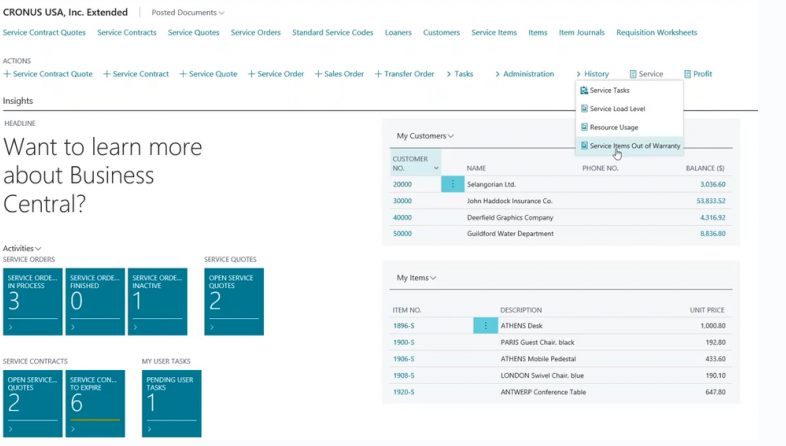
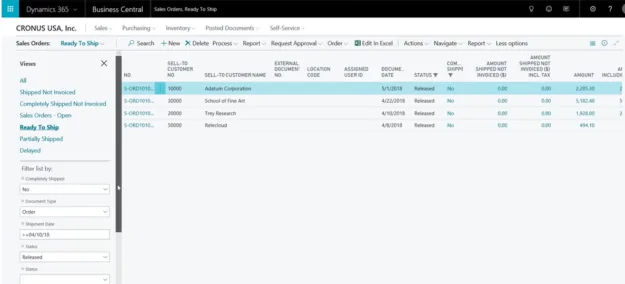
If you have not seen Business Central up close, this short introduction walks through the interface and how it holds together as one system.
FAQs
What is an industrial manufacturing ERP?
An industrial manufacturing ERP is a system that runs the full production stack for discrete, complex-assembly shops: multi-level BOMs, routings, shop-floor capture, costing, and traceability, all tied to finance in one data model.
It differs from generic ERP by posting production events to the ledger as they happen.
Is Microsoft Dynamics 365 Business Central good for industrial manufacturing?
Yes, for Canadian mid-market industrial manufacturers between $10M and $500M in revenue. Business Central Manufacturing covers production orders, capacity planning, routings, vendor management, and shop-floor execution with native EN/FR UX.
For larger multi-plant operations, SAP S/4HANA or Oracle Cloud ERP are the typical picks.
How long does an industrial manufacturing ERP implementation take?
Typically 6 to 12 months for a mid-market Canadian shop from initial kickoff to official go-live. Operational data cleanup and shop-floor user training will heavily stretch that timeline if your legacy item master list is messy.
Highly accelerated, out-of-the-box templated implementations focusing strictly on core financials, basic purchasing, and inventory control can achieve a rapid phase-one go-live in 120 to 150 days.
Can one industrial manufacturing ERP handle both ETO and make-to-order?
Yes, if the system is built for discrete manufacturing and the partner knows your mix. Business Central handles both in one data model.
Lightweight MRP tools often cannot.
What does an industrial manufacturing ERP cost in Canada?
For a Canadian mid-market industrial manufacturer, year-one costs typically land between $250,000 and $750,000+ CAD all-in. That covers core software licences, professional implementation services, data migration, and shop-floor training.
Enterprise operations with complex multi-site manufacturing environments push past $1,000,000 significantly.
Do I need an industrial manufacturing ERP if I already have QuickBooks and a spreadsheet-based MRP?
If your month-end close takes more than 10 days, your WIP numbers are a day old, or quoted-vs-actual job cost drift is unexplained, yes.
Those three signals point at an ERP, not another spreadsheet.

Why Canadian Industrial Manufacturers Choose Gestisoft As Their Industrial Manufacturing ERP Partner
Choosing the industrial manufacturing ERP is only half the work. The implementation partner shapes whether you actually get the ROI on the brochure.
Gestisoft has been a Microsoft Solutions partner since 2004, with a publicly stated specialization in Engineer-to-Order manufacturing on Business Central and real industrial clients across the country. Credentials behind the work:
- Microsoft Solutions Partner in Business Applications.
- B Corp Certified.
- Great Place to Work Canada Certified (February 2024 to February 2025).
- Canada's Most Admired Corporate Cultures 2023.
- Prix Performance Québec winner.
- Bilingual EN/FR delivery from Montréal, Toronto, Ottawa, and Québec City offices.
That matters for an ERP project because the team that scopes, builds, and supports your shop lives inside your production for years.
One Canadian industrial client's words after years of working together:
“I see that Gestisoft is always moving forward, keeping up with the latest trends, and that gives us confidence. I'm happy to be with a supplier like Gestisoft because I know they'll grow with my solution." - Olivier Marotte , VP Finance, Groupe UP”
That is what an industrial manufacturing ERP partnership should feel like at year three, not just at go-live. The fastest way to know if the fit is right for your shop is a conversation.
Find Your Industrial Manufacturing ERP Fit
Walk your shop through with Gestisoft, a Microsoft Solutions Partner since 2004, and leave with scope, cost, and a plan you can trust.
 Free Discovery Call
Liked what you just read? Sharing is caring.

November 02, 2026 by Muhammad Ali Iqbal by Muhammad Ali Iqbal SEO Content Strategist & Copywriter
Driven by a passion for search engine optimization, strategic content, and conversion-focused writing. A copywriter and content strategist who lives for content that ranks, engages, and delivers real business results.
