

Most business owners don't go looking for an ERP business consultant when things are calm. They start the search after a bad month-end close, a missed audit, a failed software rollout, or a board meeting where someone asked a simple question that nobody could answer.
If that sounds familiar, you're not late. An ERP business consultant helps you avoid the next bad month-end… looking at how your business actually runs, figuring out where your current systems hold you back, and guiding you through choosing, implementing, and using an ERP system that fits the way you work.
This guide will cover what an ERP business consultant really does, what they cost in Canada, when you actually need one, and how to pick the right partner without getting burned.
Talk to a Gestisoft Expert About Your ERP Project
Get a clear view of what an ERP project looks like for your business. Our team has 25+ years of Microsoft Dynamics experience and works with Canadian SMBs every day.
 Free discovery call
What Is an ERP Business Consultant?
An ERP business consultant helps companies select, implement, and optimize an Enterprise Resource Planning system… with a sharper focus on the business side of the project, not just the technical side.
That distinction matters. A purely technical consultant configures the software the way you ask. An ERP business consultant asks why you're asking for it that way. They challenge weak assumptions, surface business processes that need fixing before automation, and translate what your finance, ops, and sales teams need into something the ERP platform can deliver.
How an ERP Business Consultant Is Different From an IT Consultant
Both can be useful… they solve different problems. An IT consultant focuses on infrastructure: servers, networks, security, integrations. They keep the lights on.
An ERP business consultant focuses on outcomes: faster month-end close, cleaner inventory data, fewer manual rekeys, real-time dashboards your CFO can trust. They start with business goals and work backward into technology.
If your problem is "our server keeps crashing," call an IT consultant. If it's "we don't know our gross margin without three people pulling spreadsheets for a week," you need an ERP business consultant.
5 Signs You Need an ERP Business Consultant in Canada
Five clear signs we notice often with Canadian small and medium businesses that indicate it's time to hire an ERP business consultant.
Your Month-End Close Has Become a Multi-Day Event
If closing the books takes more than a couple of days, your accounting team is fighting your tools, not using them. This was the trigger for Groupe UP, a Quebec construction and industrial products company… their monthly closings used to take half a day, annual closings ran overnight, and both are significantly faster after their Business Central rollout with Gestisoft.
You've Outgrown Excel and QuickBooks but You're Not Sure What Comes Next
The most common trigger. Spreadsheets work brilliantly until they don't. The tipping point is usually around 20–30 employees, or when you add a second location, a second entity, or your first international supplier.
Your Sales and Ops Teams Disagree on the Numbers
When sales says you have inventory and ops says you don't, the issue isn't your people. It's two systems with no shared source of truth. An ERP business consultant identifies whether you need one unified ERP platform or smarter integrations between what you already have.
You're About to Make a Major Change and You Don't Want a Disaster
New acquisition. New product line. New warehouse. New compliance requirement. Big changes expose every weakness in your current setup. A consultant brought in before the change costs a fraction of what it costs to clean up after.
Your ERP Software Isn't Delivering What the Demo Promised
This happens more than vendors admit. Either the ERP implementation was rushed, the configuration didn't match your real workflows, or your team never got proper training. A good ERP business consultant can rescue a stalled project, sometimes that's the entire engagement.
If two or more of these sound like your business, you're not too early. You're probably overdue.
What Does an ERP Business Consultant Actually Do?
The textbook answer is "select, implement, customize, and support." Accurate but not useful. Here's what the work actually looks like.
Early On: Understanding How Your Business Runs
They spend time with your team (finance, ops, sales, sometimes the warehouse floor) mapping how work gets done today. Not how the org chart says it gets done. They surface the workarounds: spreadsheets that compensate for missing reports, duplicate data entry, manual approvals. The ERP system can't fix a broken process… it can only automate it faster.
During Selection: Matching the Right System to the Right Business
An ERP business consultant evaluates ERP options against your actual requirements, not a generic feature checklist. If you're a 40-person manufacturer, they'll steer you away from systems built for 500-person enterprises. If you have multi-currency or multi-entity needs, they'll flag the cloud ERP platforms that handle those natively. Our breakdown of the full role of an ERP consultant goes deeper.
During Implementation: Owning the Project, Not Just Watching It
They manage configuration, data migration, integrations, user testing, and go-live. They're also the person who tells your CFO the timeline needs to shift two weeks because the legacy data is messier than anyone realized. Uncomfortable but it's the difference between a clean go-live and a project that limps for a year.
After Go-Live: Making the System Stick
They run hypercare, train users, fix early issues, and help your team build the habits that make the system stick. This is where user adoption is won or lost… and where most disappointed ERP buyers say their previous partner disappeared.
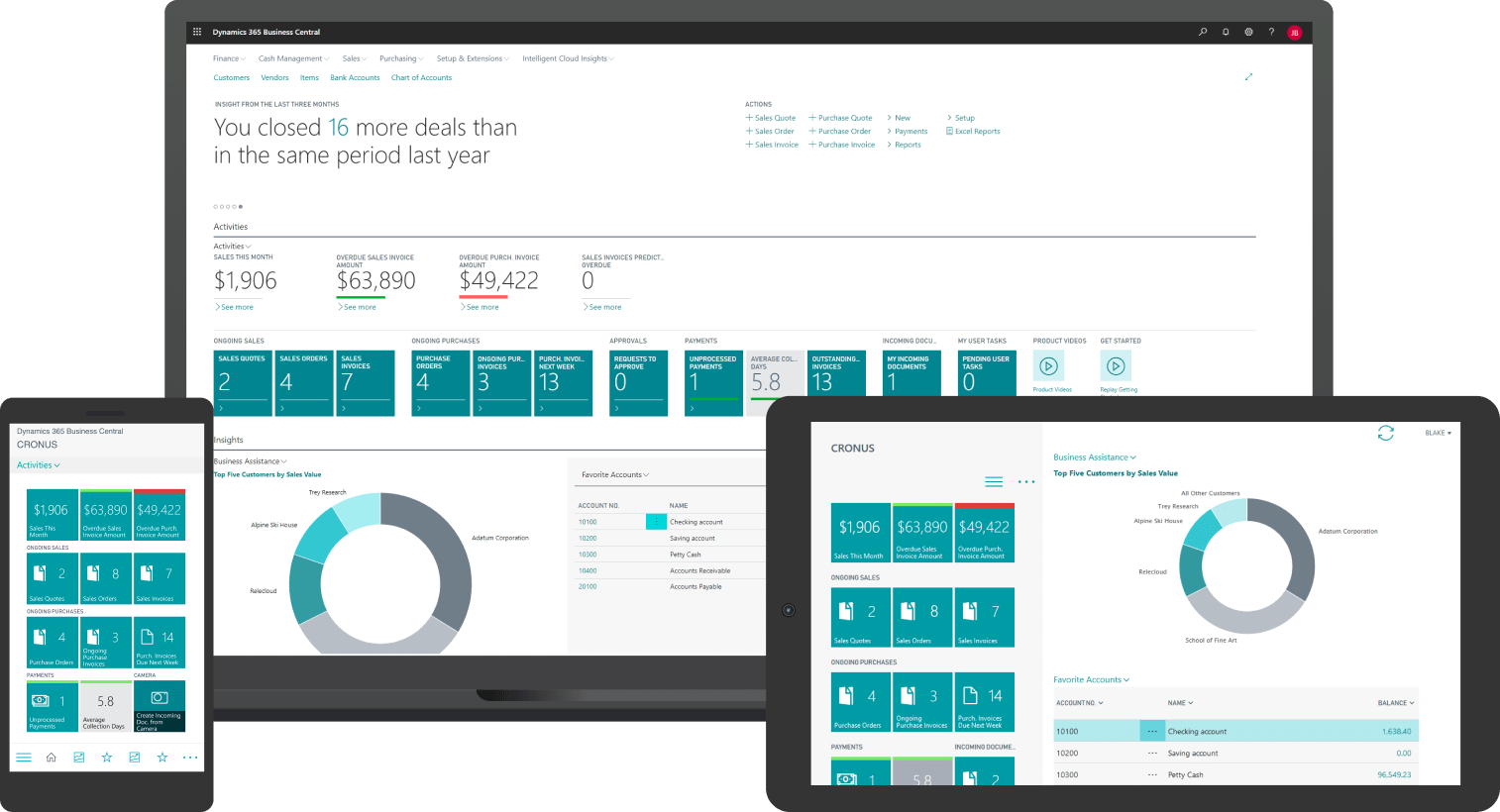
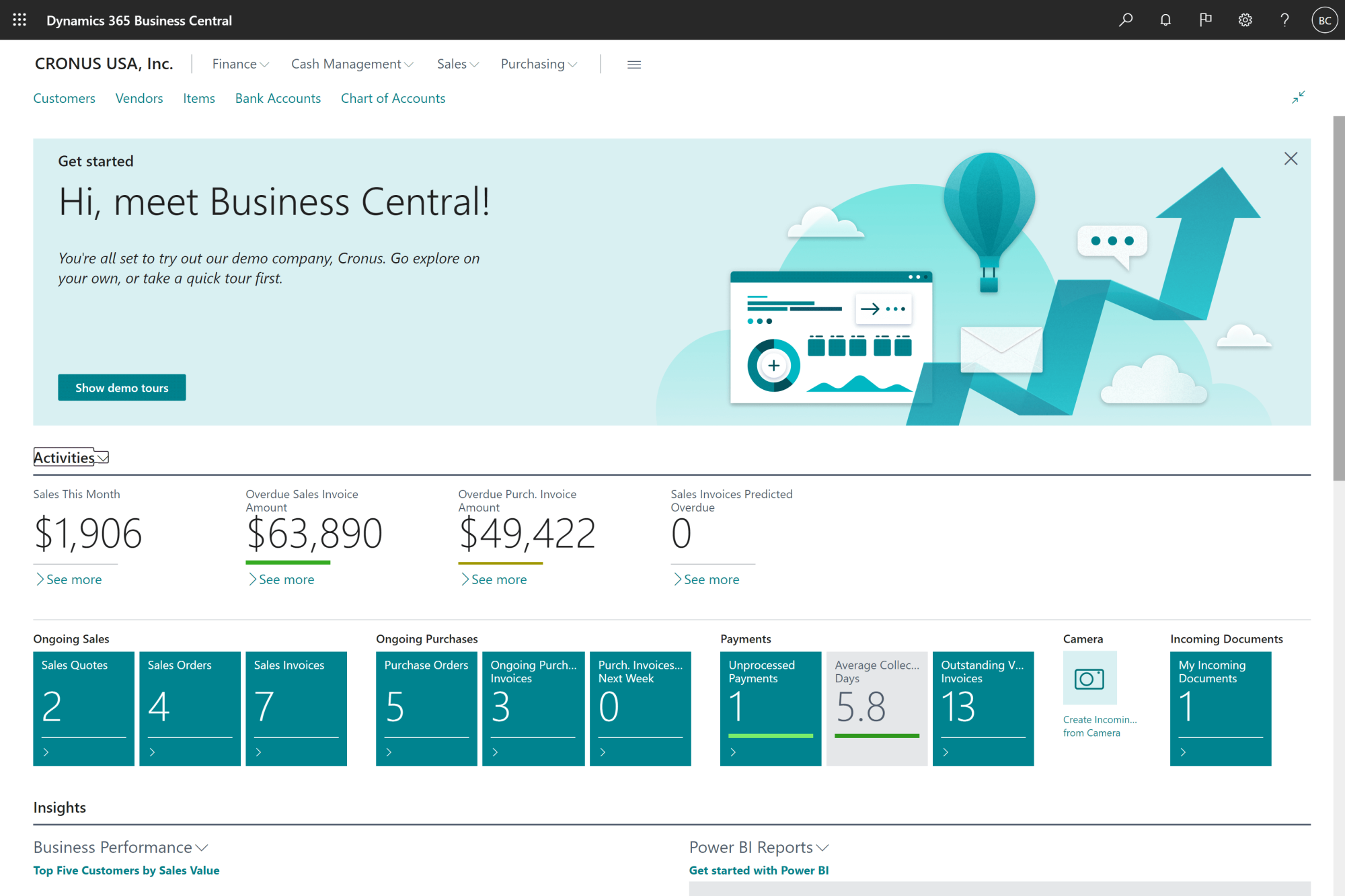
Here's a quick look at what your team will actually be working in once a Business Central setup is live.
How Much Does an ERP Business Consultant Cost in Canada?
The question most competitors dodge. Realistic CAD ranges based on the Canadian SMB market — your actual number depends on scope, complexity, and how prepared your internal team is.
Hourly Rates
An experienced ERP business consultant in Canada typically charges $150 to $275 CAD per hour. Junior consultants come in lower, senior architects and solution leads higher.
Small Project Engagements
A needs assessment, ERP selection, or business process review generally runs $5,000 to $25,000 CAD, often fixed-fee.
Full Implementation Projects
A straightforward Business Central setup for a small business with clean data and limited customization usually starts around $15,000 to $30,000 CAD in consulting fees. A mid-market deployment with manufacturing modules, multi-entity consolidation, payroll integration, and data migration from a legacy ERP can run $75,000 to $200,000 CAD or more. Licensing is separate.
Ongoing Support Retainers
Monthly retainers typically range from $1,500 to $8,000 CAD, depending on user count and how much active development versus passive support you need.
What Pushes the Price Up or Down
Heavy customization, dirty legacy data, multi-entity consolidation, bilingual rollouts, and weak internal project ownership push costs up. Clean processes, a single legal entity, a dedicated project champion, and willingness to adopt the system's standard workflows keep them down.
For a deeper look at the numbers, our guide onERP implementation cost breaks down where the money goes.
5 Reasons to Adopt a Cloud ERP
A free eBook on why Canadian SMBs are moving to a cloud ERP like Business Central… and the business outcomes they're seeing.

Independent ERP Business Consultant vs. Implementation Partner: Which Should You Hire?
A debate the SERP doesn't handle well. Most articles pick a side. Each model has a clear use case.
When an Independent ERP Business Consultant Makes Sense
An independent ERP business consultant (or an advisor) doesn't sell software and doesn't take vendor commissions. They give vendor-neutral guidance on which ERP platform to choose, then often step away while a separate implementation partner handles the deployment.
This fits when your selection decision is genuinely uncertain… say, you're comparing Business Central against NetSuite and Acumatica and want an objective referee. The trade-off: independent consultants are typically more expensive per hour, and they don't always carry the technical depth needed to configure the ERP system once it's chosen.
When an Implementation Partner Makes Sense
An implementation partner is a certified vendor partner who both advises and deploys. The advantage is depth: they've configured the platform hundreds of times and own the outcome end-to-end. The trade-off is they're not vendor-neutral by definition. A Microsoft Partner will recommend Microsoft solutions.
In practice, most Canadian SMBs are better served by a strong implementation partner than by an independent consultant… partly because the SMB ERP market has consolidated around a few solid platforms, and partly because deep platform expertise is where most projects succeed or fail. If you've shortlisted your platform, hiring a goodBusiness Central implementation partner is usually the faster path.
Get a Realistic ERP Plan From a Microsoft Partner
Skip the guesswork. Our consultants will walk you through scope, timeline, and budget based on your real operations, not a sales pitch.
 Free discovery call
How Long Does an ERP Business Consultant Project Take?
Your timeline depends on scope, team availability, and the cleanliness of existing data.
Needs Assessment and ERP Selection
4 to 10 weeks, depending on how many stakeholders need interviewing and how many vendors you're evaluating.
Small Business Central Implementation
Finance and basic operations for a single-entity business with clean data: 8 to 16 weeks to go-live.
Mid-Market Implementation
Manufacturing, distribution, or multi-entity needs: 4 to 9 months from kickoff to go-live, longer with heavy integrations.
Complex Enterprise Rollout
Multi-location, multi-business-unit, or multi-country deployments: 9 to 18 months or more.
Any ERP consultant who promises a complex mid-market ERP in 30 days is selling you something. Any consultant who can't give you a rough range in the first conversation either hasn't done the work or doesn't want to commit.
How to Choose an ERP Business Consultant Without Getting Burned
Here are some things you need to consider before signing…
Ask for Client References in Your Industry, in Canada, From the Last 24 Months
A consultant with real depth produces those references quickly. Hesitation tells you everything. Industry experience matters because manufacturing, distribution, professional services, and association management each have specific workflow patterns that take years to learn.
Our roundup of ERP consulting companies in Canada is a useful starting shortlist...
Ask Them to Walk You Through Their Methodology Step by Step
Every partner says they follow a structured method. What you want is specifics: discovery, solution design, configuration, testing, training, go-live, and a defined hypercare period… with sign-off at each stage. If discovery sounds like a sales call, that's a red flag.
Verify Their Certifications Directly
For Microsoft partners, look for the Microsoft Solutions Partner designation and, for Business Central work, the Advanced Specialization for Small and Mid-market Business Management. These require documented deployments and verified customer satisfaction scores. Anyone vague about certification is worth checking against Microsoft's official partner directory.
Watch Out for These Red Flags
- A fixed-price quote without a proper discovery phase.
- A consultant who pushes customization before understanding your standard business processes.
- A team that talks more about features than business outcomes.
- A partner who minimizes the role of your internal team — successful ERP projects need an engaged internal champion.
Ask What Their Support Model Looks Like After Go-Live
If support feels like an afterthought in the sales conversation, it will be an afterthought in the relationship. Our framework forhow to choose an ERP using 10 criteria goes deeper on the evaluation side.

Why Canadian Businesses Need an ERP Business Consultant Who Knows the Local Landscape
Most ERP content online is written from a US perspective. That's a problem if your business operates in Canada, because the details that matter to your finance team are different.
An ERP business consultant who's primarily worked with US clients will configure GST/HST differently than a local team. They may not have built QST configurations… Quebec's sales tax has its own quirks. They may not understand PIPEDA requirements around where your financial and HR data physically lives. They may be unfamiliar with CRA payroll tables, ROE processing, T4 generation, or integrations with Canadian payroll providers like Nethris or Desjardins.
If your business serves clients across both official languages, you also need real bilingual capability, not translated marketing material. That shows up in your training, your support tickets, your user adoption numbers, and increasingly in your compliance posture under Quebec's Bill 96. None of this is exotic. It's the everyday reality of doing business locally… and exactly what gets dropped when you hire a partner without local roots.
Local expertise stops being a marketing line and starts being a project risk factor.
Olivier Marotte, Vice President Finance at Groupe UP, put it well aftertheir Business Central implementation with Gestisoft:
“The software is our working tool. With our previous solution, it was like having a stone hammer. We could accomplish our tasks, but the tool was outdated. With Business Central, if we decide to move into the Industrial 4.0 era, it's possible. We now have an up-to-date solution that meets our needs. We've really taken a step forward, and we can see all the possibilities we could do in the future.”
That's the shift a good ERP consultant is paid to deliver… not new software, but a step forward in how the business operates. Read the full Groupe UP case study here.
-
A functional consultant configures specific modules (finance, inventory, supply chain) to match your processes. An ERP consultant takes a wider view: they look at the whole business, identify what needs to change, and decide which modules and which ERP platform you actually need. Most projects benefit from both, often on the same team.

Why Canadian Businesses Choose Gestisoft as Their ERP Business Consultant And Implementation Partner
Gestisoft has spent 25+ years helping Canadian businesses get more out of Microsoft technology, from family-owned manufacturers in Quebec to growing service firms in Ontario and BC. We're a Microsoft Solutions Partner with deep expertise in Dynamics 365 Business Central, Dynamics 365 CRM, and Microsoft Copilot, with a 95% client renewal rate that reflects how we work… long-term, focused on measurable outcomes.
ERP isn't easy. But with the right approach, the right ERP business consultant, and an internal team willing to engage, an ERP implementation is one of the highest-impact investments a growing business can make.
Our team is bilingual, B Corp certified, and based locally… your data, your support, and your conversations all stay close. We've supported organizations like Groupe UP through full digital transformations, and we'd be glad to help you map out what that looks like for your business.
Let’s Move Forward With the Right Partner
A short conversation with a Gestisoft ERP business consultant beats weeks of comparison spreadsheets. Let's map out your next step together.
 Free discovery call
Liked what you just read? Sharing is caring.

May 20, 2026 by Muhammad Ali Iqbal by Muhammad Ali Iqbal SEO Content Strategist & Copywriter
Driven by a passion for search engine optimization, strategic content, and conversion-focused writing. A copywriter and content strategist who lives for content that ranks, engages, and delivers real business results.
