

If you sell physical products in Canada, picking the right consumer goods software can make or break your next two years. The wrong choice locks you into messy spreadsheets, broken integrations, and retailer chargebacks. The right one connects your finance, inventory, and sales into one clean picture you can actually act on.
Most brands buy the wrong type of tool because they confuse what an ERP does versus inventory software, or pick platforms built for companies ten times their size. This guide covers 10 tools matched to different revenue stages and business models, so you can find what actually fits your operations.
Pick The Right Consumer Goods Software With Expert Guidance
Save weeks of vendor demos and get a clear shortlist matched to your size, retailers, and Canadian compliance needs from day one.
 Free discovery call
Top 10 Consumer Goods Software Tools for Canadian Brands
1. Microsoft Dynamics 365 Business Central

A connected cloud ERP built for Canadian SMB consumer goods companies running production, distribution, and sales under one connected roof.
Business Central handles finance, inventory, manufacturing, and supply chain natively. It supports GST, HST, PST, CAD and USD multi-currency, and bilingual French and English operations across regions.
It connects to Shopify, Amazon, Power BI, and Microsoft 365 out of the box. Best for Canadian brands doing $5M to $200M who want one connected platform instead of stitching many separate tools together.
2. NetSuite

A cloud ERP for larger consumer goods companies that have outgrown QuickBooks or a basic accounting system across multiple operations.
NetSuite handles financials, inventory, order management, and warehouse workflows across multiple subsidiaries and entities. It works seamlessly in Canada with native multi-currency and built-in Canadian tax support.
Best for brands above $50M with international operations or complex multi-entity reporting needs. Stronger for finance-led organizations than production-heavy ones. Pricing scales fast as you add users and modules across teams.
3. SAP S/4HANA Cloud

The enterprise standard for the largest global consumer packaged goods giants... think Coca-Cola, Unilever, L'Oréal, and similar massive scale brands.
S/4HANA Cloud handles trade promotion, demand sensing, supply chain orchestration, and category management at scale. It works across Canada and integrates with Canadian tax and payroll providers smoothly.
Best for brands above $500M with complex retailer relationships, global supply chains, and internal IT teams. Heavy lift to implement and expensive to run, but unmatched at the top end of the market.
4. Cin7 Core

An inventory-first platform for smaller Canadian consumer brands selling through Shopify, Amazon, and small wholesale accounts every month.
Cin7 Core handles multi-channel orders, warehouse picking, light manufacturing, and accounting integrations with Xero or QuickBooks Online. It is widely used in Canada and supports multi-currency across both CAD and USD smoothly.
Best for product brands under $10M who need inventory accuracy more than a full ERP today. Subscription pricing keeps it accessible for growing DTC and small wholesale operations across North America.
5. Akeneo PIM

Product information management software for consumer brands selling across many channels... your Shopify store, Amazon listings, retailer portals, and printed catalogues.
Akeneo centralizes product copy, images, specs, translations, and compliance data, then syndicates everything out cleanly. It is fully available to Canadian companies and handles English and French Canadian content side by side.
Best for brands with 500-plus SKUs or complex retailer content requirements. Pairs naturally with an ERP like Business Central, which holds transactional data while Akeneo holds marketing-ready content.
6. Blue Yonder

Demand planning and forecasting software used by some of the world's largest consumer goods companies across many industries.
Blue Yonder applies machine learning to historical sales, promotions, weather, and macro signals to sharpen forecasts and reduce stockouts overall. It operates across North America with active Canadian client deployments at scale.
Best for established brands above $100M where a one percent forecast accuracy lift means real money on the bottom line. It does not replace your ERP, but layers powerfully on top.
7. Centric PLM

Product lifecycle management for consumer goods brands that launch lots of new SKUs each year... fashion, beauty, personal care, and home goods.
Centric tracks products from concept through development, sampling, sourcing, and launch. It is used by Canadian brands and supports global rollouts across North America and beyond.
Best for design-driven companies where speed to market matters more than transactional efficiency. Centric is not an ERP and does not replace one, but fills the gap most ERPs leave at product creation.
8. TELUS Consumer Goods

Canadian-built retail execution and trade promotion software for consumer goods brands selling into grocery, drug, and mass retail channels.
TELUS handles field sales workflows, shelf compliance audits, promotional planning, and deduction management end to end. As a Canadian company, it speaks the language of Canadian retailers and broker networks natively.
Best for established brands with field sales teams calling on Loblaws, Sobeys, Metro, and Walmart Canada. It sits beside your ERP, not inside it, and integrates with most major ERP platforms.
9.Acumatica Cloud ERP

A cloud-native ERP for mid-market consumer goods manufacturers and distributors who need scalable operations without enterprise-level costs.
Acumatica handles finance, inventory, production, warehouse management, and ecommerce natively. It works across Canada with multi-currency support, though Canadian tax setup typically requires partner configuration for GST, HST, and PST. Known for unlimited-user licensing, eliminating per-seat costs as teams grow.
Best for brands between $10M and $100M who have outgrown Cin7 but need more flexibility and lower cost than NetSuite. Connects to Shopify, Amazon, and retailer EDI systems smoothly.
10. Odoo

A modular, open-source ERP that small Canadian consumer goods startups can self-implement or run with a local partner.
Odoo includes apps for inventory, manufacturing, sales, accounting, and ecommerce, priced per app per user across plans. It works in Canada and has an active French Canadian community of partners.
Best for product brands under $5M who want flexibility and a low entry price, with the technical comfort to configure it. Customization can grow fast and total cost of ownership often surprises buyers.
What Should Consumer Goods Software Cover? 5 Essential Functions
Most buyers mix up categories. They ask for "consumer goods software" and get pitched everything from an ERP to a shelf-audit app.
Here is the honest map. A modern consumer goods software stack usually covers five jobs, and very few products do more than two of them well:
- ERP... finance, inventory, manufacturing, order to cash.
- PIM... product content, images, retailer syndication.
- PLM... new product development and sourcing.
- Retail execution and trade promotion... field sales and shelf.
- Demand planning... forecasting and replenishment.
A platform like Business Central covers the ERP layer for Canadian SMBs and connects to specialist tools for the rest. SAP at the top end can cover most layers natively, but most Canadian brands do not need that scale.
Knowing which job each tool actually does keeps you from buying overlap or missing a gap entirely.
How to Choose the Right Consumer Goods Software for Your Business
Buying consumer goods software is less about features and more about fit. Here is what actually moves the needle when Canadian brands make this choice.
Match Consumer Goods Software to Your Stage
Revenue and complexity matter more than industry.
- Under $5M and selling through Shopify? An inventory tool like Cin7 may be enough.
- Between $5M and $200M with production, multi-channel sales, and a finance team? You need a real ERP like Business Central.
- Above $200M with multiple subsidiaries or international operations? Look at NetSuite or SAP.
Skipping a stage costs you money. Buying enterprise software too early kills your cash flow. Buying inventory-only software when you need an ERP creates the silos you are trying to fix. So, make sure you choose the right one…
Canadian Specific Things Your Consumer Goods Software Must Handle
Most US-built tools forget Canada. Before you commit, confirm the software handles:
- GST, HST, PST, and QST calculations across provinces.
- Bilingual French and English interfaces and customer documents.
- CAD and USD multi-currency without messy workarounds.
- PIPEDA-aligned data residency... ideally Canadian data centres.
- T4A and Canadian payroll exports if you run payroll inside the system.
- Cross-border shipping documentation if you sell into the US.
If a vendor cannot answer these in the first demo, that tells you something.
Integration Red Flags to Watch For
Modern consumer goods operations depend on clean data flowing between systems. Watch out for vendors who:
- Charge separately for every integration after the first one.
- Cannot show you a working Shopify or Amazon connector live.
- Push "we can build a custom API" instead of pointing to native connectors.
- Hide EDI capabilities behind expensive add-ons when you sell to major retailers.
- Do not support real-time inventory sync, only nightly batches.
These signals mean integration costs will balloon after go-live.
Skip The Costly Mistakes Before You Commit
Talk through your specific consumer goods setup with a Microsoft Partner who has implemented dozens of Canadian brands end to end.

What are the Common Mistakes Canadian Brands Make When Buying Consumer Goods Software?
After years of helping consumer goods companies switch systems, the same five mistakes show up again and again. Avoiding them saves six figures and a year of pain.
Buying Consumer Goods Software Based on a Demo Instead of a Pilot
Demos are scripted. Your business is not. The software always looks magical when the vendor controls the data. Insist on a sandbox with your own SKUs, your own customers, and your own pricing complexity loaded in.
That is where you find out if the system handles your reality. A good ERP implementation consultant will push for this kind of structured validation, not let you sign on a polished demo.
Confusing Software Features with Partner Capability
The software is half the equation. The partner who configures, migrates, and supports it is the other half... and often the bigger half. Two brands can buy the same Business Central licence and end up with completely different outcomes based on who implemented it.
When you compare options, evaluate the partner with the same rigour as the platform. Strong ERP consultancy services will tell you what will not work, not just what will.
Underestimating Data Migration
Your existing data is messier than you think. Duplicate customers, inconsistent SKU codes, vendor records nobody owns, pricing rules from 2018 that still apply somehow.
Plan for at least two full mock migrations and one final rehearsal before go-live. Brands that skip this end up cleaning data in production while the new system is supposed to be running the business.
Skipping Change Management
Even the best consumer goods software fails if your team will not use it. Allocate real time and budget for training, role-based onboarding, and on-the-floor support during the first 60 days. The system that works is the one people actually open every morning.
Picking a Partner Who Does Not Know Consumer Goods
Distribution and ERP for consumer brands have specific patterns... lot tracking, expiry dates, retailer EDI, deduction management, kitting and bundling. A generalist partner can deliver the software but not the workflows.
Ask every partner shortlist candidate to walk you through how they have implemented ERP distribution for a brand like yours. If they cannot, keep looking.
Skip The Costly Mistakes Before You Commit
Talk through your specific consumer goods setup with a Microsoft Partner who has implemented dozens of Canadian brands end to end.
 Free discovery call
Where Microsoft Dynamics 365 Business Central Fits in the Consumer Goods Software Stack
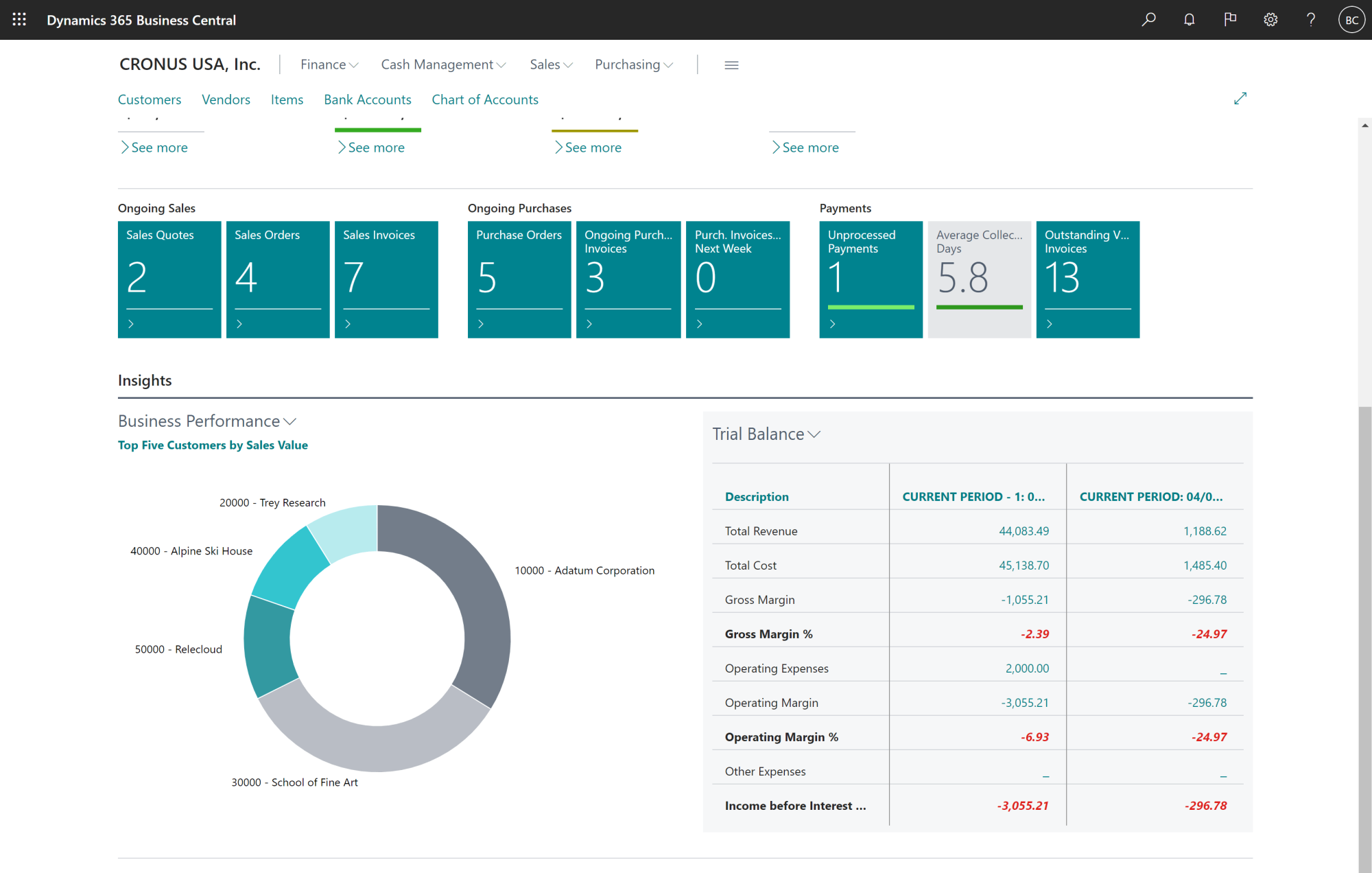
Business Central is the connected core that ties consumer goods operations together for most Canadian SMBs. It is not the cheapest entry point and it is not the heaviest enterprise platform. It sits in the sweet spot for brands doing roughly $5M to $200M.
Here is where it earns its spot in a consumer goods software stack:
- Finance built for Canada with native GST, HST, PST, PIPEDA-aligned hosting, and bilingual reporting.
- Inventory and production with lot and serial tracking, expiry dates, and BOMs that handle kitting, assembly, and light manufacturing.
- Sales orders and warehouse workflows that move from EDI in to picking, packing, and shipping without re-keying anything.
- Multi-channel commerce through native Shopify integration and connectors for Amazon and other marketplaces.
- AI and Copilot for sales order entry, item descriptions, late payment prediction, and bank reconciliation.
- Open APIs that connect cleanly to Akeneo for PIM, Salesforce or Dynamics 365 CRM for customer relationships, and Power BI for analytics.
For most Canadian consumer goods brands, Business Central replaces three or four disconnected systems and finally puts margin per SKU, per customer, and per channel on one screen. It is the connected operations backbone the other tools in your stack plug into.
Before we get into how Business Central fits into the stack, here is a quick look inside the software itself.
-
Consumer goods software is a category of business tools that help brands manage the operations behind getting products from idea to shelf. It usually covers ERP for finance and inventory, PIM for product content, PLM for new product development, demand planning, and retail execution. Most companies use a mix of two or three tools rather than one all-in-one platform.
Why Gestisoft Is The Right Consumer Goods Software Partner For Canadian And North American Brands
Picking software is the easy part. Picking the right Microsoft Partner to implement and support it is what determines whether your consumer goods software project pays back or stalls out.
Gestisoft has been a Canadian Microsoft Partner for over 25 years, serving SMB and mid-market companies across Canada and North America. We focus exclusively on Microsoft Dynamics 365 Business Central, Dynamics 365 CRM, and Microsoft Copilot.
What that means for a consumer goods brand:
- A bilingual team that speaks English and French Canadian fluently.
- Deep experience with Canadian tax, PIPEDA, and cross-border distribution into the US.
- B Corp certified, Great Place to Work certified, and recognized by Canada's Most Admired Corporate Cultures.
- Implementation, migration, support, optimization, and training under one roof.
- A structured methodology built on hundreds of mid-market North American implementations.
Here is what one of our clients said about working with us:
“The solution delivered to us has significantly improved our production visibility. We are now able to track our production in real time, and have more accurate data on the costs of each production run.”
That kind of visibility... margin per run, real-time tracking, accurate costing... is exactly what consumer goods brands need to compete in a tight-margin category every day.
If that sounds like the kind of partner you want guiding your next move, the next step is simple.
Get A Clear Consumer Goods Software Plan From Canadian Experts
Walk away from one call with a tailored shortlist, a realistic timeline, and honest pricing for your Canadian or North American operation.
 Free discovery call
Liked what you just read? Sharing is caring.

May 22, 2026 by Muhammad Ali Iqbal by Muhammad Ali Iqbal SEO Content Strategist & Copywriter
Driven by a passion for search engine optimization, strategic content, and conversion-focused writing. A copywriter and content strategist who lives for content that ranks, engages, and delivers real business results.
