

Most buyers spend weeks comparing features and almost no time comparing the types of software distribution, which is exactly where projects go sideways. You're not just buying software. You're buying a way of receiving it, paying for it, supporting it, and living with it for the next five years.
The types of software distribution behind any product decide who fixes problems, where your data lives, and what your real total cost looks like in year three. That's a much bigger decision than which dashboard color you like.
This guide walks through the 7 main types of software distribution Canadian businesses actually choose between in 2026... so you know what you're signing up for before you sign anything.
Talk to a Microsoft Partner Before You Pick a Model
Gain a definitive answer on which distribution model will save your team months of implementation time and budget.
 Free discovery call
What Are the 7 Types of Software Distribution?
Software distribution is how a vendor gets its product into your hands and keeps it running. The types of software distribution differ in where the software lives, who maintains it, how you pay, and how much help you get setting it up.
Here are the seven types of software distribution worth knowing.
1. On-Premise Distribution: Software You Install on Your Own Servers
On-premise is the original of the types of software distribution. You buy a license, install the software on hardware you own, and your IT team handles updates, security, and uptime.
It still has a place in regulated industries, government, and businesses with strict data-control rules. The trade-off is real, though. You carry the cost of servers, patching, backups, and outages.
Most Canadian SMBs have moved away from this model unless compliance forces them to stay. A well-known example is SAP S/4HANA, still widely deployed on-premise by large enterprises.
2. Cloud-Based Distribution: Vendor-Hosted, Browser-Accessed
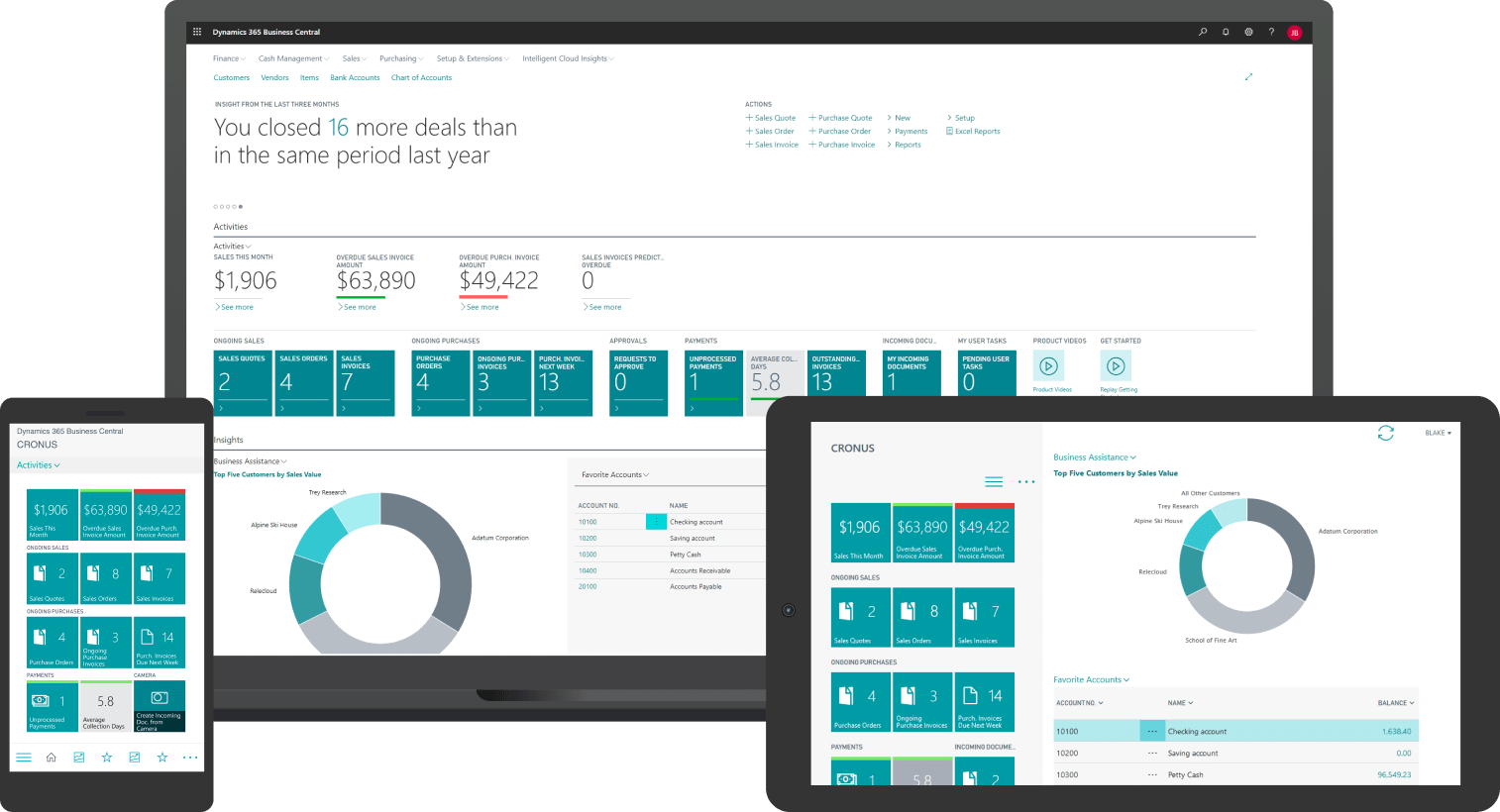
Cloud distribution is the modern default among the types of software distribution. The vendor runs the infrastructure, you log in from a browser, and updates happen quietly in the background. Microsoft Dynamics 365 Business Central reaches Canadian businesses this way, and so do most major business platforms today.
You get faster deployment, lower upfront cost, and predictable monthly billing. The catch is internet dependency and less control over upgrade timing. For most growing businesses, the benefits of cloud ERP outweigh those concerns by year two.
3. SaaS Distribution: Subscription Software, Multi-Tenant
SaaS often gets used interchangeably with cloud, but they're not the same thing. Cloud is the delivery method. SaaS is the business model layered on top. Salesforce is the textbook example of a SaaS product.
With SaaS, you pay per user per month, scale up or down without renegotiating contracts, and share infrastructure with other customers in a secure, isolated way.
It's the lowest-friction way to get enterprise software, and it works well for teams that don't want to think about IT. The difference between SaaS and cloud ERP shows up most in pricing, scalability, and how customizations are handled across customer accounts.
4. Hybrid Distribution: Part On-Premise, Part Cloud
Hybrid is one of the types of software distribution built for companies in the middle of a migration or with split needs. Some workloads run locally, others run in the cloud, and the systems talk to each other. Microsoft Azure Arc is a well-known platform built specifically for hybrid scenarios.
Common scenario: sensitive customer data stays on-premise for compliance, while reporting, collaboration, and analytics run in the cloud. It's also useful for businesses in remote areas with unreliable internet... critical operations stay local, everything else lives online. Hybrid takes more setup, but it gives you flexibility most pure models can't match.
5. Partner-Led Distribution: Implemented Through a Certified Reseller
Most enterprise ERP and CRM software reaches Canadian buyers through a partner channel, making this one of the most common types of software distribution in B2B. Microsoft, for example, sells Dynamics 365 through certified partners who handle implementation, training, customization, and local compliance.
A good Business Central partner does more than install the software. They translate vendor capability into something your team can actually use, with bilingual support, Canadian tax setup, and industry-specific configuration baked in.
The right partner also pushes back when you're about to make a costly mistake, which is something a self-serve subscription portal will never do for you.
6. Marketplace Distribution: One-Click Install From a Platform
Marketplace distribution means software gets delivered through a platform like Microsoft Marketplace (previously known as AppSource and Azure Marketplace), the Apple App Store, or the Google Workspace Marketplace.
It's clean and fast. Apps are pre-vetted, billing flows through your existing platform account, and you can usually try before you buy. This works best for add-ons, integrations, and smaller productivity tools where setup is light. For complex, multi-department software, marketplace alone usually isn't enough... you still need help with rollout, training, and integration.
7. Open-Source Distribution: Free to Use, You Manage Everything
Open-source is one of the most misunderstood types of software distribution. There's no license fee. You download the code, deploy it, and maintain it. Odoo Community Edition is a popular example in the business software space.
The "free" label is misleading. Operational cost is real: you need skilled developers, security expertise, and a plan for upgrades. For technical teams with strong internal capacity, open-source can be powerful and flexible. For non-technical SMBs, it's usually a hidden cost trap that turns into a project nobody wants to own.

Why the Different Types of Software Distribution Matter for Canadian Businesses
The types of software distribution you pick affect far more than IT. They touch cash flow, compliance, support quality, and how fast your team can adapt when the business changes.
Data Residency and Provincial Compliance
Where your data physically sits matters more in Canada than in many other markets. Quebec's Law 25, federal privacy rules, and sector-specific regulations all care about data location and access control.
Some types of software distribution rule themselves out for regulated industries. A US-only SaaS tool with no Canadian data centre creates a compliance question you don't want to answer at audit time.
Cloud and partner-led models from vendors with Canadian regions usually solve this cleanly. The question to ask any vendor early: where is the data stored, who can access it, and what happens if regulations tighten next year.
Bilingual Support and Local Implementation
A Montreal manufacturer running on US-only support hours and English-only documentation will hit a wall fast. The right distribution model accounts for EN/FR support, Canadian invoicing, and GST/QST/HST handling out of the box.
This is where partner-led distribution often wins in Canada. A local Business Central consultant builds the implementation around how Canadian businesses actually operate, not how a Silicon Valley template thinks they should. That includes things like Quebec-specific labour rules in payroll, bilingual customer communications, and reporting that finance teams can actually use at month-end.
Total Cost Over 5 Years, Not Day One
The cheapest of the types of software distribution on day one is rarely the cheapest at year five. On-premise has high upfront cost but low monthly cost. SaaS reverses that. Open-source looks free until you add up the hiring cost. Partner-led adds implementation fees but saves you from the cost of a failed rollout.
A useful framework: add licensing, subscriptions, internal staff time, training, and the cost to scale. That's the real number. Most Canadian SMBs are surprised when they run the math.
Map the Right Distribution Model to Your Business
Walk away knowing exactly which software delivery model will save your team thousands of hours and dollars over the next five years.
 Free discovery call
How to Choose Between the Types of Software Distribution
Picking from the types of software distribution isn't one decision. It's three smaller ones, and getting any of them wrong creates pain later.
Match the Types of Software Distribution to Your IT Team's Capacity
Be honest about who's available to support the software. If you don't have a dedicated IT team, on-premise and open-source create silent costs that show up as missed updates, security gaps, and project delays. Those costs rarely appear in the original budget, which is why they sting.
Most Canadian SMBs land on cloud plus partner-led for a reason. The vendor handles infrastructure, the partner handles implementation, and your team focuses on actually using the software. That's the path with the fewest surprises.
Decide Who Carries the Risk... You or the Vendor
Every one of the types of software distribution is a risk-transfer decision in disguise.
On-premise means you carry everything: servers, security, backups, uptime. SaaS shifts most of that to the vendor. Partner-led shares the risk... the vendor owns the platform, the partner owns the implementation, and you own the business outcomes.
Pick the model that puts the risk where it's best managed. Strong internal IT? Carry more of it. Lean team? Transfer it.
Plan for Year 3, Not Just Month 1
The types of software distribution lock you in to some extent. Switching from on-premise to cloud mid-life is a real project. Switching cloud vendors is easier but still requires migration work. Switching open-source to commercial usually means rebuilding integrations.
Choose the model that fits where the business is going, not just where it is today. If you're planning to grow into new provinces, add bilingual operations, or hire remote teams, that should shape the decision now. A solid grasp of ERP consulting helps you frame this conversation properly.
The biggest mistake here is treating the software decision as an IT project. It's a business decision with IT implications, and the people who feel the consequences most are in finance, operations, and customer service.
Watching the cloud and partner-led model in action is faster than reading about it. Here's a quick demo of how Business Central looks when delivered this way…
Common Mistakes Businesses Make With the Types of Software Distribution
Most regret in software buying traces back to one of these three missteps with the types of software distribution. They're avoidable if you spot them early.
Picking the Cheapest of the Types of Software Distribution Without Counting Hidden Costs
The lowest sticker price almost never wins long-term. Open-source "free" software costs more in hires and security. On-premise "one-time" licenses cost more in upgrades, hardware refreshes, and downtime.
Run a five-year total cost view before deciding. The cheapest day-one option is often the most expensive year-three option, and that gap is where most software regrets live.
Skipping the Partner Conversation for Complex Software
Enterprise ERP and CRM rarely succeed as DIY installs. The partner channel exists because the gap between vendor capability and business use is bigger than most teams realize.
Trying to self-implement complex software is one of the most common reasons projects stall, blow budgets, or get scrapped entirely. A short conversation with a partner before you sign anything costs nothing and can save the whole project.
Locking In Before Checking Canadian Compliance
Buying a US-only SaaS tool and discovering it can't produce a bilingual invoice or handle provincial tax rules is a painful moment. So is finding out your data lives in a region that creates a compliance question at your next audit.
Check Canadian fit early: data residency, EN/FR support, GST/QST/HST, payroll handling, and provincial reporting. If the vendor can't answer these questions in a sentence, that's your answer.
Get the ERP Selection Checklist
Walk through 10 evaluation criteria that separate the right software vendor from the wrong one... before you commit to a contract.

-
The seven main types are on-premise, cloud-based, SaaS, hybrid, partner-led, marketplace, and open-source. Each one differs in where the software lives, who maintains it, and how you pay for it. Most Canadian businesses today choose a mix of cloud and partner-led distribution for their core systems.
Why Canadian Businesses Choose Gestisoft to Navigate the Types of Software Distribution
Gestisoft has spent nearly three decades helping Canadian businesses pick between the types of software distribution and implement Microsoft business solutions, including Dynamics 365 Business Central, Dynamics 365 CRM, and Microsoft Copilot. As a certified Microsoft Partner serving clients across Canada and North America, the team delivers fully bilingual implementation, support, and training from offices in Montreal, Quebec City, Toronto, and Ottawa.
The business is B Corp certified, recognized as a Great Place to Work in Canada, and has earned the Prix Performance Québec for operational excellence. Industry expertise spans manufacturing, distribution, professional services, fashion and apparel, regulatory bodies, and municipalities, which means recommendations come from people who understand how Canadian businesses actually run.
What clients say about working with the team:
“Gestisoft's consultants come from the industry, so when we worked together, we spoke the same language and shared the same vision of what was important and necessary. They guided us in implementing industry best practices. Throughout the project, their industry expertise eliminated any potential irritants that might have risen from inexperience in the distribution environment.”
If you're weighing the types of software distribution for your next project, the fastest way to get clarity is a free conversation with someone who's helped Canadian businesses make this exact decision for nearly three decades.
Get a Clear Software Distribution Roadmap
Walk away with a plain-language plan that protects your business from the wrong vendor, the wrong model, and the wrong rollout sequence.
 Free discovery call
Liked what you just read? Sharing is caring.

May 22, 2026 by Muhammad Ali Iqbal by Muhammad Ali Iqbal SEO Content Strategist & Copywriter
Driven by a passion for search engine optimization, strategic content, and conversion-focused writing. A copywriter and content strategist who lives for content that ranks, engages, and delivers real business results.
