

A distributor gets a call on a Tuesday afternoon. A long-standing customer wants to know where their order is. The answer, after three minutes of checking across two spreadsheets and a text to the warehouse, is: it shipped late because the inventory record showed 40 units available when there were actually 12. Nobody caught it in time. The customer is not impressed. This is exactly the kind of problem that a proper software distribution management setup is built to prevent.
That scenario plays out more often than most distribution teams want to admit. It's not a people's problem. It's a systems problem, and software distribution management exists specifically to close that gap. The right platform connects inventory, purchasing, order management, warehouse operations, and financials into one place so everyone is working from the same real-time picture.
This guide covers the 10 best software distribution management platforms worth evaluating in 2026. You'll see what each one does well, who it fits, and what to actually weigh when it's time to decide.
Talk to a Gestisoft Distribution Expert
Walk away knowing exactly which software fits your operation, what it costs, and how long it takes to get running.
 Book a free consultation
Top 10 Software Distribution Management Platforms in 2026
There's no shortage of distribution software systems competing for your attention. Most operations only need to seriously evaluate a handful, so here's what you actually need to know about each one.
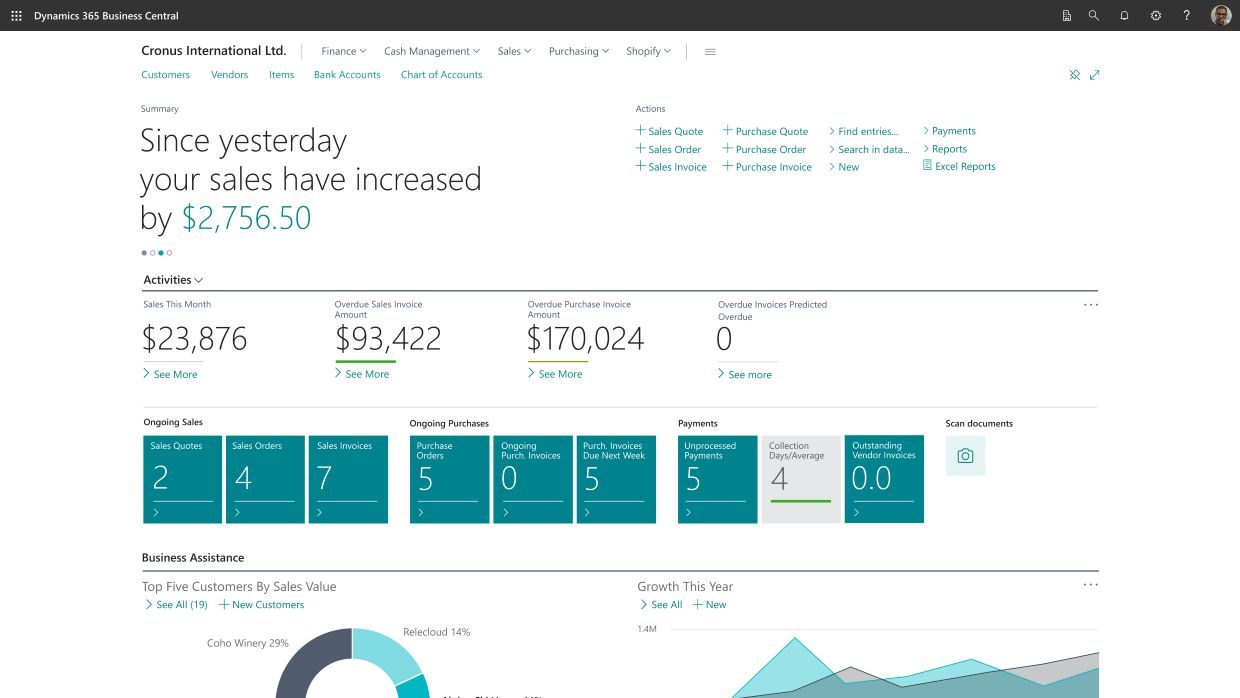
1. Microsoft Dynamics 365 Business Central

Best for: Small to mid-size distributors ready to unify operations.
Business Central handles inventory, purchasing, order management, warehouse operations, and financials inside a single cloud-based platform. As a software distribution management solution, it gives mid-size teams multi-warehouse inventory that updates in real time, automated reorder points that prevent stockouts, and Microsoft Copilot that now assists with demand forecasting directly inside the system.
It connects natively with Excel, Outlook, and Teams, which means your team keeps working in tools they already know. For distributors already running on Microsoft tools, there's no sharper fit.

Best for: Growing distributors who want flexible, unlimited-user access.
Acumatica prices by resource consumption, not by the number of users, which matters when your entire warehouse floor needs system access. Its software distribution management module covers purchasing, order fulfillment, inventory control, and warehouse operations with strong mobile support.
Native connectors link to Amazon, Shopify, and major shipping carriers out of the box. A solid choice for operations scaling quickly that cannot afford per-seat licensing to slow them down.

Best for: Established mid-market and multi-entity wholesale distributors.
NetSuite's software distribution management platform covers multi-location inventory, complex pricing, landed cost tracking, and multi-currency financials in one connected place. It's built for distributors operating across multiple entities or regions, where consolidation and real-time reporting across business units matter.
The annual subscription model and implementation complexity mean it's a better fit for operations with a dedicated finance team and budget to match. Powerful, but not a starting point for smaller operations.
4. SAP Business One

Best for: Growing SMBs with complex inventory and procurement needs.
SAP Business One brings enterprise-grade supply chain management to mid-size companies without the full SAP price tag. It covers purchasing, warehouse management, inventory, and financials with strong analytics built in.
Implementations tend to run longer and require experienced partners, and the learning curve is real. For distributors handling complex supplier relationships and detailed costing across multiple product lines, it delivers a level of control that lighter tools simply cannot match.
5. Sage X3

Best for: Mid-size distributors in multi-country or multi-site operations.
Sage X3 is a software distribution management platform built for distribution across multiple sites, currencies, and regulatory environments. It's strong in industries like food and beverage, chemicals, and industrial goods where traceability and compliance are non-negotiable.
Cloud or on-premises deployment gives larger operations flexibility. The trade-off is complexity… implementation requires a skilled partner, and it's not well-suited for smaller teams who need to be up and running fast.
6. Odoo

Best for: Small distributors who want a modular, low-cost starting point.
Odoo is open-source and modular, making it one of the more accessible software distribution management options for teams starting from scratch. The inventory module handles multi-location tracking, automated replenishment, and basic order management. The enterprise edition starts around $24.90 per user per month.
The real cost shows up in customization: getting Odoo to fit a specific distribution workflow usually requires technical resources. Teams with tight budgets can also explore free software options for distribution businesses before committing to a paid platform.

Best for: Small distributors running QuickBooks who need real inventory control.
Fishbowl is the most-used inventory management software for QuickBooks, and it earns that position. It handles multi-location inventory, barcode scanning, purchase orders, and order fulfillment without pulling you out of your existing accounting setup.
For a small distribution business that's outgrown Excel but isn't ready for a full ERP, it's an efficient bridge. Growth does hit a ceiling… once operations span multiple entities or require advanced financial reporting, Fishbowl's limits start to show.

Best for: Distributors selling across multiple channels including e-commerce.
Cin7 connects inventory, orders, and fulfillment across B2B wholesale accounts, online storefronts, and physical locations in one platform. For omnichannel sellers, it functions as a practical software distribution management tool that syncs with Shopify, Amazon, and other major marketplaces in real time.
Its built-in EDI handles supplier and retail partner connections without extra middleware. Pricing has climbed in recent years and some users flag support delays, but for omnichannel operations managing diverse sales channels it remains one of the most practical options at this price point.
9. Extensiv

Best for: Distributors operating through or partnering with 3PL warehouses.
Extensiv is a software distribution management tool built specifically for the 3PL and fulfillment layer of distribution operations, managing inventory across third-party warehouse locations, automating pick-pack-ship workflows, and providing full order visibility across fulfillment partners.
For businesses that outsource warehousing but still need real-time control over inventory and shipping status, it fills a gap that general ERP systems often don't address cleanly. Niche, but excellent if your supply chain runs through external partners.

Best for: Very small distributors taking their first step off spreadsheets.
inFlow covers the basics of software distribution management: stock tracking, purchase orders, sales orders, and basic reporting in a clean, approachable interface. It's cloud-based, requires minimal training, and connects to QuickBooks and Shopify for teams that need accounting and e-commerce sync without a heavy integration project.
The ceiling arrives quickly as operations grow, and it lacks the warehouse management and financial depth that mid-size distribution businesses need. A good starting point, not a long-term platform.
See Business Central Running in a Real Distribution Operation
Gestisoft configures Business Central specifically for distributors, from inventory setup to carrier connections. See what that looks like for your operation.
 Book a free consultation
How to Choose the Right Software Distribution Management System
Here's a fact most software comparison guides skip: the majority of failed ERP implementations don't fail because of the software… They fail because the business picked a platform that didn't match where they actually were in their growth, or because the implementation partner didn't understand the industry well enough to configure it correctly.
So before you shortlist platforms, start with your operation size.
Small Operations: Get Off Spreadsheets First
For teams under 20 people running a single location, tools like inFlow or Fishbowl give you the core software distribution management capabilities you need to get off spreadsheets fast and at a cost that makes sense.
These tools are straightforward to set up and work well as a first step into structured inventory management. They're not built to scale far, and that's fine. The goal at this stage is accuracy and visibility, not full supply chain management.
Mid-Size Operations: Connect the Full Picture
Mid-size distributors, roughly 20 to 150 people with multiple locations and a real finance function, are the natural home for Business Central or Acumatica if per-user licensing is a concern.
Business Central is priced accessibly for SMBs and covers the full range of distribution software systems you'd expect at this level: multi-warehouse inventory, order management, supplier tracking, and financial integration. Both platforms grow with the business and don't require a system change when you add a warehouse or a new product line.
Larger Operations: Match Complexity With Depth
For operations beyond 150 people with multi-entity complexity, global supplier networks, or specialized compliance requirements, NetSuite or Sage X3 become the relevant software distribution management options.
The implementation investment is higher, but so is the operational return for organizations that genuinely need that level of depth. These platforms are built for businesses that have already outgrown mid-market ERP for distribution and need enterprise-grade control without moving to a full SAP stack.
The Question Nobody Asks: Who Supports You After Go-Live?
One question that rarely gets asked during the evaluation stage: who supports you after go-live? A distributor running on an ERP that no one internally understands will spend more in support costs and manual workarounds than they saved in licensing.
The right implementation partner is as important as the right platform. Someone who has been inside distribution operations can tell you which configurations actually matter for a business like yours, and that knowledge alone can prevent months of delays.
Cloud vs. On-Premises Software Distribution Management
On-premises ERP still exists, and for some operations with strict data security requirements it's the right call. But for most distributors evaluating options in 2026, cloud-based software distribution management is the standard. Automatic updates, remote access for field teams, and lower infrastructure costs are the obvious reasons.
The less obvious one: cloud ERP is where AI tools like Microsoft Copilot actually live. If you want demand forecasting, automated anomaly flagging, and intelligent reorder assistance built into your platform, cloud is the only path that gets you there.
5 Reasons to Adopt a Cloud ERP
Not sure if cloud ERP is the right move for your distribution business? This free eBook breaks down the real benefits of making the switch, so you can make the call with confidence.

How AI Is Changing Software Distribution Management
AI in ERP used to mean a slightly smarter dashboard. What's available now is meaningfully different. Software distribution management platforms like Business Central have Microsoft Copilot embedded directly into daily workflows. It analyzes historical order patterns to assist with demand forecasting, flags reorder anomalies before they turn into stockouts, and surfaces supply chain risk signals without anyone needing to build a custom report.
In the 2025 Release Wave 2, Microsoft added AI agents inside Business Central that automate purchase and sales order processing end to end, cutting manual data entry out of those workflows entirely. For distributors, that means fewer errors on high-volume order cycles and faster response times when supplier conditions change. These aren't experimental features rolled out in a beta environment. They're live, tested, and available to Business Central users today.
The practical implication is straightforward: distributors who chose cloud ERP before AI became standard are already getting the benefit. Those still on legacy or on-premises systems will need to upgrade before any of this applies to them. That's the longer-term cost of delaying the platform decision, and it's one more reason why AI in ERP has moved from a nice-to-have conversation to a critical one.
Here's a full walkthrough of what's new in Business Central for distributors…
-
Software distribution management refers to the platforms and processes that distributors use to manage inventory, purchasing, order fulfillment, warehouse operations, and financials in one connected system. The goal is to replace disconnected spreadsheets and siloed tools with a single source of accurate, real-time data across the entire operation.
Why Gestisoft Is the Right Partner for Software Distribution Management
Choosing the right software distribution management platform is one decision. Choosing the right partner to implement it is another, and in practice, the second one has more impact on your outcome than the first.
Gestisoft has been implementing Microsoft solutions in Canada for over 27 years. Our team includes more than 110 specialists, we deliver hundreds of projects per year across North America, and we hold a 95% client renewal rate for 2024. We are a certified Microsoft Solutions Partner, recognized for ERP and CRM delivery across industries.
What actually sets us apart in the distribution space isn't the certifications. It's the fact that our consultants come from industry backgrounds, not just software backgrounds. We've been inside distribution operations. We know what a rough month-end looks like when your inventory data is wrong. We know which Business Central distribution configurations actually matter for a distributor and which ones just add complexity without value. That kind of working knowledge doesn't come from a software manual.
Here's how one client put it after working with us on a distribution implementation:
“Gestisoft's consultants come from the industry, so when we worked together, we spoke the same language and shared the same vision of what was important and necessary. They guided us in implementing industry best practices. Throughout the project, their industry expertise eliminated any potential irritants that might have risen from inexperience in the distribution environment”
That's the difference between an implementation that stalls at month three and one that delivers real results, and it's exactly the kind of partnership we bring to every distribution project we take on.
Your Distribution Operation Deserves the Right Partner
From first conversation to go-live and beyond, we work alongside your team. Let's talk about what that looks like.
 Free discovery call
Liked what you just read? Sharing is caring.

May 20, 2026 by Muhammad Ali Iqbal by Muhammad Ali Iqbal SEO Content Strategist & Copywriter
Driven by a passion for search engine optimization, strategic content, and conversion-focused writing. A copywriter and content strategist who lives for content that ranks, engages, and delivers real business results.
