

ShipStation alternatives are searched more than ever in 2026, mostly because of ShipStation's July 2025 pricing restructure that pushed many sellers off the platform. New tiers, locked API access on lower plans, and limited Canadian carrier coverage all hit hard for operations teams running in Canada.
This guide covers ten ShipStation alternatives worth considering this year. Some are simpler label tools at lower cost. Others are full operations platforms that absorb shipping into inventory, accounting, and warehouse work.
Every option below was evaluated for Canadian carrier coverage, real operational fit, and how it scales when label printing isn't the only problem anymore. These ShipStation alternatives sit on a spectrum from cheap label tools to full operations platforms.
See How a Connected ERP Replaces a Stack of Shipping Tools
Stop paying for label software, inventory software, and accounting software that don't talk to each other. A single platform can handle all three.
 Free discovery call
10 Best ShipStation Alternatives to Use in 2026
Here's the 2026 lineup of ShipStation alternatives, ordered by how well each one scales with your operation. We start with the most operationally complete option and move toward simpler, lower-cost picks.
1. Microsoft Dynamics 365 Business Central: Best ShipStation Alternative for Full Operations
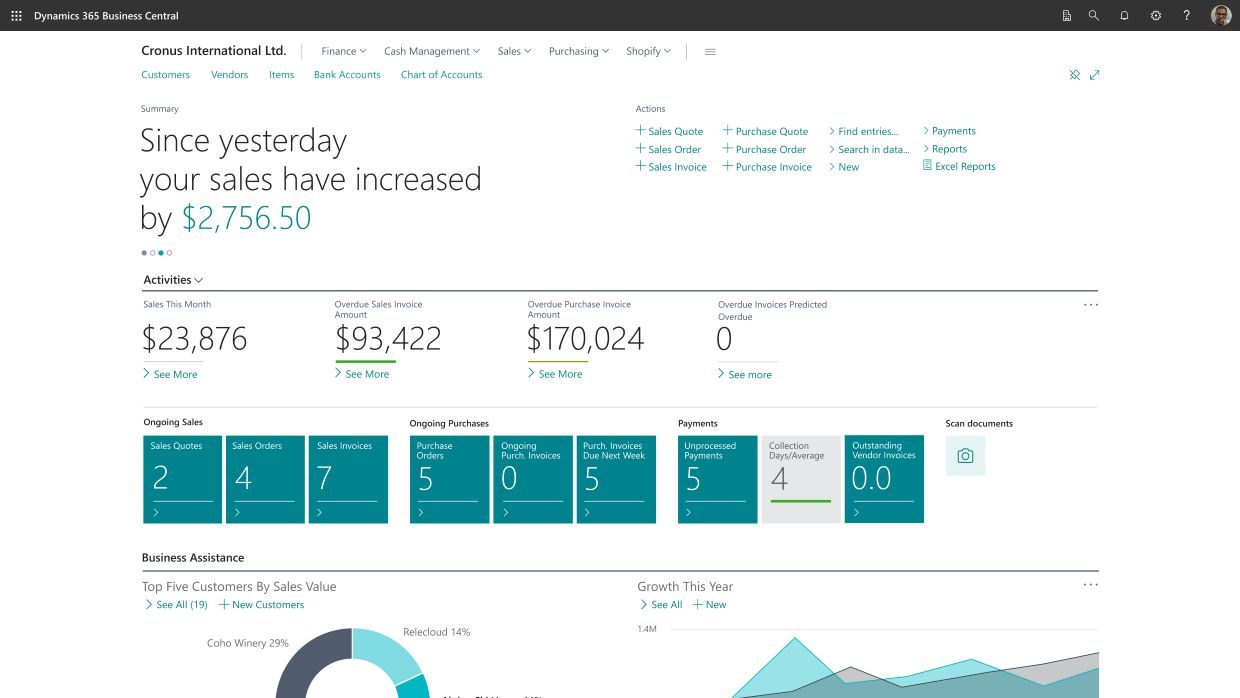
When your shipping problem is actually an operations problem, this is where ShipStation alternatives stop being just shipping tools. Microsoft Dynamics 365 Business Central handles sales order entry, inventory across locations, picking, packing, accounting, and logistics in one unified system.
Canadian businesses get native multi-currency, GST and HST handling, and Canada Post, Purolator, and US carrier connections via AppSource extensions or direct API bridges. Best for distributors, wholesalers, and growing ecommerce ops where shipping is one part of a bigger picture. Pricing is CA$108.50 per user per month for Essentials, plus implementation.
2. Shippo: Best ShipStation Alternative for Multi-Carrier Shipping at Lower Cost
Shippo is the most common direct swap when people search for ShipStation alternatives that just print labels for less. The platform offers a free Starter plan for up to 30 labels per month, then paid Pro tiers from US$17 per month with full API access.
It connects to 40+ carriers including USPS, FedEx, UPS, DHL, and Canada Post, with returns, tracking, and customs paperwork built in. Best for small to mid-sized ecommerce sellers who want straightforward multi-carrier shipping.
It’s also important to note that own-carrier-account users pay a US$0.05 per-label fee on the free tier (waived with Shippo's rates).
3. Veeqo: Best Free Option for Amazon and Multi-Channel Sellers
Veeqo is Amazon-owned and completely free for shipping and inventory management, making it hard to beat among ShipStation alternatives on price. It syncs orders across Shopify, Amazon, eBay, Walmart, Etsy, TikTok Shop, BigCommerce, and WooCommerce.
Orders route to carriers including USPS, UPS, FedEx, DHL, OnTrac, and Amazon Shipping. Inventory tracking, barcode picking, and rate comparison are included without monthly fees or shipment caps.
The catch is that Amazon owns the infrastructure, which some multi-channel sellers avoid for data privacy reasons. Best for Amazon-first or budget-conscious sellers who want unified inventory and shipping at zero software cost.
4. Easyship: Best for International and Cross-Border Shipping
Easyship is built for sellers shipping internationally, where customs and duties get complicated fast. The platform aggregates 550+ courier services and can display real-time landed cost (shipping, taxes, and duties) at checkout, a feature most ShipStation alternatives don't handle cleanly.
Canadian sellers shipping to the US or further abroad get clear rate comparisons, automated customs paperwork, and built-in tracking. Best for DTC brands and ecommerce stores with significant global order volume. A free plan is available, with the Plus tier from US$29 per month. Unlocking live tax and duty breakdowns at checkout requires the Premier plan from US$69 per month.
5. Pirate Ship: Best Free Option for USPS-Heavy Sellers
Pirate Ship is genuinely free with no monthly subscription, no per-label fees, and no setup minimums. You pay only for the postage, accessing deeply discounted USPS Commercial and Cubic pricing alongside competitive UPS rates. There are no shipment caps, no user limits, and no upsell tiers.
The trade-off is feature depth. While it integrates with Shopify, Etsy, Amazon, and eBay, it lacks advanced automation rules, inventory management, and deep analytics. Best for low-to-mid volume sellers, side businesses, or independent operations where straightforward, pay-as-you-go simplicity matters more than enterprise infrastructure.
6. ShippingEasy: Best for Sellers Who Want Shipping Plus Basic Marketing
ShippingEasy differentiates itself from other ShipStation alternatives by offering an integrated Customer Marketing email tool right next to your shipping queue. Using live order data, you can run post-purchase email sequences, review requests, and abandoned-cart campaigns from the same dashboard.
Its carrier breadth and core logistics automation are more basic than ShipStation's. Best for smaller ecommerce sellers wanting simple, data-driven email marketing alongside label printing. The Growth plan starts at US$19.99 per month for 200 shipments. Unlocking the Customer Marketing automation requires an additional volume-based add-on subscription.
7. Ordoro: Best for Small Teams Combining Inventory and Shipping
Ordoro offers a modular platform: shipping tools on a free entry plan, with multichannel inventory and dropshipping as paid layers on top. The system syncs inventory across sales channels, generates purchase orders, and automates dropship routing alongside label printing.
It integrates with USPS, UPS, FedEx, DHL, Canada Post, and Sendle. Best for small-to-mid-sized ecommerce teams running hybrid setups where self-shipping and partial dropshipping coexist.
Basic shipping is free; the Advanced Dropship plan runs US$299 per month, Advanced Inventory US$349, and Premium Inventory US$499 (adding purchase orders, kitting, and bill of materials).
8. ShipHero: Best for High-Volume DTC Brands and 3PLs
ShipHero is built for enterprise warehouse-scale operations, not casual sellers. It functions as a full Warehouse Management System with batch picking, multi-warehouse routing, mobile barcode scanning, and 3PL client billing.
Brands and 3PLs running thousands of orders per day choose it because most ShipStation alternatives in the small-business tier can't handle that volume cleanly. Best for high-velocity fulfillment centers and multi-warehouse operations.
Pricing is quoted on request, with third-party data showing the Standard plan at US$1,995 per month (5 users included) plus a US$2,000 onboarding fee.
9. Sendcloud: Best for European Carrier Coverage
Sendcloud is the European-leaning option if you ship into the EU or run a Canadian DTC brand expanding into Europe. It connects to 160+ international carriers including DHL, DPD, GLS, PostNL, and Royal Mail, alongside major North American shipping providers.
Branded tracking, local return portals, and checkout shipping options are core features. Best for Canadian or US brands with European customers or EU expansion plans. A free Essential plan is available; the Lite tier starts at €35 per month, with a per-label fee of €0.08 to €0.12 added on top of postage.
10. ClickShip: Best Canadian-Built Option for Canada Post and Purolator
ClickShip is Canadian-owned (by Freightcom) and engineered specifically for Canadian shipping, a rarity among ShipStation alternatives that typically target US sellers. It provides pre-negotiated discounts on Canada Post, Purolator, Canpar, UPS Canada, and major US cross-border carriers.
It handles both parcel and LTL freight, integrates with Shopify, WooCommerce, Amazon, eBay, and Walmart.ca, and uses smart packaging optimization to cut dimensional weight charges.
Best for Canadian small-to-mid-sized ecommerce sellers wanting domestic discounts without subscription overhead. Free to sign up with no monthly fees on the standard plan.
Pick the Right Platform Before You Pick the Tool
Get our 10 key ERP selection criteria to evaluate operations platforms beyond shipping software alone.

How to Choose the Right ShipStation Alternatives for Your Business
Pricing alone is a bad way to evaluate ShipStation alternatives. Carrier mix, integration depth, and how the tool fits your wider stack matter more across a 12-month window. Here's what to check.
What to Check Before You Switch
A short checklist that separates the tools worth demoing from the ones worth skipping.
Carrier Coverage in Canada
If you ship inside Canada, your shortlist must include Canada Post and Purolator at competitive rates. US-first tools often charge premium markups for Canadian carriers, which eats your savings quickly. Check the published rate sheets before you book a demo, not after.
Integration With Your Sales Channels and Accounting
Look at how the tool connects to your sales channels and accounting system. A cheaper option that needs three Zapier connections to stay in sync is rarely cheaper after a year of subscriptions and manual fixes. Native integrations beat patched ones every time.
Volume Tiers and Pricing Breakpoints
ShipStation restructured pricing in July 2025, and the entry-level Starter plan now begins at US$14.99 per month for 50 shipments. Map your next 12 months against each platform's pricing breakpoints before switching. Most ShipStation alternatives scale differently, so model the math on your actual volume.
Ask what happens when you outgrow the plan: does pricing scale smoothly, or does the next tier double the bill?
Common Mistakes When Picking ShipStation Alternatives
Three mistakes Canadian operations teams make most often when they swap tools.
Picking on Price Alone
A free tool that creates four hours of manual reconciliation every week isn't free. Calculate total cost including labor, integration fees, and the cost of errors before you choose.
Treating Shipping as a Standalone Problem
If shipping doesn't talk to accounting or inventory, you'll spend hours every week reconciling numbers, re-keying data, or fixing channel-sync errors. Most ShipStation alternatives solve the label problem but leave this data flow problem untouched.
Locking Into a US-Only Tool
Carrier rates, customs paperwork, and currency handling matter more than the dashboard's design. For wholesale and distribution teams making this decision at scale, we cover the broader software-selection logic in our distribution management software guide.
Here's a quick look at how the same pick-and-ship workflow runs inside Business Central, end-to-end.
Signs You've Outgrown ShipStation Alternatives (and What Comes Next)
Sometimes the answer isn't a different shipping tool. It's a different category of software. These are four signs your shipping app is no longer the real problem, no matter which of the ShipStation alternatives you pick next.
Your Shipping Tool Doesn't Talk to Your Accounting
If your team manually re-keys shipped order data into QuickBooks, NetSuite, or Excel at month-end, you're paying for the shipping software twice. Once in subscription, once in labor.
Real-time accounting integration is where most shipping tools stop and where an ERP-driven inventory system starts.
You're Updating Inventory Manually Across Channels
When stock goes out the door, it should subtract from inventory in every connected channel automatically. Your Shopify store, Amazon listing, B2B portal, and warehouse counts should all stay in sync without a spreadsheet.
Manual updates create overselling and stockouts. Connecting Shopify inventory directly to an ERP keeps stock accurate across every sales channel and warehouse without daily reconciliation work.
Multi-Warehouse or Cross-Border Operations Are Breaking Your Setup
Two warehouses, a Toronto fulfillment partner, and a US-based 3PL exceed what most shipping software handles cleanly.
Multi-currency invoicing, location-specific tax, and cross-border duty calculations need a system designed for that complexity from day one.
You're Paying for ShipStation Plus Four Other Tools to Make It Work
If your shipping stack is ShipStation plus an inventory app plus a returns tool plus an accounting connector plus a Zapier subscription gluing it together, the math often favors consolidating.
Pulling shipping, warehouse, and accounting into one ERP cuts the tool count and removes the integration tax. Our breakdown of warehouse management inside an ERP covers how picking, packing, and shipping workflows live in one system rather than stitched across four.
-
Pirate Ship and Veeqo are the strongest free options. Pirate Ship is best for USPS-heavy, low-volume shippers. Veeqo covers multi-channel sellers and includes inventory sync without monthly fees.
Why Gestisoft Is the Right Partner When You're Looking at ShipStation Alternatives
We've helped Canadian distributors, manufacturers, and ecommerce operations replace patchwork shipping stacks and ShipStation alternatives with Microsoft Dynamics 365 Business Central for years. As a Microsoft Solutions Partner since 2004 and a B Corp certified company, Gestisoft works across Canada and North America in English and French.
The work isn't just installing software. It's mapping the actual order-to-cash flow and building integrations that fit how your team works. From sales order entry through pick, pack, ship, invoice, and reconcile, the whole loop runs in one system.
“As a customer since 2015, I would like to highlight the quality of support and expertise provided by Gestisoft for our Business Central application. Their competence is notable and has greatly contributed to the success of my business. I highly recommend them as a service provider for Business Central.”
If you want that kind of long-term partnership behind your operations stack, the next step is a short conversation.
Talk to a Canadian Microsoft Partner Who Has Done This Before
We've helped operations teams move from patchwork shipping stacks to one connected platform. See if it fits your business.
 Book a free consultation
Liked what you just read? Sharing is caring.

June 22, 2026 by Muhammad Ali Iqbal by Muhammad Ali Iqbal SEO Content Strategist & Copywriter
Driven by a passion for search engine optimization, strategic content, and conversion-focused writing. A copywriter and content strategist who lives for content that ranks, engages, and delivers real business results.
