

Inventory and warehouse are often spoken about as if they're the same job. They're not. Inventory and warehouse management are two different layers of the same operation, and confusing them is one of the most expensive mistakes a growing business can make.
If you sell, store, ship, or manufacture physical goods, the way you handle stock and the way you run your warehouse are two distinct disciplines. They share data. They share tools. But they answer very different questions.
This guide walks through how the two differ, where they overlap, and how to figure out what your business actually needs. For most Canadian SMBs running one or two sites with under a few thousand active SKUs, a single ERP usually covers both jobs cleanly. The decision only gets harder as scale and complexity climb.
Get Clarity On Your Stock And Fulfillment Setup In One Short Call
Talk to a Gestisoft consultant about your current workflows. You'll get a straight read on where the friction is and what a realistic next step looks like.
 Book a free consultation
6 Real Differences Between Inventory and Warehouse Management
Most articles online stop at definitions. This one is built around the differences that actually shape your software choice. Read these six and you'll already have a clearer answer than most teams ever get.
1. Scope: One Watches Stock, the Other Runs the Floor
Inventory management asks what you own, where it sits across the business, and how much of it you have. Warehouse management asks how each item moves through one specific building.
Inventory keeps the big picture. Warehouse keeps the floor running.
That split matters because a single tool rarely does both well at scale. Below a certain size, an integrated ERP handles both layers comfortably. Above that, the warehouse layer often needs its own engine.
2. KPIs: Days of Cover Vs Picks Per Hour
Inventory teams live by days of cover, turnover ratio, fill rate, and write-off percentage. Warehouse teams live by picks per hour, putaway speed, order accuracy, and dock-to-stock time.
The two sets of numbers feed each other. Better picks per hour means orders ship faster, which improves fill rate. Lower turnover means slow-movers clog up bins.
But they're different scoreboards. The leader looking at one set rarely solves problems in the other set without translation.
3. Decision Layer: Strategic Vs Operational
Inventory management lives at a strategic layer. Reorder points, supplier terms, safety stock, and product mix decisions sit here. Most are made monthly or quarterly.
Warehouse management lives at an operational layer. Where to put pallet 247, which picker takes the next wave, how to slot fast-movers near the dock. These happen in seconds.
A tool designed for one rhythm struggles with the other, which is why most blended teams need shared data rather than shared interfaces.
4. Time Horizon: Months Ahead Vs Right Now
Inventory plans months ahead. What season is coming, what tariffs are changing, what suppliers are slipping, what the forecast looks like for Q3.
Warehouse runs right now. The receiving truck is at the dock, the order needs to leave by 4 p.m., the bin in aisle 12 has the wrong count.
This time-horizon split is why one team feels reactive while the other feels strategic. Both are essential. Neither replaces the other.
5. Software Footprint: ERP Module Vs Dedicated System
Inventory management almost always lives inside an ERP. The stock ledger and the general ledger share one database, which is why finance trusts the numbers.
Warehouse management can live inside the ERP too, or it can run as a dedicated system bolted on. The core building blocks stay the same either way: receiving, putaway, picking, packing, shipping, plus barcodes and integrations. Our breakdown of warehouse management system components covers each one in detail.
For SMBs, the ERP module is often enough.
6. Ownership: Finance Vs Operations
Inventory management is usually owned by finance, supply chain, or a director of operations who reports up the strategic chain. Their numbers feed the cost of goods sold and working capital.
Warehouse management is usually owned by the warehouse manager and a floor supervisor. Their numbers feed throughput, accuracy, and customer service levels.
When the two functions report into different leaders without shared tooling, most inventory and warehouse pain originates right there.
How Inventory and Warehouse Actually Work Together
Definitions are easy. The handoff between the two layers is where most teams trip up. Here's what the day-to-day actually looks like.
Receiving: Where Both Disciplines Meet at the Dock
A purchase order is created at the inventory layer. The truck arrives at the warehouse layer. The receiving clerk scans against the PO, confirms quantities, and checks for damage.
The moment the receipt is posted, inventory updates and the items become available for selling. The warehouse decides where to store them next. If the two systems aren't talking to each other, this is the first place mismatches show up.
Putaway: The First Real Handoff
Inventory says the goods exist. Warehouse decides where they live.
A directed putaway tells the worker exactly which bin, based on rules like product velocity, weight, or expiration date. Without clear putaway logic, fast-movers end up at the back of the building and pick times double.
Picking and Packing: Where Warehouse Logic Takes Over
Once an order drops, warehouse logic runs the show. Pick paths, wave planning, batch picking, packing rules, and label printing all live here.
Inventory's job is just to confirm what's available and reserve it. Everything else is execution.
For a small operation, one picker working from a list is fine. As volume climbs, the inventory and warehouse layers start needing to coordinate in real time so two orders never reserve the same unit.
Shipping and the Loop Back to Inventory
Shipping closes the loop. The order leaves the dock, the system posts the shipment, inventory is decremented, costs are pushed to the general ledger, and finance can see the impact within minutes.
That single posting is where inventory and warehouse data finally rejoin into one record.
Do You Need Separate Inventory and Warehouse Systems? A Decision Framework
Here's the question no one actually answers. Use these three checkpoints to figure out where your business sits today.
When an ERP Handles Inventory and Warehouse in One Place
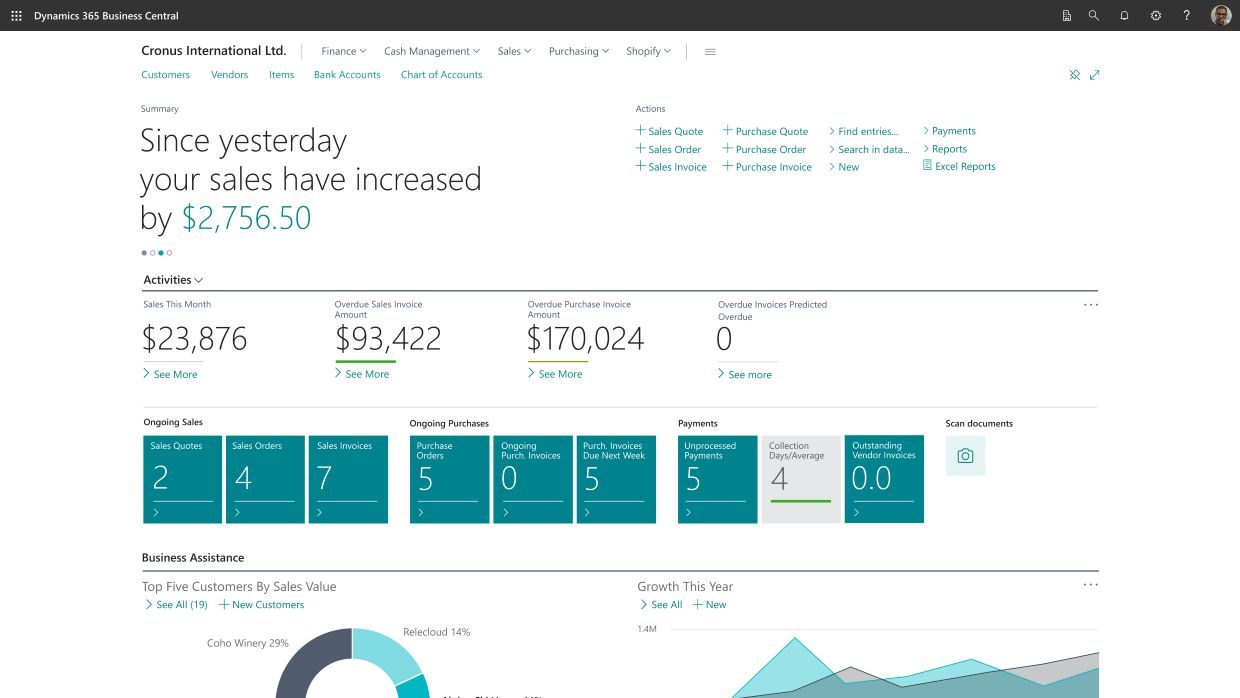
For most Canadian SMBs running one or two sites with under a few thousand active SKUs and basic picking, an ERP like Microsoft Dynamics 365 Business Central handles both layers in one database.
You get bin tracking, putaway, picks, cycle counts, and serial or lot traceability without the cost or integration overhead of a second platform.
If you're still on spreadsheets for stock or you've outgrown QuickBooks, this is usually the first move. The short version is that manual errors compound, real-time updates break down across teams, and there's no clean link to accounting. Our full breakdown on Excel versus ERP for inventory management covers the full case if you want to go deeper.
When You Actually Need a Dedicated WMS on Top
You need a dedicated warehouse management system on top of your ERP when one or more of these show up:
- Daily pick volume in the thousands, with multiple wave releases per shift.
- Directed picking, zone picking, or voice-picking workflows.
- Multiple warehouses with cross-docking or transfer complexity.
- 3PL operations where you charge customers based on storage and handling.
- Carrier integrations and shipping automation across many providers.
If none of these apply, an ERP-native warehouse module is usually enough. A separate WMS adds licensing, integration, and ongoing maintenance costs. The integration alone often runs longer than the original ERP rollout.
Here's a simple test: if your inventory and warehouse data already clash in one system, adding a second system won't help. If they don't fight but the warehouse is hitting throughput ceilings, that's when a WMS earns its keep.
If you're sizing up the build, our practical guide on ERP and WMS together covers ERP-native vs standalone WMS, what each setup actually costs, and when each one makes sense.
Signs You've Outgrown Spreadsheets for Inventory and Warehouse
Three signs say it's time to move:
- Your inventory count on paper never matches the floor.
- Picking errors and reships are climbing month over month.
- Finance and operations are arguing about whose number is right.
When these show up together, the cost of staying on spreadsheets crosses the cost of an ERP. Many SMBs in Canada land on Business Central as the first real upgrade because it pulls stock, costs, purchasing, and warehouse into one ledger. Our deeper look at ERP-based inventory control covers the real-time visibility, automated replenishment, and demand forecasting that change daily decisions.
Pressure-Test Your Current Setup With An Expert
Connect with one of Gestisoft’s expert. And you'll get an honest read on whether your ERP can handle the warehouse layer or whether a bolt-on is genuinely justified.
 Book a free consultation
What Canadian SMBs Should Know About Inventory and Warehouse Pressure in 2026
The Canadian context shifts the math. Three things in particular are changing how SMBs in Canada need to think about stock and warehouse setup right now.
Cross-Border Tariffs Are Reshaping Inventory Strategy
Tariff uncertainty on goods moving between Canada and the US is pushing many businesses to stockpile earlier and hold more safety stock than they used to. That extra inventory has to live somewhere.
For finance, it changes working capital math. For operations, it changes warehouse layout. For inventory planners, it changes reorder logic.
A single connected system makes those decisions visible across all three teams instead of letting them happen in isolation. When inventory and warehouse data sit in the same place, a finance leader can look at a working capital report and a warehouse leader can look at bin occupancy from the same source of truth.
Warehouse Rent and Space Are Now Strategic Costs
Industrial warehouse rent in major Canadian markets has softened from its 2024 peak but remains historically elevated. Every square foot now carries a clearer return-on-cost expectation than it did a few years ago.
That's pushed inventory and warehouse decisions closer together. You can't optimize storage without knowing turnover. You can't justify a new lease without knowing dead stock.
Decisions that used to be made by two teams in two systems are now made by one team looking at one screen.
Bilingual Operations Add a Quiet Layer to Warehouse Software
In Québec, and increasingly across other parts of Canada, warehouse SOPs, picker training, and item labels often need to run in both English and French. That sounds small, but it's a real software requirement.
A Canadian Microsoft Partner implementation builds the bilingual layer in from day one. A US-templated rollout often patches it in later, at higher cost.
Find Out If Your Operation Is Ready For An Integrated
Our self-evaluation guide walks through the questions worth asking before you spend a dollar on new software.

Common Mistakes in Inventory and Warehouse Management (And How to Avoid Them)
Most teams don't lose to a software vendor. They lose to four predictable mistakes. Here's the pattern from over two decades of implementations.
Treating Inventory and Warehouse as One Job With One Tool
It feels efficient. It rarely works.
Lumping the two layers into a single role means strategic decisions get made by someone running the floor, or floor decisions get made by someone looking at a spreadsheet. Both fail.
The fix is keeping the layers conceptually separate even when the software is shared.
Skipping Bin and Zone Setup on Day One
It's tempting to launch fast with a single location and worry about bins later. Six months later, you have inventory but no idea where any of it is.
Setting up bins, zones, and putaway rules at go-live is one of the highest-leverage decisions a warehouse can make.
Letting Cycle Counts Slip
Annual full counts hide problems for ten months at a time.
Cycle counts, where a small portion of inventory is counted every day, catch errors while they're still small. Skipping them is the silent killer of inventory accuracy.
Buying Software Before Fixing the Process
Software amplifies whatever process you put into it.
If your receiving is sloppy, a new ERP will give you sloppy receiving at higher speed. The pre-go-live workflow review is where most projects either save themselves or quietly fail.
The teams that get inventory and warehouse right almost always spend two to four weeks before go-live cleaning data, fixing item master gaps, and pressure-testing exception workflows. That's the unglamorous part nobody puts in a sales deck.
-
Inventory management tracks what stock you own, where it sits, and how much you have. Warehouse management runs the daily floor activity of one specific building: receiving, putaway, picking, packing, and shipping. Inventory is the strategic view. Warehouse is the operational view.

Why Gestisoft Is the Right Partner for Inventory and Warehouse Management
Gestisoft is a Canadian Microsoft Solutions Partner that has been implementing Microsoft Dynamics 365 Business Central for SMBs since 1997. We work with clients across Canada and North America in both English and French.
Inventory and warehouse implementations aren't shipping software. They're change projects. Our team designs the bin logic, picking rules, counting strategy, and training so adoption sticks long after go-live.
A few things that matter when you're choosing a partner: we deliver more than 220 projects a year, our team includes over 110 specialists, and our 2024 client renewal rate sat at 95 percent. Our certifications include Microsoft Solutions Partner, B Corp, and Great Place to Work Canada.
We've seen what happens when an SMB rushes the inventory and warehouse build, and we've seen what happens when they take a few extra weeks to do it right. The difference is rarely the software. It's the partner.
“The solution delivered to us has significantly improved our production visibility. We are now able to track our production in real time, and have more accurate data on the costs of each production run”
If your current setup is starting to slow you down, the next step is a short conversation.
Turn Your Stock And Fulfillment Into A Strategic Advantage
Let’s connect with Gestisoft. We'll review your current setup and show you what's possible with Business Central.
 Book a free consultation
Liked what you just read? Sharing is caring.

June 16, 2026 by Muhammad Ali Iqbal by Muhammad Ali Iqbal SEO Content Strategist & Copywriter
Driven by a passion for search engine optimization, strategic content, and conversion-focused writing. A copywriter and content strategist who lives for content that ranks, engages, and delivers real business results.

