

Picking the right ERP software distributor is harder than picking the ERP itself, and most distribution companies in Canada find that out the painful way.
You spend three months comparing Business Central against NetSuite, Acumatica, and Sage X3. You finally choose a platform. Then you sign with the first partner who shows up with a slick deck, and twelve months later you're stuck with a half-finished project, a frustrated warehouse team, and an invoice you didn't see coming.
The software didn't fail you. The partner did.
This guide walks you through what an ERP software distributor actually does, why the partner matters more than the software, and the specific things to check before you sign... especially if you're running a distribution business in Canada.
Get Clarity Before You Commit To An ERP Distributor
Talk to a Microsoft Partner who's implemented Business Central for Canadian distributors. We'll map your operations, flag risks, and tell you straight if it's the right fit.
 Book a free consultation
What An ERP Software Distributor Actually Does
An ERP software distributor is the company that resells, implements, and supports an ERP platform on behalf of the original software publisher. Think of it as the difference between Microsoft, who builds Dynamics 365 Business Central, and the Microsoft Dynamics 365 Business Central specialist in Canada who configures it for your distribution warehouse, trains your team, and stays on the phone when something breaks at month-end close.
Most major ERP platforms sell through a partner network. Microsoft, Sage, SAP, Acumatica, Oracle NetSuite... they all rely on partners to deliver the product. That partner is your real day-to-day relationship for the next five to ten years.
What The Partner Actually Owns
The publisher gives you the software. Everything else lives with the ERP software distributor: scoping the project, configuring modules for your workflows, migrating data from your old system, training users, building custom reports, integrating with your eCommerce or EDI platform, and troubleshooting when something goes sideways. Working with the right ERP implementation consultant is often what separates a clean go-live from a project that drags into year two.
Why The ERP Software Distributor Matters More Than The Software Itself
Here's a counterintuitive truth: two distribution companies can buy the exact same ERP and end up with completely different outcomes. One runs smoothly, closes books in three days, and has real-time inventory visibility across four warehouses. The other is still patching data sync issues two years post-go-live.
Same software. Different partner.
The reason is simple. Distribution operations are messy. You've got vendor pricing matrices, customer-specific contract pricing, lot tracking, multi-warehouse transfers, drop-shipping, backorders, returns, and seasonal demand swings... and every distribution business handles them slightly differently.
A good ERP software distributor knows your industry well enough to configure the system around how you actually work. A bad one forces your workflows into a generic template and tells you to adapt.
How A Bad ERP Software Distributor Wrecks A Project
A few patterns show up over and over when projects go wrong. If you've seen any of these in past software rollouts, it wasn't bad luck. It was a bad partner.
- Over-promises in sales, under-delivers in implementation. The deck said go-live in six months. Reality is fourteen.
- Bait and switch on the team. A junior consultant runs discovery. Then a senior architect comes in later and has to redo half the work because the scope was wrong.
- No industry experience. You're a food distributor with lot expiry tracking and a halal certification requirement. Your partner has only ever done professional services firms.
- Post-go-live support is "log a ticket and wait". Nobody answers the phone when your warehouse picker can't print a shipping label at 6 a.m.
- Budget creep. Every change request becomes a change order. By month nine you've spent 60% more than the contract said.
None of this is the software's fault. It's the ERP consulting companies you picked.
Signs You Need An ERP Software Distributor (Not Just Accounting Software)
A real ERP software distributor only makes sense once you've outgrown basic tools. If you're still on QuickBooks or Sage 50 and things are working, don't fix what isn't broken. But there are clear signals that you've crossed the line:
- Stock counts are always wrong by Friday because inventory lives in Excel and three people are editing it at once.
- Sales reps phone the warehouse to check if a product is actually available, because the system can't be trusted.
- Pricing rules live in someone's head or across three different spreadsheets, and the wrong customer keeps getting the wrong price.
- Month-end close takes more than a week and your bookkeeper is exhausted.
- You can't tell which products or customers are actually profitable, only which ones generate the most revenue.
- You're re-typing the same data into two or three different tools. The Excel vs. ERP for software for inventory management gap shows up fastest for distributors... spreadsheets don't scale, and the workarounds you've built will eventually break.
When you recognize three or more of these signs, it's time. The next question is who you trust to deliver it.
Download The 10 Key ERP Selection Criteria Guide
A practical guide that walks you through the 10 criteria that matter most when picking an ERP. Cut through the noise and focus on what actually moves the decision.

What To Look For In An ERP Software Distributor In Canada
Choosing your partner is essentially choosing a five-to-ten-year business relationship. The criteria below come from what consistently separates successful distribution ERP projects from the messy ones.
Microsoft Partner Status And Real Distribution Experience
If you're looking at Microsoft Dynamics 365 Business Central, the partner needs current Microsoft Partner certifications. Not "we used to be." Active. Microsoft publishes a partner directory, and the partner's tier and specialization tell you how much real Business Central work they do. A partner who closes two BC projects a year is not the same as one who runs forty.
Then ask about distribution specifically. How many distribution companies have they implemented for? What did the projects look like? Were any in your sub-vertical, whether that's food, industrial, consumer goods, or auto parts?
Ask for references in your industry, not generic ones. Different distribution software systems make sense for different sub-verticals... and a partner with real experience will recognize those differences in five minutes.
Bilingual Support And Canadian Compliance Knowledge
This one trips up American partners who try to sell into Canada. Your ERP software distributor needs to actually understand:
- GST, HST, and PST handling across every province you sell into.
- Quebec's QST, and the way it's filed separately from GST.
- Provincial tax rules that change based on shipping address, not billing address.
- Canadian payroll, T4s and T4As, and EI/CPP deductions if your ERP is also handling payroll.
- EDI connections to Canadian big-box retailers like Loblaws, Sobeys, Costco Canada, and Walmart Canada.
- Bilingual user interfaces and French-language documentation if any of your staff prefer to work in French.
A US-based partner can technically deliver Business Central in Canada. Most of the time it's a bad fit. Get a partner based in Canada, with bilingual consultants if any part of your business runs in French. Reviewing what real ERP distribution software looks like for Canadian operations gives you a fast read on whether a partner is talking generic theory or actual Canadian reality.
Get A Distribution-Ready ERP Plan Built For Canadian Operations
Gestisoft has implemented Business Central for Canadian distributors handling multi-province tax, EDI with major retailers, and bilingual teams. See how it could work for yours.
 Book a free consultation
How An ERP Software Distributor Implements Business Central For Distribution
A solid implementation has a predictable shape. If a partner can't walk you through it before you sign, that's a signal.
Discovery
The partner spends time with your operations team understanding how orders actually flow today, where the friction is, what reports leadership needs, and what's special about your business. Two to four weeks is typical.
Design And Configuration
The partner takes the discovery output and configures Business Central to match... chart of accounts, dimensions, customer and vendor master data structure, warehouse zones and bins, item categories, pricing logic, approval workflows. This is where deep distribution expertise matters most.
Data Migration
This is where projects usually slip. Your old data is messier than you think. A good partner builds a cleansing and validation plan and gives you realistic timelines.
Training And User Acceptance Testing
Your team needs hands-on time with the system before go-live. Skipping or rushing this is one of the top reasons distribution implementations stumble.
Go-Live And Hypercare
The first thirty to ninety days post-go-live are critical. Your team adjusts, edge cases surface, and the partner stays close to fix things quickly.
Ongoing Support And Roadmap
After hypercare ends, you should have a clear support model and a plan for the enhancements you didn't prioritize at launch.
The Typical Implementation Timeline With An ERP Software Distributor
For a Canadian distribution company with 30 to 100 users, a single warehouse or two, and reasonably clean data, expect four to six months from contract signing to go-live.
Multi-warehouse with EDI integrations and custom reporting can push it to nine months (or even more). Anyone promising you full ERP go-live in eight weeks for under a hundred grand is either selling a watered-down version or hiding scope they'll bill for later.
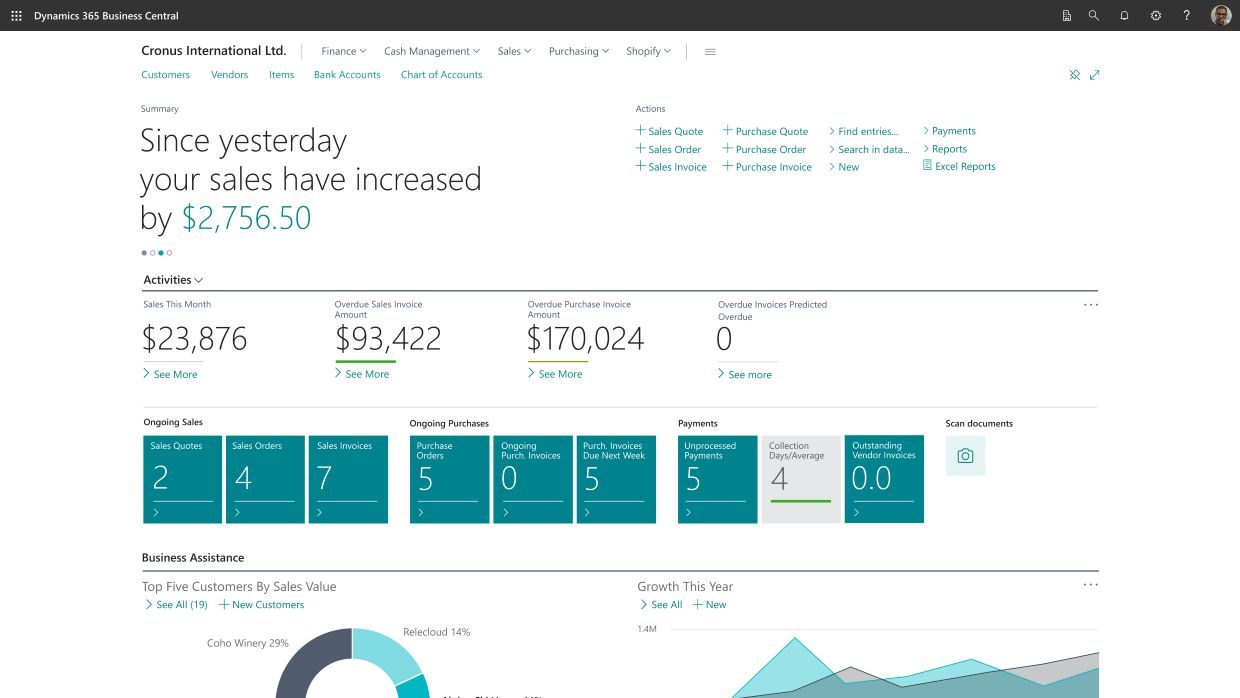
Before you start interviewing partners, it helps to see what the platform itself actually looks like in action.
Red Flags To Avoid When Choosing An ERP Software Distributor
Some warning signs come up early, if you know what to listen for.
No References In Your Industry
Or references who pick up the phone but answer vaguely. A partner who's done real distribution work will have clients happy to talk in detail about specific outcomes.
Pricing Is "We'll Scope It After We Win The Deal"
A serious partner can give you a realistic range based on your size and complexity before you sign anything. If they can't, they either don't know what they're doing or they're hiding something.
You Haven't Met The Actual Consultants
The sales rep is doing all the talking. The implementation team is who matters. Meet them, ask about their distribution experience, and trust your gut.
"Best Practices" With No Specifics
A partner who can't tell you exactly how they've adapted Business Central for a distributor with your challenges is selling a script, not expertise. Push for concrete examples.
Change Management Is An Afterthought
ERP implementations fail more often because users don't adopt the system than because the system doesn't work. A partner focused only on technical configuration is missing half the job.
No Named Project Manager
You're going to be working with that person for months. You should know who, and you should feel confident in them before the contract is signed.
Vague Post-Go-Live Support
Ask who you call at 7 a.m. when something breaks, what the response time is, and whether it's the same consultant who knows your setup or a generic help desk you'll have to re-explain everything to.

Questions To Ask Before You Sign With An ERP Software Distributor
Bring these to your final partner meeting. The answers tell you a lot.
- How many Business Central implementations have you done for distribution companies in Canada?
- Can I speak to two references in my industry, in my region?
- Who specifically will be on my project team, and can I meet them before signing?
- What's your fixed-fee versus time-and-materials breakdown, and what triggers a change order?
- What does your post-go-live support look like in months 4 through 12? What about year 2 and beyond?
- How do you handle Canadian tax setup, and have you done it for distributors selling into multiple provinces?
- What's your typical timeline for a company my size, and what causes timelines to slip?
- How do you train end users, and what's your approach to change management?
- What integrations have you built with EDI providers, eCommerce platforms, and shipping carriers we'd use?
- If we needed to add a new warehouse, a new sales channel, or a new country in year two, what would that look like?
The answers should be specific. If they're vague, you have your answer.
-
An ERP software distributor is the company that resells, configures, implements, and supports an ERP platform on behalf of the publisher. For Microsoft Dynamics 365 Business Central, the distributor is a certified Microsoft Partner who handles the project from scoping to post-go-live support.
Why Gestisoft Is The ERP Software Distributor Canadian Distributors Trust
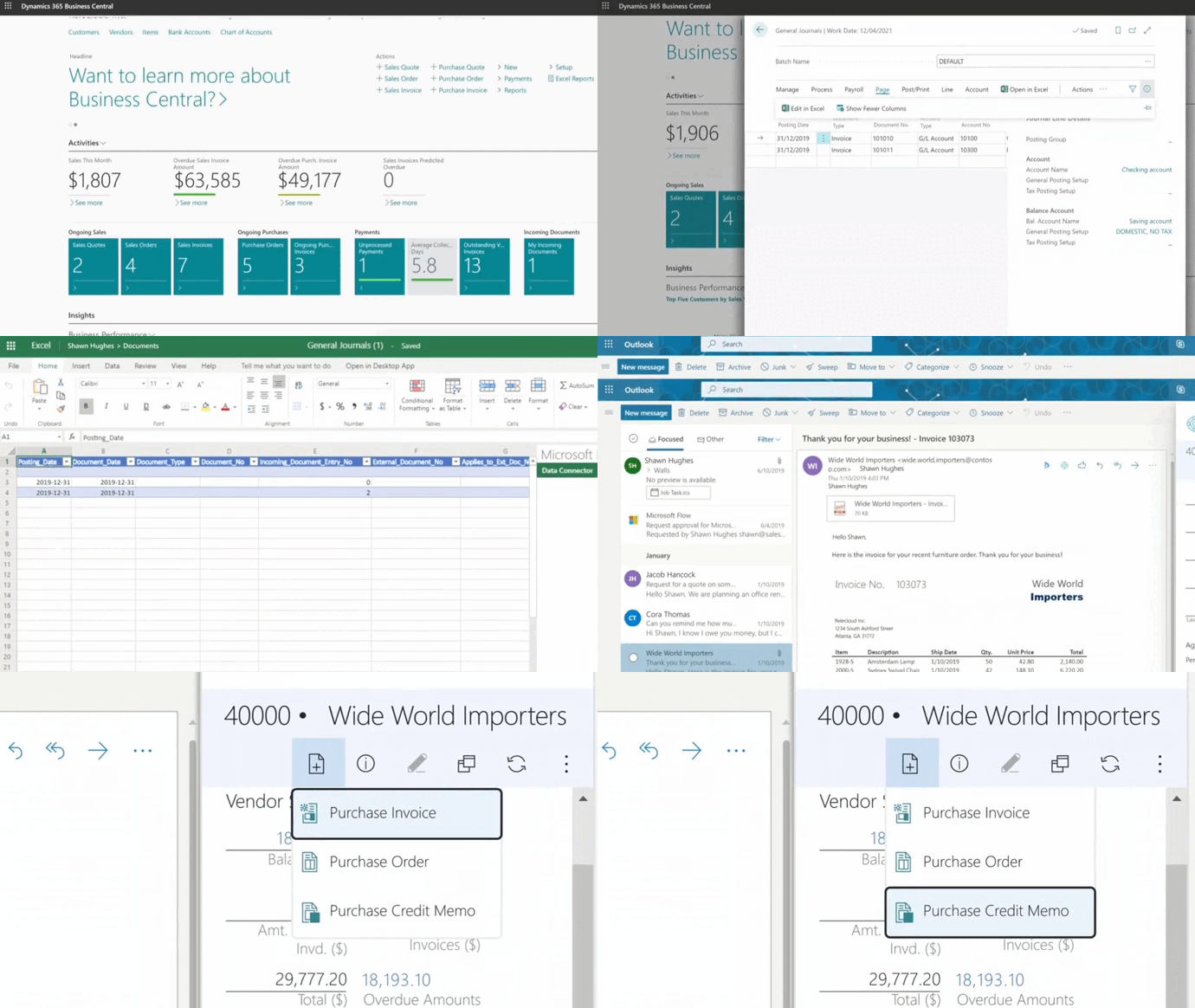
Gestisoft has been a certified Microsoft Partner since the early days of Dynamics. We're headquartered in Quebec with offices in Montreal, Toronto, Ottawa, and Quebec City, and we work in both English and French. Our entire focus is helping Canadian small and mid-sized businesses get real value from Microsoft Business Applications... Business Central, Dynamics 365 CRM, Copilot, and custom solutions like Legio and Civio.
For distribution companies specifically, we've configured Business Central for businesses handling everything from multi-warehouse consumer goods operations to industrial distributors with complex contract pricing.
We know the Canadian compliance landscape... GST, HST, QST, PST, T4s, EDI to Canadian retailers... because we live in it. Our team includes implementation consultants, support specialists, and trainers who stay with you long after go-live, not a help desk that doesn't know your setup.
Don't take our word for it. Here's what one of our clients had to say:
“The solution delivered to us has significantly improved our production visibility. We are now able to track our production in real time, and have more accurate data on the costs of each production run.”
We're also B Corp Certified, named one of Canada's Most Admired Corporate Cultures in 2023, and a Great Place to Work in Canada. None of those things implement your ERP, but they tell you something about how we work.
If you're evaluating an ERP software distributor for your distribution business, we'd be glad to be on your shortlist.
Put Gestisoft On Your ERP Partner Shortlist
Tell us about your operations and we'll show you exactly how Business Central could work for you, what it would cost, and what the timeline looks like. No pitch deck, just answers.
 Book a free consultation
Liked what you just read? Sharing is caring.

May 21, 2026 by Muhammad Ali Iqbal by Muhammad Ali Iqbal SEO Content Strategist & Copywriter
Driven by a passion for search engine optimization, strategic content, and conversion-focused writing. A copywriter and content strategist who lives for content that ranks, engages, and delivers real business results.
