

An ERP reseller is a certified partner who sells, implements, and supports ERP software on behalf of vendors like Microsoft. They act as your local guide, helping you choose the right system, configure it to fit your business, and train your team to use it well.
Choosing the right ERP reseller can make the difference between a smooth project and a costly headache. The right ERP reseller brings clear processes, accurate data, and systems that support growth. The wrong one brings delays, budget overruns, and frustrated teams.
This guide gives you 10 clear qualities to check before you sign with any partner. Whether you run a manufacturing plant, a distribution center, or a multi-location service business, use these criteria to compare options and choose one that fits your needs, budget, and culture.
Plan Your ERP Project With An Expert
Get clear on scope, budget, and timeline for your ERP project. Walk through your processes with a Gestisoft consultant and identify the right next steps with Microsoft Dynamics 365 Business Central.
 Free discovery call
Top 10 ERP Reseller Qualities To Check Before You Sign
These 10 qualities separate great partners from mediocre ones. Use them as your baseline when you meet with potential ERP resellers.
1- ERP reseller experience in your industry
Your business processes are not generic. A manufacturer tracks shop floor time. A distributor manages lot numbers and logistics. A professional services firm bills by project. Look for an ERP reseller with real experience in your industry.
Ask for case studies, client references, and similar projects. An ERP software consultant who understands your workflows can map your needs faster and with fewer mistakes.
If a partner has never worked in your sector, you will spend extra time explaining processes, and they may miss key requirements.
2- Clear ERP methodology and project plan
A good ERP project follows a clear path: discovery, design, configuration, testing, training, go‑live, and support. A strong partner explains this up front and walks you through each phase.
Ask:
- What does your discovery phase look like?
- How do you handle scope changes?
- Who leads the project?
- What checkpoints happen before go‑live?
If they cannot answer clearly, keep looking.
3- Certified expertise with your ERP platform
Certifications matter. When an ERP reseller holds official certifications for Microsoft Dynamics 365 Business Central, SAP, NetSuite, or another platform, it means their consultants have passed exams, completed training, and follow best practices set by the vendor.
Certified teams know:
- How to use standard features instead of custom code
- How updates and new releases affect your system
- Where to find help when something breaks
Ask for proof of certifications and confirm that the people working on your project, not just the company, hold those credentials.
4- Strong finance and operations understanding
ERP is not just software. It touches your chart of accounts, your inventory valuation methods, your approval workflows, and your compliance reports. An ERP specialist with accounting and operations experience can design a system that supports your finance team and your warehouse team at the same time.
Look for consultants who:
- Understand accrual vs. cash accounting
- Know how to handle multi-currency or inter-company transactions
- Can explain inventory costing methods (FIFO, weighted average, etc.)
- Speak your language, not just IT language
If your partner only knows the technical side, you will struggle to get the reports and controls you need.
5- Focus on change management and training
Most ERP projects fail because of people, not technology. Your team needs to learn new screens, workflows, and habits. A good ERP reseller plans for this from day one.
Ask how they handle:
- Training (live sessions, recorded videos, documentation)
- Super users (people on your team who learn the system deeply and help others)
- Support after go‑live (will someone be available when questions come up?)
If training is an afterthought, expect low adoption and high frustration.
6- Realistic timelines and budgets
Be careful with partners who promise fast timelines and low costs without asking many questions. ERP projects take time. A simple implementation for a small business might take 3 to 6 months. A more complex project with multiple locations, integrations, or custom needs can take 9 to 18 months.
A realistic partner will:
- Ask detailed questions before quoting
- Explain trade‑offs (e.g., "If we skip this feature now, we can go live faster and add it later")
- Build contingency into the plan
- Be honest about what fits your budget and what does not
If a quote feels too good to be true, it probably is.
7- ERP reseller honesty about limits and risks
A strong and honest ERP reseller will tell you "no" when something does not fit the system or your timeline. They will warn you about risks like data quality issues, integration challenges, or the need for process changes.
This honesty protects you. It prevents scope creep, reduces the chance of project failure, and sets realistic expectations with your team.
Look for a partner who:
- Points out where your current data needs cleanup
- Warns against heavy customization that could hurt future upgrades
- Recommends phased rollouts if your project is complex
If a vendor says "yes" to everything, they may not understand the real risks.
8- Strong support model and SLAs
Your ERP system will run your business every day. When something goes wrong, you need fast, reliable help. Before you sign, ask about:
- Support hours (business hours only, or 24/7?)
- Response times (how fast will they reply to urgent issues?)
- Support channels (phone, email, portal, chat?)
- Who will support you (a dedicated team, or a general queue?)
Make sure the support model fits your needs. If you operate across time zones or run weekend shifts, standard 9‑to‑5 support may not be enough.
9- Growth and roadmap support
Your business will change. You may add new products, open new locations, hire more people, or expand into new markets. Your ERP system and your partner need to grow with you.
Ask potential partners:
- Can the system scale as we add users and data?
- How easy is it to add new modules or features later?
- Do you help clients plan for future needs, or just the current project?
A good partner thinks beyond go‑live and helps you build a roadmap for the next 3 to 5 years.
10- Cultural fit and clear communication
You will work with your ERP reseller for months during the project and for years after go‑live. You need a partner who listens, explains things in plain language, and respects your team.
Pay attention during early meetings:
- Do they ask good questions, or do they just talk about features?
- Do they explain concepts clearly, or do they use jargon?
- Do they respect your timelines and budget constraints?
- Do your teams feel comfortable working together?
Cultural fit is hard to measure, but it matters. If something feels off early, trust your instinct.
Download 10 Key ERP Selection Criteria Guide
Download a practical guide that walks you through 10 essential criteria for selecting the right ERP system and partner for your business.

ERP Reseller Checklist To Compare Partners Side By Side
Now that you know the 10 qualities, turn them into a decision tool. Build a simple scorecard with one row for each quality and one column for each partner you are considering.
Here is how to use it:
Step 1: List the 10 qualities down the left side of a table.
Step 2: Add columns for Partner A, Partner B, and Partner C.
Step 3: After each meeting or demo, score each partner on each quality using a scale of 1 to 5:
- 1 = Weak or no evidence
- 3 = Meets the standard
- 5 = Exceeds the standard
Step 4: Add up the scores and compare. But do not just pick the highest number. Look at the pattern. For example:
- Partner A might score high on industry experience but low on support.
- Partner B might be strong on training but weak on project methodology.
- Partner C might be balanced across all areas.
Use this scorecard with your finance team, operations lead, and IT manager. Discuss strengths and gaps. Make a decision based on facts, not just feelings or price. The cheapest option is rarely the best option. Look for the partner who fits your needs, your culture, and your long‑term goals.
ERP Reseller Red Flags To Avoid Before It Is Too Late
Not every partner is a good fit. Watch for these warning signs when evaluating potential ERP reseller candidates.
Vague proposals with no clear scope
If a proposal does not list specific deliverables, timelines, or responsibilities, you have no way to hold the partner accountable. A good proposal clearly defines what is included, what is not, and who does what.
Few or no questions about your processes
A partner who does not ask detailed questions about how you work today cannot design a system that fits you tomorrow. Strong consultants ask about your chart of accounts, inventory flows, approval chains, and reporting needs.
No reference clients or case studies
Every good ERP reseller has happy clients they can share. If a partner cannot provide references or show examples of past projects, be cautious.
Pressure to sign quickly without proper discovery
ERP projects are big decisions. A partner who pushes you to sign before you have clarity on scope, timeline, and cost is not acting in your best interest.
Promising heavy customizations right away
Customizations are expensive, hard to maintain, and difficult to upgrade. A strong partner fits your needs to standard features first and only customizes when truly necessary.
No clear support structure or named contacts
You need to know who will help you after go‑live. If the partner cannot tell you how support works or who your main contact will be, that is a warning sign.
Too cheap or too fast
If a quote is far below others and promises an unrealistic timeline, be skeptical. Low prices often mean inexperienced consultants, hidden fees, or cut corners.
See how Microsoft Dynamics 365 Business Central works in a real demonstration.
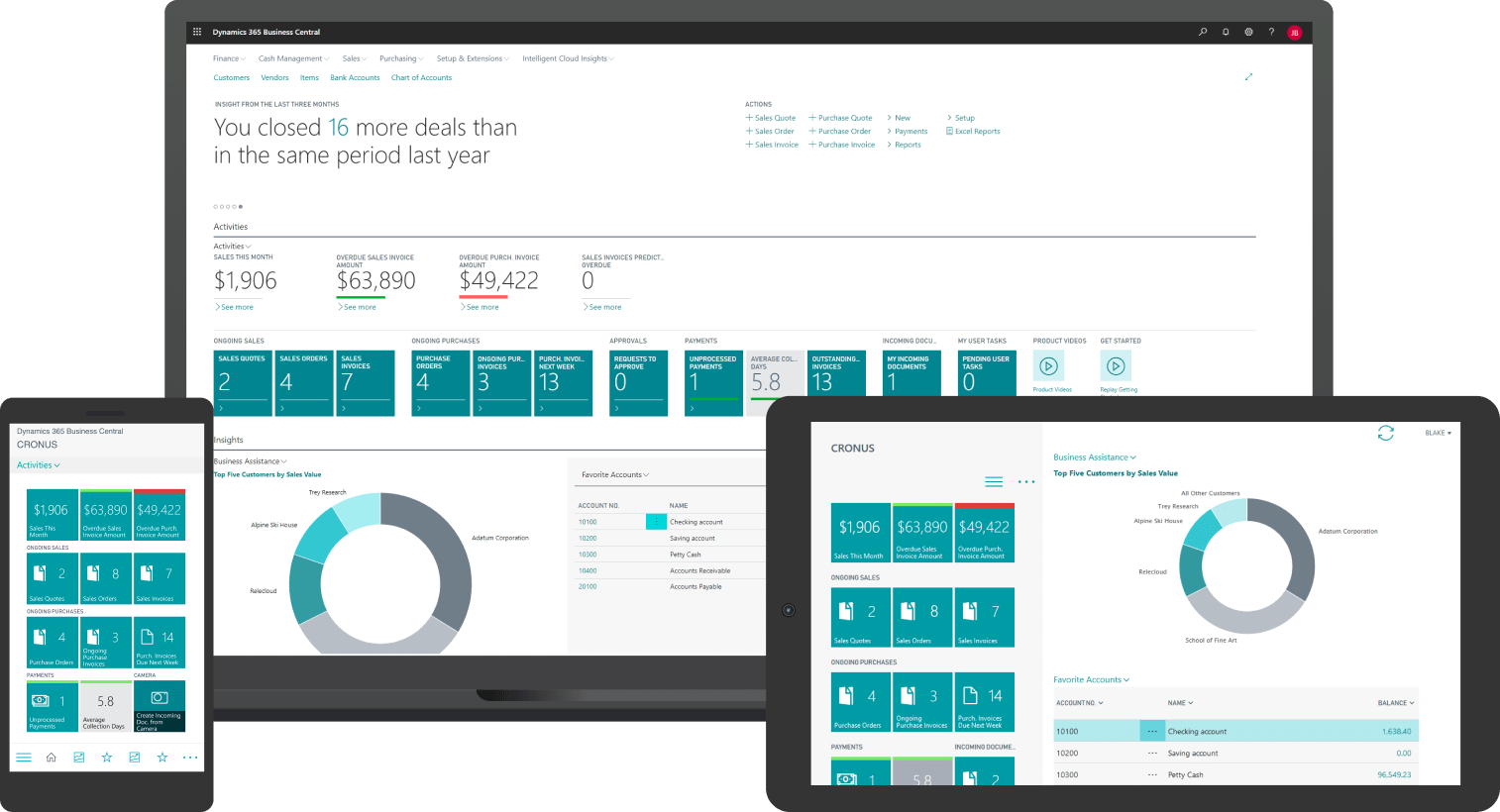
ERP Reseller And Microsoft Dynamics 365 Business Central: What To Expect
If you are evaluating Microsoft Dynamics 365 Business Central, you need an ERP reseller who knows the platform deeply and can guide you through implementation, training, and long-term optimization.
Business Central is a cloud‑first ERP built for small and mid‑sized businesses. It brings together finance, operations, sales, and service in one system and connects natively with Microsoft 365, Teams, Power BI, and Power Platform.
Here is what a strong Business Central ERP reseller should do…
Map your processes to standard features first
Business Central has powerful out‑of‑the‑box capabilities for accounting, inventory, purchasing, sales, and project management. A good partner shows you how standard features meet your needs first, keeping your system clean, easy to upgrade, and cost‑effective.
Use extensions and integrations only where needed
When standard features do not fit, Business Central offers extensions and Power Platform for custom workflows. A smart partner knows when to use these tools and when to adjust your process instead. For example, if you need advanced logistics management software capabilities, they might recommend a proven extension rather than building from scratch.
Help you build dashboards and reports
Business Central includes role‑based dashboards and built‑in reports. Your partner should help you configure these so your teams see the data they need without manual exports or spreadsheets.
Set realistic expectations
ERP will not fix broken processes overnight. It gives better visibility, cleaner data, and less manual work, but only with proper training, change management, and continuous improvement.
If you are in distribution and looking for the best ERP software for distribution, Business Central offers strong inventory, warehouse, and order management tools. Your partner should show you how these features apply to your industry.
-
An ERP reseller is a partner who sells, implements, and supports ERP software on behalf of vendors like Microsoft. They help businesses choose the right system, configure it, migrate data, train users, and provide ongoing support.

Why Gestisoft Is The ERP Reseller Partner That Fits
Gestisoft is a certified Microsoft Dynamics 365 Business Central ERP reseller serving businesses across Canada. We align with the 10 qualities in this guide and focus on realistic, long‑term success.
We bring industry experience in manufacturing, distribution, professional services, regulatory bodies, and municipalities. Our structured approach includes analysis, implementation, migration, optimization, support, and training. Our team holds Business Central certifications and stays current with product updates and best practices.
We help clients unlock strategic insights, streamline reporting, and use intelligent automation to reduce manual work through careful configuration and ongoing optimization. We offer support plans that keep your system running smoothly and provide optimization services as your business changes.
Gestisoft is B Corp certified and recognized as a Great Place to Work and one of Canada's Most Admired Corporate Cultures. We value listening, clear communication, and collaboration. We do not promise perfect results in 30 days. We promise a clear process, realistic timelines, skilled consultants, and a partnership that lasts.
Talk To Gestisoft About Your ERP Project
Discuss your current systems, key challenges, and goals with a Gestisoft consultant. Get a clear view of whether Microsoft Dynamics 365 Business Central and our team are the right fit.
 Free discovery call
Liked what you just read? Sharing is caring.

March 19, 2026 by Muhammad Ali Iqbal by Muhammad Ali Iqbal SEO Content Strategist & Copywriter
Driven by a passion for search engine optimization, strategic content, and conversion-focused writing. A copywriter and content strategist who lives for content that ranks, engages, and delivers real business results.
