

An ERP development company can either unlock your team's productivity or leave you stuck with a half-built system that nobody wants to use. The stakes are higher than most leaders realize at the start.
You're not just choosing software. You're choosing the partner who will map your actual workflows, migrate your data, train your people, and still be there when something breaks three months after go-live.
Most businesses waste weeks comparing vendor websites and sitting through generic demos. What actually matters? The questions you ask in the first call, the real project costs beyond the initial quote, and the warning signs that separate partners who deliver from those who disappear after go-live.
This guide gives you the selection framework, the budget ranges, and the red flags you need to know before you sign anything.
Get Your ERP Roadmap In One Call
Find out if Business Central fits your business, what it will really cost, and whether your timeline is realistic before you invest a dollar.
 Book a free consultation
What An ERP Development Company Really Does Today
Most people think "development" means coding everything from scratch. That's rarely the reality in 2026, especially with platforms like Business Central.
ERP Development Company Vs ERP Vendor Vs Consultant
Here's where confusion starts.
Microsoft is the ERP vendor. They build and maintain Business Central. An ERP development company like Gestisoft sits between you and Microsoft. They take the platform and turn it into something that fits your business.
A solo consultant might help with strategy, but an ERP development company handles the full lifecycle: discovery, configuration, custom extensions, integrations, data migration, training, and ongoing support. The role of an ERP software consultant includes strategic, functional, and technical responsibilities that blend throughout each project phase.
Core Jobs Of An ERP Development Company On A Real Project
Let's say you run a 60-person distribution company. You're juggling QuickBooks, spreadsheets for purchasing, another tool for inventory, and email threads for sales orders.
Process Mapping And Configuration
An ERP development company will start by mapping your actual processes... not the ones in the manual, but the ones your team actually follows. Then they'll configure Business Central modules for finance, sales, purchasing, and warehouse management.
Custom Extensions And Automation
Where the system doesn't quite match your workflow, they'll build extensions or connect Power Automate to handle approvals and notifications.
Data Migration And Historical Continuity
They'll also pull your historical data from those disconnected systems, clean it, and load it into Business Central so you don't lose visibility into past orders or vendor history.
Ongoing Support And Update Management
After go-live, they stay involved. Updates from Microsoft roll out regularly, and your development partner makes sure custom pieces still work. Support plans handle questions, troubleshooting, and ongoing optimization as your needs evolve.
When To Bring In An ERP Development Company For Your Business
Timing matters more than most leaders think. Wait too long, and you're managing chaos. Jump too early, and you might overspend on a system you're not ready to use.
Signs You Need An ERP Development Company Now
You know it's time when certain pain points become daily blockers, not occasional frustrations:
- Your finance team spends a full week closing the books each month because they're reconciling data across three different systems.
- Your warehouse can't tell you real-time stock levels without someone physically checking bins or calling around.
- Your sales team re-enters the same customer orders from email into QuickBooks, then again into a shipping tool... burning hours and introducing errors every single day.
- Critical business knowledge lives in one person's head. A manufacturer we know relied on one "master spreadsheet" that only two people understood. When one of them left, production planning nearly stopped.
That's the breaking point where spreadsheets become a business risk, not just an inconvenience.
Why An ERP Development Company Beats DIY Or Generic IT Help
Internal IT teams are great at keeping your network running and managing devices, but ERP projects require process expertise they don't usually have.
A generic software dev shop can build you something custom, but they won't know how to handle month-end close, lot tracking, or landed cost calculations.
An ERP development company brings repeatable methodology, templates, and a library of solved problems. They've seen what breaks during data migration, and they know how to train skeptical users who liked the old system just fine.
When comparing ERP consulting companies across different platforms, those with deep Business Central and industry focus reduce your project risk significantly.
10 Key ERP Selection Criteria
A free guide to help you compare ERP options using 10 clear criteria, so you can choose with confidence and avoid common selection traps.

How To Choose An ERP Development Company Without Regret
This is the part most buyers skip, then regret six months into the project when timelines slip and costs creep up.
Questions To Ask An ERP Development Company In Early Calls
Don't just ask generic questions. Push for specifics that reveal how they actually work:
- "Tell me about a project where things went wrong and what you did to fix it." Good partners won't pretend everything always goes perfectly. Listen for honesty and problem-solving, not excuses.
- "Who will actually be on my project team day to day?" You need to know the consultants doing the configuration and training, not just the VP who shows up for the sales pitch.
- "How do you handle Microsoft's regular updates when we have customizations?" A vague answer here is a red flag. You want a clear process for testing and managing changes.
- "How many Business Central projects have you taken from implementation to long-term support?" If they've done dozens of go-lives but most clients don't stay for support, that tells you something about how well those projects actually landed.
Many teams start by shortlisting firms that offer ERP consultancy services focused on their industry, especially in distribution and consumer goods, before narrowing down to the partner whose methodology and support model actually fit their reality.
Decision Criteria To Compare One ERP Development Company To Another
The right partner isn't always the one with the flashiest website or the longest client list. Look deeper.
Industry Expertise And Domain Knowledge
A partner who's built ERP for manufacturers understands bills of materials, shop floor data, and production costing. A partner who works with service firms knows project accounting and utilization tracking.
If they don't speak your language, you'll spend half the project explaining your business instead of building the solution.
Platform Depth And Technical Capability
You want a team that knows Business Central inside and out, not a shop that dabbles in five different ERPs and will "figure it out" on your dime.
Check their certifications, but also ask how they stay current with new features. Business Central evolves fast, and partners who don't keep up leave you stuck with outdated approaches.
Support Model And Long-Term Partnership
Some firms do the project and disappear. Others offer structured support plans with regular health checks and proactive guidance.
Think about what happens when your finance lead has a question at 4 p.m. on month-end close day. Will someone pick up, or will you wait three days for a ticket response?
Map Your ERP Budget With A Business Central Expert
Walk through modules, integrations, and realistic budget ranges so you can take a solid plan to your board.
 Book a free consultation
ERP Development Company Costs, Timelines, And Project Risks
Let's talk real numbers, not "it depends" answers.
Typical Budget Ranges With An ERP Development Company
Discovery and roadmap work typically runs between $8,000 and $20,000, depending on how many locations and processes you're mapping.
For a mid-sized Canadian business rolling out Business Central for finance, sales, purchasing, and basic inventory, expect initial implementation costs in the $60,000 to $150,000 range. That includes configuration, training, and data migration for a single entity with straightforward workflows.
Add integrations like ecommerce, CRM, warehouse management systems, or payroll, and each one adds $10,000 to $40,000 depending on complexity.
Data migration can be deceptively expensive if your legacy data is messy. If you're pulling from multiple old systems and need historical reporting, plan for serious cleansing time.
Ongoing support typically runs 15 to 25 percent of your implementation cost per year. So if your project was $100,000, budget $15,000 to $25,000 annually for support, updates, and optimization.
If distribution is a big part of your world, understanding how Business Central handles ERP distribution scenarios like multi-warehouse stock, complex pricing, and EDI becomes essential before you finalize your partner choice.
How An ERP Development Company Can Reduce (Or Increase) Project Risk
The wrong partner can turn a six-month project into an 18-month nightmare. Here's where risk lives.
Timeline Realism And Pilot Testing
Unrealistic timelines kill more projects than technical problems. A partner who promises a three-month implementation for a complex multi-location business is either inexperienced or dishonest. Good partners push back on dangerous deadlines and insist on time for pilot runs and user testing.
Here's a common scenario: a manufacturing company wants to go live before their busy season, giving the ERP development company only 10 weeks. A responsible partner will push back and extend the timeline by four weeks to allow for proper training and a pilot with the production team.
That extra time prevents disasters. Without it, teams end up entering live orders into a system they don't understand, right in the middle of their highest-volume period.
Customization Strategy And Technical Debt
Some partners over-customize because it's billable. Others under-customize and leave you forcing your workflows into rigid software.
The best partners find the middle. They configure the platform fully, customize only where it creates real business value, and use Power Platform tools for workflow automation instead of heavy custom code.
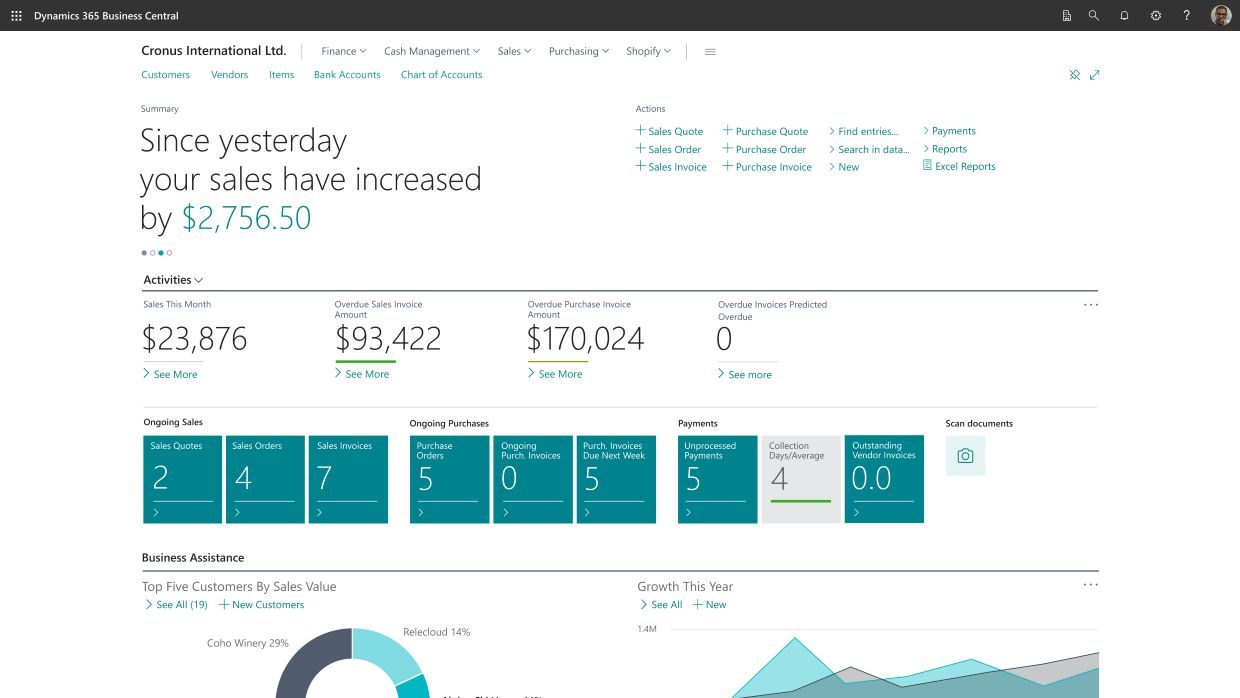
To see how the system looks in real life, watch this short Microsoft Dynamics 365 Business Central demo.
ERP Development Company Role With Microsoft Dynamics 365 Business Central
Business Central is the engine. Your ERP development company is the team that tunes it to your business.
What An ERP Development Company Adds On Top Of Business Central
Microsoft provides robust core modules for financials, sales, purchasing, inventory, and project management. But out of the box, Business Central doesn't know how your approval process works, or how your pricing varies by customer tier, or how you track commissions.
An ERP development company configures those business rules, builds extensions where needed, and connects Business Central to your other tools.
For example, manufacturers often need real-time production visibility and accurate job costing. Distributors need multi-warehouse stock management and integration with EDI systems.
Service firms and regulatory bodies need project accounting and complex approval workflows. Some ERP development companies, like Gestisoft, also build specialized apps on top of Business Central and Microsoft's cloud, such as LEGIO for membership management or CIVIO for citizen request management, which shows the depth of what's possible when you pair the platform with domain expertise.
The broader Microsoft competitive advantage comes from cloud scale, AI integration, and tight connections between Business Central, Power BI, Teams, and other tools that reduce ERP risk for growing businesses.
Real Business Central Scenarios An ERP Development Company Solves
Let's say you're migrating from an old on-premise ERP and QuickBooks. Your development partner will extract historical transactions, clean duplicate records, map your old chart of accounts to Business Central's structure, and load everything so you maintain reporting continuity.
They'll also set up integrations... maybe Shopify for ecommerce orders, a WMS for warehouse operations, and your payroll system so employee data flows automatically.
Another common scenario: automating approvals. Your purchase orders above $5,000 need CFO sign-off, and expense reports need manager approval before they hit accounting.
An ERP development company will use Power Automate to route those requests, send notifications, and log every decision for audit trails.
Why Gestisoft Is The ERP Development Company For Business Central Projects
Gestisoft focuses exclusively on Microsoft Dynamics 365 Business Central, with deep expertise in manufacturing, distribution, fashion and apparel, regulatory bodies, municipalities, and professional services.
The team works across North America, with offices in Montreal, Toronto, Ottawa, and Québec, supporting projects in both English and French. Our services cover the full lifecycle: business analysis, implementation, migration from legacy systems, support plans, optimization, training, and pay-per-session workshops.
As a certified Microsoft partner, B Corp, and Great Place to Work recipient, Gestisoft's team stability matters because ERP projects succeed when your partner's consultants aren't constantly turning over.
Here's what one client says about working with Gestisoft:
“Anytime I have requests, I've never had a problem with Gestisoft's team. I always get quick answers, and we always manage to solve what we wanted to solve.”
You can read the full Groupe UP customer story to see how this kind of support plays out in a real Business Central implementation.
When you work with Gestisoft, you're not getting a generalist who dabbles in ERP. You're getting a team that lives and breathes Business Central every day.
Plan Your Business Central Project With Gestisoft
Stop wasting time on disconnected systems and gain clarity to confidently present a realistic budget and timeline to your board.
 Book a free consultation
Liked what you just read? Sharing is caring.

May 19, 2026 by Muhammad Ali Iqbal by Muhammad Ali Iqbal SEO Content Strategist & Copywriter
Driven by a passion for search engine optimization, strategic content, and conversion-focused writing. A copywriter and content strategist who lives for content that ranks, engages, and delivers real business results.
