
A consumer goods ERP is the system that quietly runs a CPG company once spreadsheets stop being enough. It keeps inventory honest across every channel you sell on, tracks money in and out, handles orders from retail and e-commerce in the same place, and gives your team one version of the truth instead of five.
For Canadian CPG companies juggling Loblaws POs, Shopify orders, and a warehouse running on paper picks, the right system is the difference between a chaotic Monday and a calm one.
This guide is for operators, finance leads, and owners trying to figure out if they actually need a consumer goods ERP, what it should do, what it costs in time and money, and how to pick the partner who'll implement it.
Talk to a Consumer Goods ERP Expert
Get clarity on whether your business is ready, which Business Central setup fits your channels and SKU volume, and what a realistic timeline looks like for your team.
 Free discovery call
What a Consumer Goods ERP Actually Does
A consumer goods ERP pulls together the moving parts of a CPG business into one system. Finance, inventory, sales orders, purchasing, warehouse, and reporting all live in the same place. The point isn't software for the sake of software. The point is that your team stops re-typing the same order in three tools.
How a Consumer Goods ERP Connects Your Sales Channels
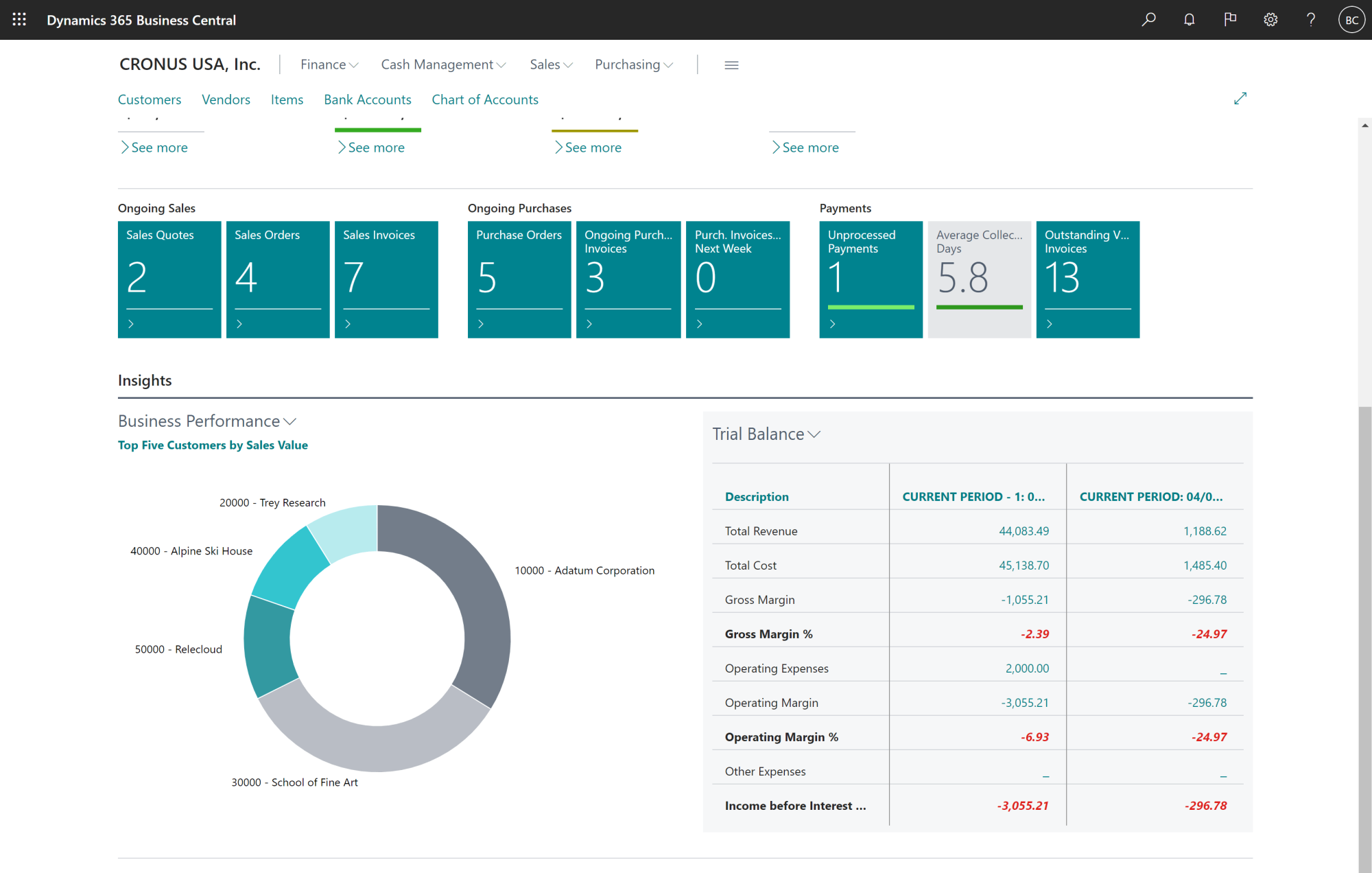
Most CPG companies don't sell through one channel anymore. You might have wholesale to grocery chains, your own Shopify store, a few marketplace listings, and B2B accounts that order by email. Each one creates a record somewhere. A modern system makes them all post to the same inventory and the same general ledger, so when a unit ships out the door, every channel knows.
That matters because the alternative is messy. Without one in place, you get oversells (two channels promise the same unit), undersells (you have stock but the website doesn't know), and end-of-month reconciliation that takes a week. With a proper system in place, your ERP distribution software becomes the single source of truth and the rest of your stack plugs into it.
Why Consumer Goods ERP Inventory Tracking Is Different
Generic ERP tracks inventory. A consumer goods ERP tracks the kind of inventory a CPG company actually has. That means lots and batch numbers for food, beverages, cosmetics, or supplements. Expiry dates with FEFO (first expired, first out) picking rules. Kitting and bundling for product variants. Landed cost tracking so you know the true margin on imported goods after duty and freight.
If you sell a product with an expiry date and your current system doesn't enforce FEFO at picking, you're sending out short-dated stock and your warehouse team is the one absorbing it. A proper system handles this in the background.
When Spreadsheets Stop Working: Signs You Need a Consumer Goods ERP
There's no clean revenue threshold that says "you need ERP now." The triggers are operational, not financial. You'll usually hit two or three of these before someone in the room says it out loud.
The Operational Triggers That Push CPG Teams to Move
The signs are pretty consistent. Order entry takes longer every quarter because the team is keying the same data into multiple systems. Stock levels never quite agree across QuickBooks, your e-commerce platform, and the spreadsheet your warehouse manager keeps. Month-end close stretches from three days to two weeks. Retailers start hitting you with chargebacks for short ships or late deliveries, and nobody can trace which PO went wrong.
Your Team Is Doing the System's Job
You've hired someone whose actual job is copying and pasting between tools. That role exists because your tools don't talk to each other. It's a sign the manual layer has grown bigger than the systems underneath it.
Simple Questions Take Too Long to Answer
"What's our true margin on our top 10 SKUs this quarter?" If that question takes a week and four spreadsheets, your tools are the bottleneck. A modern ERP answers it in a dashboard.
Customer Promises Are Getting Risky
Sales is promising delivery dates the warehouse can't actually hit. The disconnect between what you sell and what you can ship is widening. That's the moment the cost of not having ERP starts showing up in lost accounts, and the moment when free software for distribution business tools clearly stop being enough.
What to Look for in a Consumer Goods ERP
Not every ERP fits a consumer goods business. Some are built for manufacturing job shops, some for professional services, some for retail with cash registers. The CPG stack has its own non-negotiables.
Must-Have Features in Any Consumer Goods ERP
Here's what actually matters when you're evaluating a system, in plain language:
- Multi-channel order management. Orders from EDI, e-commerce, marketplaces, and direct B2B all flow into one queue.
- Real-time inventory across locations. No batch updates. When a unit moves, the system knows immediately.
- Lot, batch, and expiry tracking. Non-negotiable if you sell anything perishable or regulated.
- EDI capability. If you sell to major Canadian retailers, you'll need this on day one, not as a phase-three project.
- Landed cost. True margin requires knowing the full cost of a product after duty, freight, and brokerage.
- Warehouse management. Bin-level tracking, barcode scanning, and directed picking. Paper picks don't scale past a certain point.
- Power BI or equivalent reporting. You need to slice margins by SKU, channel, and customer without hiring a developer.
- Microsoft 365 and Shopify integration. Most CPG teams already live in Excel, Outlook, and Shopify. Your system should connect to them, not fight them.
Anything missing from this list, you'll be paying to add later. Get it sorted before the contract is signed.
Talk to a Consumer Goods ERP Specialist
See exactly which features your business needs today, which can wait, and what a fixed-scope implementation looks like for a company your size.
 Free discovery call
What a Consumer Goods ERP Costs and What You Get Back
Pricing for a consumer goods ERP varies wildly depending on size, complexity, and how the project is scoped. For a small to mid-sized Canadian CPG company moving from spreadsheets to Microsoft Dynamics 365 Business Central, you're looking at two cost layers. First, the software licenses themselves, which are per-user, per-month. Second, the implementation, which is where the real variation happens.
For a typical Canadian SMB distributor, the total first-year investment (including licensing, implementation, migration, and training) generally lands between $40,000 and $150,000 CAD (or even more depending on various factors).
A clean, well-scoped implementation for a CPG distributor with one warehouse and a few sales channels typically runs three to five months. More complex setups, with multiple warehouses, advanced MRP, or heavy customization, can stretch longer. Some partners offer fixed-fee packaged implementations specifically for consumer goods distribution, which removes the budget anxiety that usually comes with these projects.
On the return side, the gains aren't theoretical. CPG companies that move off spreadsheets typically consolidate four to six disconnected tools into one distribution management software platform. Order entry time drops. Inventory accuracy climbs from "rough guess" to "we trust the number." Month-end close shortens. Chargebacks fall because shipments are more accurate.
The investment usually pays back within two years, sometimes faster if the team was burning hours on manual reconciliation.
Want to see what a real Business Central setup looks like? This walkthrough covers the basics quickly.
Consumer Goods ERP Realities Specific to Canadian Companies
Canadian CPG companies have a few realities that often get ignored. Worth flagging if you're shopping for a system.
Tax, Compliance, and Reporting Built for Canada
GST and HST handling has to be right out of the box, including the provincial variations. QST in Québec works differently and your system needs to handle it properly, not as a workaround.
CRA-compliant reporting matters, especially for audit trails on receivables and payables. Microsoft Dynamics 365 Business Central handles all of this natively, which is one of the reasons it shows up so often in Canadian SMB shortlists.
Bilingual Operations and Local Support
If your team is bilingual, your system needs to be too, with the interface, reports, and email templates available in French and English. Local partner support in the same time zone also matters more than people admit when something breaks at month-end.
Cross-Border Sourcing and Sales
A lot of Canadian CPG companies source from the US or China and sell into both Canada and the US. Multi-currency, landed cost with duty calculations, and customs documentation all have to work cleanly. Microsoft's competitive advantage in the SMB space is partly because of how well these Canadian and cross-border pieces are built in.
Retail Compliance With Canadian Grocers
Major Canadian grocers and pharmacies have specific EDI requirements, label specs, and delivery windows. A system that doesn't speak EDI fluently will cost you in chargebacks within six months.
Get the Cloud ERP Playbook for Consumer Goods Teams
See the five reasons most CPG companies move from on-premise tools and spreadsheets to cloud ERP, what they gain in visibility and speed, and what to watch out for during the move.

How to Pick a Consumer Goods ERP Implementation Partner
The software is only half the project. The partner who implements it is the other half, and arguably the bigger half. The right ERP software consultant understands your industry before they understand your software. They've shipped projects for companies that look like yours. They ask questions about your operations, not just your IT setup.
Industry Experience That Actually Matches Yours
Generic ERP credentials aren't enough. You want a partner who has shipped projects for CPG distributors with multi-channel selling and the inventory complexity that comes with it. Ask for specific examples and talk to references. If their case studies are all manufacturing job shops or pure retail with no CPG names, keep looking.
A Clear Implementation Methodology
You want a structured plan with named phases, not "we'll figure it out as we go." A good partner will walk you through discovery, configuration, data migration, testing, and go-live support before you sign. If they can't draw the project on a whiteboard in fifteen minutes, that's a sign.
Local Presence and Bilingual Capability
If your team is bilingual or operates in Québec, a partner who works in French and understands Canadian compliance is worth more than a cheaper offshore option. Time zones matter when something breaks at month-end close. So does shared business culture.
Post-Go-Live Support That Sticks Around
The hard part is not the go-live. It's the six months after, when your team is still learning and edge cases are still surfacing. Confirm what support looks like after launch, who you call, and what's included versus what costs extra.
Fixed-Fee or Fixed-Scope Pricing
Open-ended time-and-materials contracts are how ERP projects go over budget. A partner who offers a fixed-fee or fixed-scope option for the implementation has done this enough times to know what it should cost. That's a signal of maturity, not rigidity.
Red Flags to Walk Away From
- Partners who promise unrealistic timelines (six weeks to full ERP go-live for a multi-channel CPG company is almost never real).
- Partners who never mention change management.
- Partners whose case studies are all manufacturing or pure retail.
The good ERP consultant firms will happily talk through methodology, references, and pricing before you sign.
-
A consumer goods ERP is an enterprise resource planning system built or configured for CPG companies. It handles finance, multi-channel inventory, sales orders, purchasing, warehouse operations, and reporting. The key difference from generic ERP is support for CPG-specific features like lot and batch tracking, expiry management, EDI for retail compliance, and landed cost.
Why Gestisoft Is the Right Partner for Your Consumer Goods ERP
Gestisoft is a Canadian Microsoft Partner with over twenty-five years of experience implementing Microsoft Dynamics 365 Business Central for CPG distributors and other SMBs. We work with clients in North America, have a team that speaks two languages, and are certified by Microsoft, B Corp, and Great Place to Work.
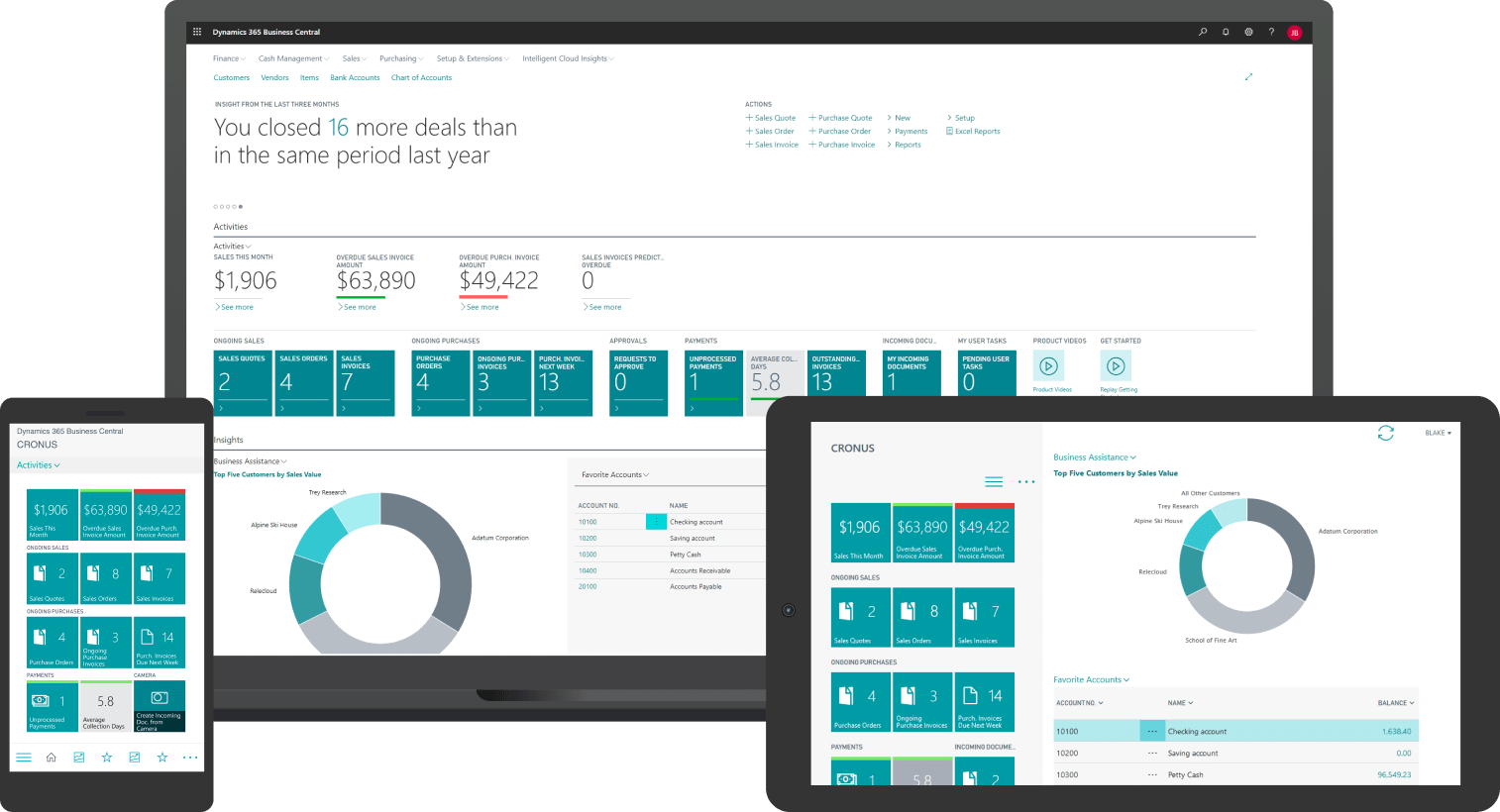
What's different about working with Gestisoft on your consumer goods ERP project is that the implementation is productized. We offer fixed-fee packaged implementations specifically designed for CPG distribution, with structured tiers built around what growing companies actually need: core finance, multi-channel sales, warehouse automation, advanced shipping, multi-warehouse support, MRP, and Power BI dashboards. You see the scope, the price, and the timeline before the project starts.
We also know the Canadian piece, which a lot of US-based partners don't. GST, HST, QST, bilingual interface, CRA-compliant reporting, EDI for Canadian grocers and pharmacies, and Shopify integration are all standard parts of what we deliver, not custom work bolted on after the fact.
Here's what one of our long-term clients has to say:
“As a customer since 2015, I would like to highlight the quality of support and expertise provided by Gestisoft for our Business Central application. Their competence is notable and has greatly contributed to the success of my business. I highly recommend them as a service provider for Business Central.”
Ready to see if it's a fit? Book a free discovery call and we'll walk through your operations together.
Get Your Consumer Goods ERP Roadmap
Walk through your channels, SKU volume, and current pain points with a Business Central specialist and leave with a clear next step.
 Free discovery call
Liked what you just read? Sharing is caring.

May 22, 2026 by Muhammad Ali Iqbal by Muhammad Ali Iqbal SEO Content Strategist & Copywriter
Driven by a passion for search engine optimization, strategic content, and conversion-focused writing. A copywriter and content strategist who lives for content that ranks, engages, and delivers real business results.
