

Picking from the best NetSuite ERP alternatives feels easy until you start comparing real quotes, real timelines, and real implementation scopes side by side. The shortlist gets messy fast.
Most "best of" lists hand you ten vendor names with one paragraph each. That's not enough to make a six-figure decision. Canadian SMBs need more than that. You need to know which platforms actually fit your size, which ones run cleanly with CAD, GST, QST, and HST, and which ones have real support coverage once the contract is signed.
This guide is built from the perspective of a Microsoft Partner that has helped Canadian businesses migrate to, away from, and around big ERP platforms since 1997. Here are eight options worth your time, plus the criteria that separate the right pick from a costly mistake.
Talk to an ERP Expert Before You Shortlist
Our team has walked through this evaluation with hundreds of Canadian SMBs. Get a candid view of what fits your operations before you sit through more demos.
 Book a free consultation
The 8 Best NetSuite ERP Alternatives for Growing Businesses
Each of these NetSuite ERP alternatives plays a different role in the market. Some compete head-on. Others suit a narrower buyer. Read the trade-offs before falling in love with a demo.
1. Microsoft Dynamics 365 Business Central
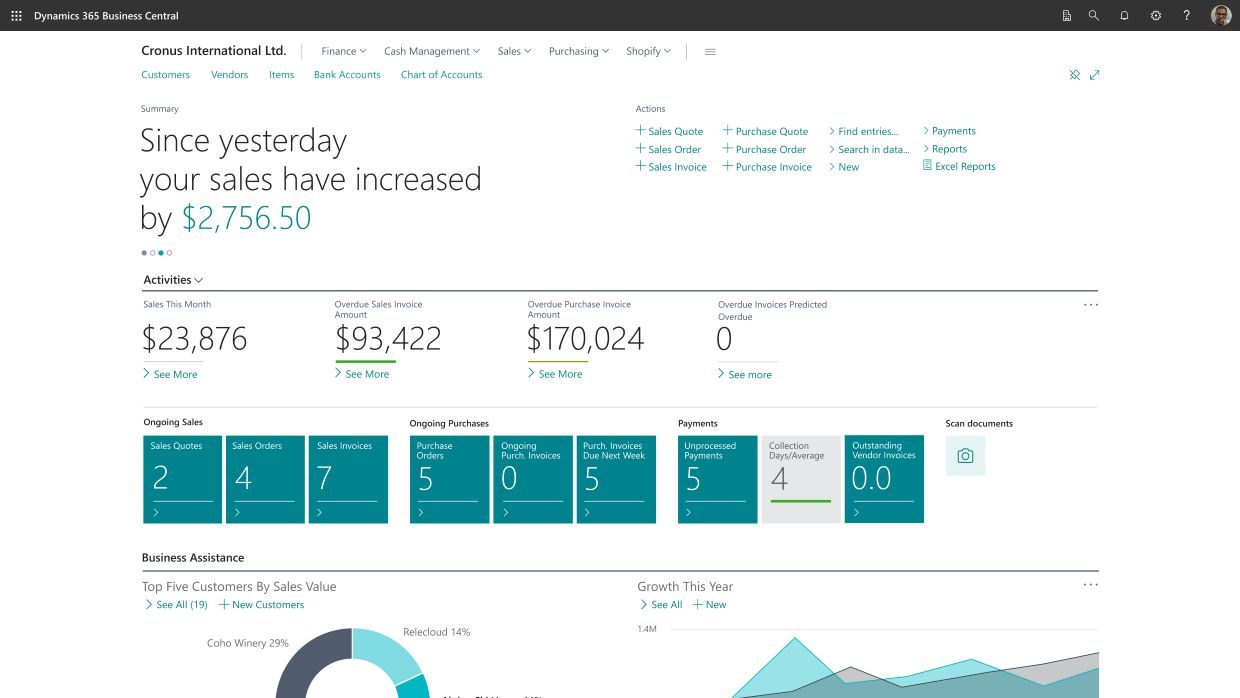
Business Central is the closest like-for-like swap for NetSuite among small and mid-sized companies, especially Microsoft 365 shops. It covers finance, inventory, sales, purchasing, projects, and on the Premium tier, manufacturing and service.
List price is USD $80 (CAD $108.50) per user per month for Essentials and USD $110 (CAD $149.20) for Premium. See our NetSuite vs Dynamics 365 Business Central comparison for the head-to-head.
2. Acumatica Cloud ERP
Acumatica's pull is its resource-based licensing rather than per-user fees. That changes the math when you want broad access for warehouse, field, or shop floor staff without a per-seat bill.
It has solid editions for distribution, manufacturing, construction, and retail. Implementation depth varies a lot by industry, so scope the quote line by line. Customer support is partner-led, similar to Business Central.
3. SAP Business One
SAP Business One targets small and mid-sized companies that want the SAP name without S/4HANA complexity. Strong in distribution and light manufacturing, with native multi-currency, multi-language, and a wide global partner network.
Reporting is functional but often gets paired with third-party BI. Pricing is partner-quoted, and contracts can lock in three-year terms. See the SAP competitors landscape for more depth.
4. Sage Intacct
Sage Intacct is finance-first, not full ERP. It shines for accounting-heavy organizations, multi-entity consolidations, nonprofits, and professional services firms where dimensional reporting matters more than warehouse or production depth.
If your operations side is light and your CFO wants real audit trails and clean consolidations, Intacct delivers. Plan to layer other tools for inventory, CRM, or manufacturing, since native coverage in those areas remains thin.
5. Odoo
Odoo is the modular, budget-conscious option, with free Community and paid Enterprise editions. The catch is the technical lift: customization, hosting, and integration usually need developer support, and the Canadian partner network is uneven.
Our Odoo vs Business Central guide concludes Odoo is cheaper at entry but often costlier long-term, while Business Central suits 25-to-500-user SMBs needing reliable financials and Microsoft integration.
6. Workday Financial Management
Workday Financials targets larger mid-market and enterprise finance teams, often paired with Workday HCM. The platform is strong on reporting, planning, and analytics, with a single data model across finance and HR.
It's a heavier commitment than NetSuite both in cost and in change management. Among NetSuite ERP alternatives, Workday is rarely a fit for sub-100-employee Canadian businesses, but the right one for finance-heavy services and SaaS firms.
7. Epicor Kinetic
Epicor Kinetic is a manufacturing-and-distribution-first ERP with deep shop floor functionality. Job costing, MRP, scheduling, and quality are mature out of the box.
The interface has modernized considerably in recent releases. Best for product-driven businesses where production visibility matters more than finance sophistication. Implementation is partner-led and benefits from sector-specific expertise.
8. Oracle Fusion Cloud ERP
Oracle's enterprise SaaS ERP sits alongside NetSuite in Oracle's portfolio after the 2016 acquisition, targeting larger organizations than NetSuite typically serves. Oracle Fusion Cloud ERP suits multi-entity enterprises with complex global finance, procurement, and project accounting needs.
Implementation timelines stretch into quarters and cost rises with scale. It's rarely right for a 50-person Canadian SMB. See our broader take on Oracle competitors and alternatives.
Get a Side-by-Side Comparison Built for Your Business
We'll walk through your current NetSuite setup, costs, and pain points, then map what a transition to a better-fit platform would actually look like.
 Free discovery call
Why Buyers Look at NetSuite ERP Alternatives in the First Place
Reasons for evaluating other options are rarely about features alone. They tend to cluster around cost, customization, and coverage. Here are the patterns we see most often with Canadian SMBs.
NetSuite Pricing Keeps Climbing at Every Renewal
The first contract usually looks reasonable. The third one stings. NetSuite renewals often arrive with steep increases tied to user growth, storage, and new modules.
For mid-market buyers, the predictability problem is what pushes them to look. Other NetSuite ERP alternatives publish list prices (like Business Central) or use clearer scaling models, which makes multi-year budgeting less painful.
The Module Tax That Inflates the Real Cost
NetSuite is modular by design. That sounds flexible until you add advanced inventory, fixed assets, revenue recognition, or warehouse management. Each one adds a line.
By year two, finance teams comparing total spend to other NetSuite ERP alternatives sometimes find the gap is wider than expected, especially when the bundled features inside Business Central Essentials or Premium would have covered the same ground.
Customizations That Need Outside Consultants
Small changes inside NetSuite frequently need SuiteScript work or a consultant on retainer. The platform is powerful, but it isn't a system most internal admins can casually modify.
Other NetSuite ERP alternatives, including Business Central and Acumatica, lean on low-code extensions and configuration that internal teams can handle. That changes the long-term cost of small process tweaks.
Canadian Support, Bilingual Coverage, and Local Tax Gaps
For Canadian SMBs, three things matter beyond features: French language coverage, multi-jurisdiction tax (GST, HST, QST, PST), and a partner who answers the phone in Eastern Time.
NetSuite handles Canadian tax adequately, but support hours and bilingual capability vary by partner. Several NetSuite ERP alternatives have stronger Canadian footprints, which can be the deciding factor for Quebec-based operations.
How to Compare NetSuite ERP Alternatives Without Regret
Picking the right option is less about ranking and more about matching. The criteria below cover what actually separates a smooth implementation from a budget overrun.
Total Cost Over Three to Five Years, Not Just Year One
License fees are the visible cost. Implementation, integrations, training, support, and add-ons are the hidden ones. Budget at three to five times your first-year license cost as a realistic total investment, and ask each vendor to break out renewal projections in writing.
Among the eight NetSuite ERP alternatives above, the ones with published list pricing and predictable scaling reduce the negotiation tax considerably.
Deployment Fits With Your Existing Tech Stack
If your team lives in Outlook, Excel, Teams, and Power BI, an ERP that integrates natively cuts adoption friction significantly. If you're on Google Workspace and Slack, the math changes.
Look at where your data already sits, what your finance team exports to today, and which platform reduces the number of bridges to maintain. The right choice closes integration gaps, not opens new ones.
Native Multi-Currency and Bilingual Support for Canada
Multi-currency handling, French language interface, GST/HST/QST/PST tax engines, and Canadian payroll integration are non-negotiable for most Canadian SMBs. Some NetSuite ERP alternatives treat Canada as an afterthought localization.
Others are deployed across hundreds of Canadian businesses. Verify before signing: ask for client references in your province, in your language, and in your industry.
Partner Ecosystem and Long-Term Support
You aren't buying the software, you're buying the relationship with whoever implements and supports it. Ask how long they've worked with the platform, where their support team is based, and what their average ticket response time looks like. A great product paired with a weak partner is a worse outcome than a B-grade product with a strong one.
Industry Depth Beyond Generic Financials
If you manufacture, distribute, or run field service, the demo needs to show your specific scenarios. Job costing for ETO manufacturers. Lot tracking for food. Multi-warehouse for wholesale. Generic financial flows are easy. Industry-specific workflows are where most ERP platforms either shine or stumble.
Our Business Central alternatives guide digs into how to evaluate this fit…
Get the 10 Key ERP Selection Criteria Guide
Walk through the 10 criteria that matter most when picking an ERP, so your selection process stays focused on what actually predicts a successful project.

Matching NetSuite ERP Alternatives to Your Business Size and Industry
Not every option suits every buyer. Here is how the eight platforms line up by business profile so you can shortlist faster.
Best NetSuite ERP Alternatives for Small Canadian Businesses
For companies under 50 users and CAD $20M in revenue, the sweet spot is Business Central or Acumatica. Both scale cleanly from small teams into mid-market without a re-platform.
Odoo can work if you have technical resources in-house and want to control costs. Sage Intacct fits if your priority is finance reporting and operations live in other systems. Avoid Oracle Fusion and Workday at this size.
Best NetSuite ERP Alternatives for Mid-Market and Multi-Entity Teams
For 50 to 500 users, multi-entity consolidations, and CAD $20M to $500M in revenue, the realistic shortlist narrows to Business Central, Acumatica, Sage Intacct, and SAP Business One.
Workday and Oracle Fusion enter the conversation for finance-heavy services firms with complex global structures. Each of these NetSuite ERP alternatives has its sweet spot. The match depends on whether you lead with finance, operations, or industry verticals.
Best NetSuite ERP Alternatives for Manufacturers and Distributors
Product-driven businesses need real production and warehouse functionality, not finance with a bolt-on. Business Central Premium, Epicor Kinetic, Acumatica Manufacturing, and SAP Business One are the strongest NetSuite ERP alternatives here.
The deciding factor is usually production complexity: discrete versus process, make-to-order versus make-to-stock, and how deeply your shop floor needs to integrate with planning and quality.
Curious what one of these NetSuite ERP alternatives actually looks like in practice? Here's a short Business Central walkthrough that shows how the interface feels in day-to-day use.
Migration Realities Across the Top NetSuite ERP Alternatives
Migration is where ERP projects gain or lose their reputation. The technical lift is real, but the human side is where most teams stumble. Here is what to plan for across any of these platforms.
How Long an ERP Migration Actually Takes
Most migrations from NetSuite to another platform run six to nine months end to end. Smaller, finance-only deployments can close in four. Larger, multi-entity manufacturing rollouts can stretch past twelve.
The variables are data complexity, integration count, customization depth, and how much your team can dedicate during the project. Vendors who quote three months for a full ERP swap are usually quoting a partial scope.
What Data Cleanup Looks Like Before Go-Live
Garbage in, garbage out. Most NetSuite environments have years of accumulated test data, deprecated SKUs, duplicate customers, and unused custom fields.
Before you migrate, run an inventory of what to keep, what to archive, and what to leave behind. Plan for two to four weeks of focused cleanup with your finance and operations leads. This step is what separates clean go-lives from messy ones.
Why Change Management Decides Project Success
The platform doesn't fail. Adoption does. Our ERP migration mistakes guide lays out the five patterns we see most: treating migration as a technical-only project, over-customizing to replicate legacy workflows, assuming your data is clean, underestimating user training, and skipping change management.
Among NetSuite ERP alternatives, the platforms that win post-launch are the ones where leadership stayed visible for the first ninety days after deployment.
-
For most small Canadian SMBs, Microsoft Dynamics 365 Business Central is the strongest direct replacement. It covers finance, inventory, sales, and projects in one platform, integrates natively with Microsoft 365, and is sold through a Canadian partner network with bilingual support and full local tax coverage.

Why Canadian SMBs Choose Gestisoft for NetSuite ERP Alternatives
Gestisoft has been a Microsoft Solutions Partner since 2004 and a Canadian-built company since 1997. We're B Corp certified and Great Place to Work certified.
Our bilingual specialists serve SMBs across Canada and North America in English and French. Business Central is the platform we live in every day, which is why we can tell you honestly when it's the right fit and when it isn't.
When clients evaluate Business Central in Canada, they get a partner who has implemented for manufacturers, distributors, professional services firms, and associations across the country. We scope projects realistically, train teams properly, and stay engaged after go-live.
Here's how one long-term client put it:
“As a customer since 2015, I would like to highlight the quality of support and expertise provided by Gestisoft for our Business Central application. Their competence is notable and has greatly contributed to the success of my business. I highly recommend them as a service provider for Business Central.”
That kind of long-term partnership is what we build for every client, and it starts with a conversation about your business.
See What Business Central Looks Like for Your Operations
Walk through a custom demo with our team, tailored to your industry, size, and current stack. No generic pitch, no pressure.
 Book a free consultation
Liked what you just read? Sharing is caring.

June 22, 2026 by Muhammad Ali Iqbal by Muhammad Ali Iqbal SEO Content Strategist & Copywriter
Driven by a passion for search engine optimization, strategic content, and conversion-focused writing. A copywriter and content strategist who lives for content that ranks, engages, and delivers real business results.
