

The best inventory control software is the one that keeps your stock counts honest at 7am on a Monday, not the one with the slickest demo. For Canadian SMBs, that distinction matters more than most software comparison pages admit.
If you sell products, manage warehouses, or run a distribution operation, you've probably outgrown spreadsheets. Or you're about to. The question isn't whether to upgrade. The question is which of the best inventory control software options actually fits where you are now, and where you'll be in three years.
This guide skips the directory dump and gets to the real decision. You'll see eight working options, the criteria that separate the best inventory control software from the rest, the mistakes Canadian buyers make most often, and what realistic pricing looks like in Canadian dollars.
Book Your Free Inventory Software Consultation
Sit down with a Microsoft Solutions Partner that has configured stock workflows for Canadian SMBs since 1997. Bring your real stock list and your messiest problem.
 Book a free consultation
The 8 Best Inventory Control Software Options for Canadian Businesses
Each option below is grouped by who it serves best. Not every tool here is the best inventory control software for every business, but each one is the right answer for someone.
1. Microsoft Dynamics 365 Business Central

Best for: growing Canadian SMBs that want the best inventory control software wrapped inside a full ERP.
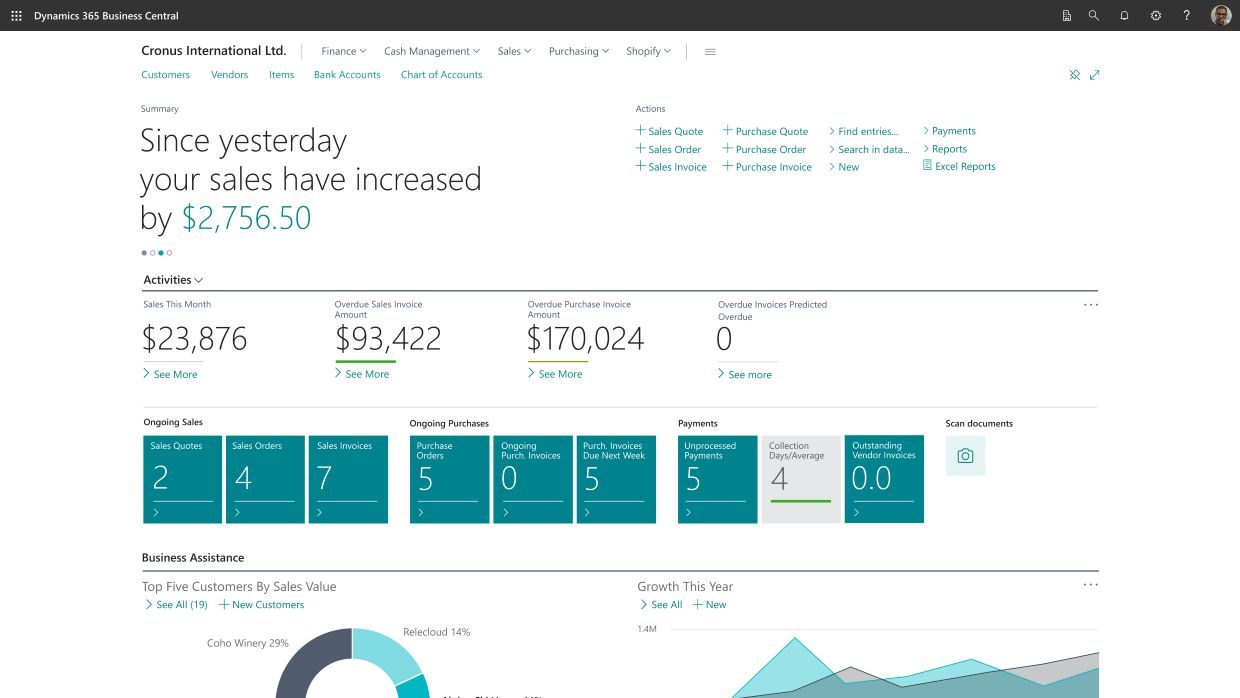
Business Central is Microsoft's ERP for small and mid-sized businesses, and inventory is one of its core modules. You get real-time stock visibility, bin-level tracking, lot and serial traceability, cycle counts, and inbound and outbound warehouse workflows.
The trade-off: you're buying an ERP, not just an inventory app, so the value compounds when finance, purchasing, and sales tie together. Canadian list pricing starts at CAD $108.50 per user per month for Essentials (this can always change subject to Microsoft review). Implementation is partner-led, which is why most buyers pair it with a local Microsoft Partner.
2. Zoho Inventory

Best for: micro businesses and online sellers with light inventory needs.
Zoho Inventory is a clean, affordable cloud tool tied into the wider Zoho ecosystem, and for very small teams it's a credible pick for best inventory control software at the entry level. You get multi-channel selling, basic warehouse management, and order management without much learning curve. There's even a free plan capped at a small number of orders per month.
The trade-off: it leans light. If you grow past a few thousand SKUs, multi-location warehousing, or complex manufacturing, you'll bump against its ceiling fairly quickly.
3. Cin7 Core

Best for: multi-channel retailers and product brands selling through Shopify, Amazon, and physical stores.
Cin7 Core (formerly DEAR Systems) is purpose-built for inventory across many sales channels. Strong on integrations, batch and serial tracking, and assembly. If you're running an e-commerce operation with growing complexity, this one earns its place on most shortlists.
The trade-off: less natural fit for service-heavy or finance-heavy operations, and the user interface takes some getting used to. For e-commerce sellers comparing standalone apps against a full ERP, our piece on inventory management software for Shopify covers when it's time to graduate.
4. Fishbowl Inventory

Best for: QuickBooks shops and small manufacturers that want inventory beyond what QuickBooks offers.
Fishbowl is one of the most popular QuickBooks add-ons for stock management, with bill-of-materials, work orders, and barcode scanning. Solid choice if you're already committed to QuickBooks and need inventory layered on top.
The trade-off: it's an add-on, not a unified system, so you'll juggle two tools and the integration can be fragile during heavy use. As your business scales past QuickBooks, you're usually shopping again within three to five years, which makes the total cost higher than it first appears.
5. NetSuite Inventory

Best for: mid-sized to large enterprises with serious budgets and multi-entity complexity.
NetSuite is Oracle's cloud ERP, and inventory is a deep, mature module inside it. For large operations, it's often shortlisted as the best inventory control software at the enterprise tier. Multi-subsidiary, multi-currency, multi-warehouse, demand planning, and advanced supply chain features are all standard.
The trade-off: pricing is firmly enterprise-tier, and Canadian SMBs frequently find it overbuilt for their stage. Our NetSuite vs. Dynamics 365 Business Central comparison walks through where each one pulls ahead.
6. Odoo Inventory

Best for: cost-sensitive teams comfortable with open-source platforms and willing to invest in setup.
Odoo is modular and flexible, and the inventory app works as a standalone or as part of the full ERP suite. Strong on barcode scanning, multi-warehouse, and routes.
The trade-off: support quality varies, and Canadian implementations often need a certified partner since the platform is community-driven. If you're stuck between Odoo and Business Central, our Odoo vs Business Central comparison breaks down where each one wins for Canadian buyers.
7. Katana

Best for: SMB manufacturers who need light MRP plus inventory in one tool.
Katana is a clean, visual platform built for makers and small factories. Real-time stock counts, production scheduling, raw materials, and finished goods all live in one place.
Trade-off: it shines for small manufacturers but starts to feel limiting once you need deep accounting, multi-entity finance, or complex distribution workflows. Canadian makers often start here and migrate to a fuller ERP when they pass roughly CAD $5M in revenue, so it's a strong starter platform rather than a long-term home.
8. inFlow Inventory

Best for: small operations that need simple, reliable inventory tracking without ERP complexity.
inFlow is one of the most cited entries when buyers search for the best inventory control software at the small-business end. It's straightforward, well-priced, and good for warehouse teams that want barcode scanning, stock counts, and basic reporting.
The trade-off: it's a point tool, so if your finance team is still in QuickBooks or Sage and your sales team is in a separate CRM, you're not getting a unified picture. Most growing Canadian businesses pass inFlow's ceiling within a couple of years, so it works best as a stopgap.
How to Choose the Best Inventory Control Software for Your Business
Picking the right tool is less about features and more about fit. The wrong choice costs more in lost time than the right one ever does in licensing.
Standalone Apps or ERP-Based Best Inventory Control Software
This is the first decision, and most buyers skip it. Standalone inventory apps (Zoho, Cin7, Fishbowl, Katana, inFlow) are fast to set up and cheap to start. They work well when your team is small, your finances are simple, and your sales channels are few. For many micro businesses, this is the best inventory control software path.
ERP-based inventory (Business Central, NetSuite, Odoo) sits inside a wider system where stock, sales, purchasing, and accounting share one source of truth. That matters once you're juggling more than one warehouse, multiple sales channels, or detailed cost reporting.
At that stage, the best inventory control software is usually the one already wired into your finance system. If you're still running stock through spreadsheets, our Excel vs. ERP for inventory management breakdown walks through the exact gaps spreadsheets hide until they hurt.
7 Criteria That Matter When Evaluating Best Inventory Control Software
The feature list is the easy part. Here's what separates a tool that helps from a tool that wastes a year of your operations team's time.
- Real-time stock accuracy. Counts must update the moment something is received, picked, or shipped. Delays of even a few minutes cost you in oversold orders.
- Bin and location control. If you have more than one warehouse or zone, you need bin-level tracking with structured rules.
- Lot and serial traceability. Critical for regulated industries like food, medical, and electronics, and useful everywhere for recalls.
- Cycle counting support. Stopping operations for full counts kills throughput. The best tools support continuous cycle counts without downtime.
- Integration with finance and sales. Inventory that lives in a silo creates reconciliation work. Look for a tool that talks to your accounting and order management.
- Canadian tax handling. GST, HST, PST, QST, and multi-province scenarios should be built in, not bolted on.
- Implementation support. A great platform with a bad rollout is a worse outcome than an average platform rolled out well.
Get the 10 Key ERP Selection Criteria Guide
A short, practical PDF that walks you through the exact 10 key selection criteria before you sign. Built for buyers who want to skip the hype.

Common Mistakes Canadian SMBs Make When Buying Best Inventory Control Software
Most regret with the best inventory control software comes from one of these four mistakes. They're all avoidable if you know what to look for.
Buying for Today, Not for Three Years From Now
If your business is growing 20% a year, the cheap tool that fits today will be the broken tool in 24 months. Plan for where you'll be, not where you are.
Choosing on Price Alone
"Free" platforms cost the most over time. Hidden costs include internal hires to maintain them, custom development for missing features, and the inevitable migration when you outgrow them.
Ignoring the Implementation Partner
The software is half the deal. The Canadian Microsoft Partner or vendor consultancy doing your rollout is the other half. A great platform with a bad implementation team produces worse outcomes than an average platform with a great team.
Skipping the Canadian Context
A US-built tool with no GST/HST logic, no multi-province shipping rules, and no bilingual support will quietly bleed your team's time. Most US-first tools are workable in Canada, but only some are built for it.
Here's what real warehouse inventory control looks like inside Business Central, including how a pick is created and a shipment goes out.
What the Best Inventory Control Software Should Do for a Growing Business
The minimum bar is stock accuracy. The real question is whether your tool makes your team faster, your customers happier, and your accountant less anxious.
Visibility Your Team Actually Trusts
Strong platforms deliver visibility your people actually trust. When sales says "we have 47 units," finance can see the same number, and the warehouse can confirm it. No reconciliation meetings, no Excel exports, no surprises at month-end.
Handling Exceptions Without Breaking
Returns, partial shipments, kitting, drop-shipping, and inter-warehouse transfers are normal in growing businesses. A platform that fights you on any of these creates manual workarounds that erode trust in the data.
Faster Decisions From Real-Time Data
Beyond accuracy, the best inventory control software shortens the gap between data and decision. Real-time dashboards on slow-moving SKUs, automated reorder points, and demand forecasting all turn inventory from a cost centre into a competitive advantage.
For a deeper read, our piece on the 11 benefits of using ERP software to improve inventory management covers the operational wins in more detail.
Built for Multi-Warehouse and Multi-Entity Growth
Growth-ready tools support multi-warehouse, multi-currency, and multi-entity setups without custom builds. If you're planning a second warehouse, a US expansion, or a new product line, your platform should welcome that move. Our write-up on the benefits of a warehouse management system covers where warehouse capabilities add measurable lift on top of basic stock tracking.
See How Inventory Control Works Inside a Real ERP
A quick walkthrough of bin management, picking, and stock visibility inside Business Central, mapped to a Canadian operation that looks like yours.
 Book a free consultation
Pricing Reality: What the Best Inventory Control Software Costs in Canada
Real pricing for the best inventory control software is rarely what the website shows. Here's what Canadian buyers actually spend.
Entry-Level Tools ($100 to $400 per Month)
Tools like inFlow, Zoho, and light Katana tiers land here. Often advertised as "starts free," but most growing teams need a paid tier within months. Free plans cap at a few dozen orders per month and a couple of users. Our guide to free inventory management software covers when "free" actually works for a Canadian SMB and when it quietly costs more than a paid tool.
Mid-Tier Dedicated Tools ($400 to $1,500 per Month)
Cin7 Core, Fishbowl, and larger Katana plans sit here, depending on users, locations, and integrations. Add-ons like advanced reporting, EDI, and additional channels often push costs higher than the listed plan suggests.
ERP-Based Inventory (Partner-Led Pricing)
Business Central licensing runs roughly CAD $108.50 to $149.20 per user per month. A typical 10-user Canadian SMB will land between CAD $13,000 and $18,000 in annual licensing. Add implementation, typically CAD $25,000 to $80,000 depending on complexity. Odoo Enterprise sits in a similar range.
Enterprise Platforms ($30,000+ per Year)
NetSuite is firmly in this tier for licensing alone, plus significant implementation. That's why it's rarely a fit for Canadian SMBs under 100 employees.
The number that matters isn't sticker price. It's total cost of ownership over three years, including software, implementation, training, integrations, and the time your team spends on workarounds.
-
For small Canadian businesses with simple needs, Zoho Inventory or inFlow Inventory work well and start affordably. For SMBs that expect growth into multi-warehouse or multi-channel operations, Microsoft Dynamics 365 Business Central is a stronger long-term fit because inventory is integrated with finance, sales, and purchasing in one system.
Why Canadian Businesses Pick Gestisoft for Their Best Inventory Control Software Rollout
Gestisoft is a Canadian Microsoft Solutions Partner that has been implementing Business Central, our recommended best inventory control software for growing SMBs, and its predecessors since 1997. We work with growing companies across Canada and North America in both English and French, and our approach to inventory rollouts is built around the operational reality of Canadian SMBs.
Our team of 110+ specialists handles 220+ projects per year, with a 95% client renewal rate for 2024. We're B Corp certified and a Great Place to Work, but what matters more for your project is that we configure inventory workflows around your real operation. Bin logic, receiving rules, cycle counting, picking methods, and warehouse roles are all designed for adoption, not just for go-live.
What clients say about working with our team:
“The solution delivered to us has significantly improved our production visibility. We are now able to track our production in real time, and have more accurate data on the costs of each production run.”
That outcome (real-time visibility, accurate costing, decisions made on current data) is the heart of what good inventory control delivers. If that's what you're missing today, we can help you get there.
Talk to a Canadian Partner About Your Inventory Setup
Bring your spreadsheets, your stockout horror story, and your shortlist. Walk away with a clear next step.
 Book a free consultation
Liked what you just read? Sharing is caring.

June 15, 2026 by Muhammad Ali Iqbal by Muhammad Ali Iqbal SEO Content Strategist & Copywriter
Driven by a passion for search engine optimization, strategic content, and conversion-focused writing. A copywriter and content strategist who lives for content that ranks, engages, and delivers real business results.
