

It's the end of the month. Your operations team has closed the production orders. Your finance team is trying to close the books. And somewhere between the shop floor and the general ledger, the numbers don't line up.
Suddenly, your mind is going a mile a minute with question after question:
- What did it cost to produce that batch?
- Where is the WIP sitting on the balance sheet right now?
- How much of that raw material variance was a pricing issue versus a waste issue?
These aren’t exotic questions, either. They're very basic questions every Canadian manufacturer needs to answer. Every single month.
And the problem isn't your team. It's that most accounting software for manufacturing in Canada was designed to record financial transactions, not to track what happens on a production floor. The gap between those two things is where manufacturers lose visibility, close the books late, and make pricing decisions based on incomplete cost data.
We’re covering what accounting software for manufacturing needs to do, why generic tools fall short on the Canadian shop floor specifically, and how Microsoft Dynamics 365 Business Central handles the complexity that standard bookkeeping tools were never designed for.
Stop Guessing Your Production Costs
Our team works with Canadian manufacturers every week. Let's talk about what accounting software for manufacturing looks like when it's built for your operations.
 Book a free consultation
Accounting Software for Manufacturing: Why it’s Different
Most accounting software handles the fundamentals: money in, money out, reconcile the books. For a service company or a retailer, that's enough.
Manufacturing is an entirely different animal.
When your business physically transforms raw materials into finished goods, your financial picture gets layered in ways that standard bookkeeping software isn't designed to track. Good accounting software for manufacturing has to handle costs at every stage of that transformation, not just when a sale is made or a bill is paid.
Here's where the complexity lies:
Three-stage inventory tracking is the first thing that separates manufacturing accounting from everything else. You're managing raw materials that haven't entered production yet, work-in-progress (WIP) inventory that's somewhere on the floor, and finished goods ready to ship. Each of these has different accounting treatment. A system that can only see "inventory" as a single line item will never give an accurate financial picture.
Job costing is the second. For custom or batch manufacturing, whether you're producing made-to-order equipment or running production runs for a specific customer, you need to track the actual cost of materials, labor, and overhead for each job or work order. Not just in aggregate. Per job. Accounting software for manufacturing that lacks real job costing forces your team to build parallel spreadsheets, which is both time-consuming and prone to error.
Overhead absorption is where most small manufacturers quietly lose visibility. Your factory rent, equipment depreciation, utilities: these indirect costs need to be allocated across production. Get it wrong and your product costs are wrong, your pricing is wrong, and your margins are a fiction.
Cost variance analysis is the payoff. When your actual production costs differ from your standard costs, materials ran over, machine time was higher than planned, or labor hours ballooned. You need to see that variance clearly, not buried in a general ledger entry from three weeks ago.
The right accounting software for manufacturing connects all of this in real time. It means your finance team and your operations team are looking at the same data, not reconciling two different versions of the truth.
The Canadian Layer of Accounting Software for Manufacturing
If you read the major roundups of accounting software for manufacturing, and there are plenty of them, you'll notice something. Almost all of them are written for a generic North American or global audience. The Canadian compliance reality barely comes up.
That's a problem for Canadian manufacturers.
GST/HST on manufacturing inputs is genuinely complicated. Input tax credits (ITCs) for goods and services used in production need to be tracked accurately. Your accounting software for manufacturing needs to handle this automatically, not leave it to manual calculation or your accountant's year-end correction.
Provincial differences add another layer. Manufacturers in Québec deal with QST on top of GST, with its own rules around ITCs and reporting. Ontario, British Columbia, and the other provinces each have their own sales tax treatment for certain manufacturing inputs and capital equipment. Software that's built for US accounting or doesn't understand Canadian tax codes will either create errors or force constant manual workarounds.
PIPEDA compliance matters if your accounting software for manufacturing is cloud-based, which most modern systems are. The Personal Information Protection and Electronic Documents Act governs how Canadian businesses store and protect data. Choosing software hosted in Canada or by a provider with Canadian data residency options isn't just a technical preference. It's a compliance consideration.
Bilingual operations are a practical reality for manufacturers with facilities in Québec or a bilingual workforce. Your accounting software for manufacturing should be able to produce reports, invoices, and financial documents in both English and French without requiring a separate system.
Accounting Software for Manufacturing: Where Basic Tools Hit the Wall
QuickBooks Online is the most popular accounting software in Canada for small businesses. That's not nothing. It earns that position. For a company that invoices clients, pays suppliers, runs payroll, and reconciles bank accounts, it works well.
But the moment a manufacturing company starts growing past about 20 employees, or takes on more complex production runs, or tries to close the books with real cost accuracy, QuickBooks starts showing its limits.
The core issue is that QuickBooks is accounting software that manufacturers use, not accounting software for manufacturing. The distinction matters. It means the system was designed for financial recording, not production management. When you try to force WIP tracking, job costing, or BOM-linked inventory into QuickBooks, you end up using add-ons, workarounds, or manual processes that undermine the whole point of having a system.
Manufacturing companies that have outgrown basic accounting software typically describe the same set of problems:
- Month-end close takes too long because inventory reconciliation is a manual exercise.
- Job costing is done in Excel spreadsheets that live on someone's laptop.
- Purchase orders for raw materials are managed in a separate system that doesn't talk to the books.
- Production team decisions and finance team reporting are always slightly out of sync.
These aren't symptoms of poor management. They're symptoms of accounting software for manufacturing that wasn’t designed for what you're doing.
Not sure if you've outgrown your current system?
We work with manufacturers across Canada to evaluate your current software and identify where the gaps are costing you time and money.
 Free discovery call
Accounting Software for Manufacturing: What Business Central Does Differently
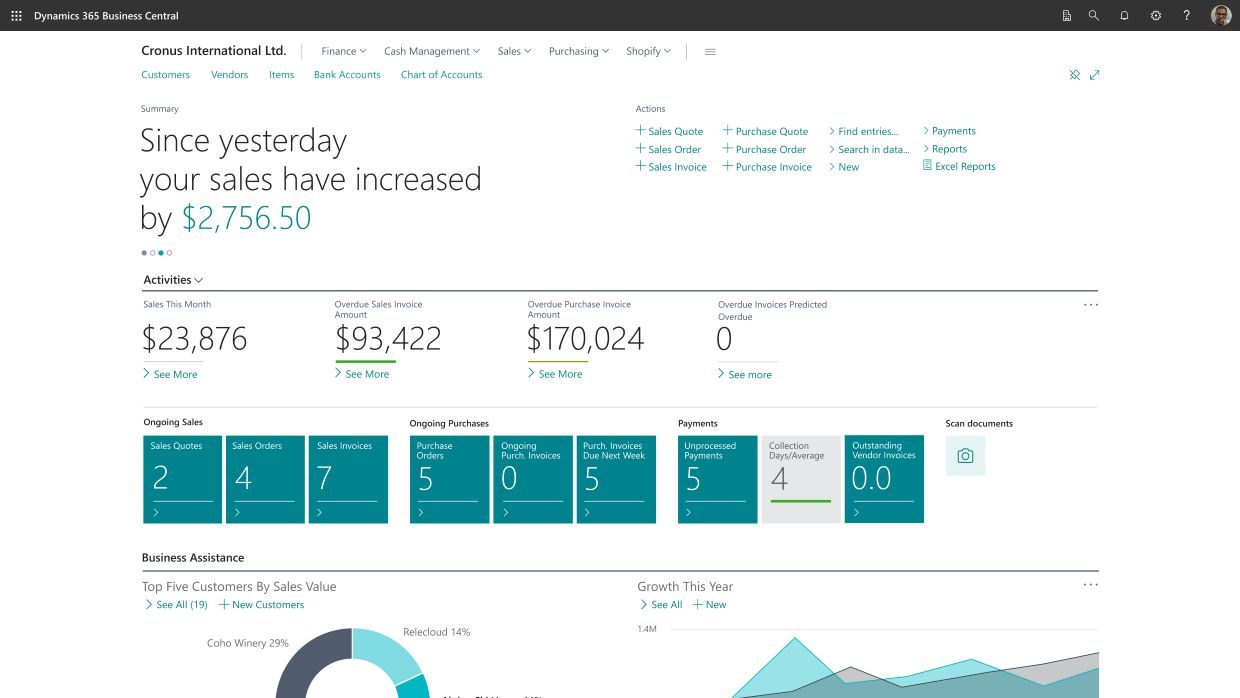
Microsoft Dynamics 365 Business Central is, at its core, an ERP: enterprise resource planning software. The enterprise label puts some Canadian SMBs off because it sounds like software for companies five times their size. Business Central is used successfully by manufacturers with 15 employees and by manufacturers with 500. The reason it works at both ends is that it's modular and configurable, not a monolithic system that forces you to use every feature on day one.
For manufacturing ERP specifically, here's what Business Central does that generic accounting software for manufacturing can't match:
Production orders and BOMs are native. Bill of materials management is built in. When a production order is created, Business Central knows what raw materials are needed, pulls from inventory, and tracks costs as the work order progresses.
WIP accounting is automatic. The system automatically updates work-in-progress balances in real time when materials are consumed and labor is posted to work orders. Your balance sheet reflects actual production status, not last month's manual count.
Job costing per work order. Every production run can be tracked to its actual cost: materials, labor hours, machine time, and overhead allocation. You can compare actual to standard costs and see variances immediately. For manufacturers who price custom jobs, this is the difference between knowing your margins and guessing at them.
Inventory costing methods. Business Central supports FIFO, average cost, standard cost, and specific item tracking. You choose the costing method that fits your production model, and the system applies it consistently across every transaction.
Canadian tax configuration. GST, HST, and QST are supported natively. ITCs can be tracked automatically. Provincial tax codes for different types of inputs, including manufacturing equipment, raw materials, services: these can be configured once and applied correctly across all transactions. This is what accounting software for manufacturing in Canada should look like.
Integrated financials. Because Business Central connects operations and accounting in one platform, your finance team sees the same data as your production team in real time. There's no reconciliation between a manufacturing system and a separate accounting system. They're the same.
The 5 Questions Manufacturers Should Ask for Any Accounting Software for Manufacturing
When you're evaluating accounting software for manufacturing, the product demos are always going to look good. The true questions are the ones that reveal whether the software fits your specific operating context, not just manufacturing in general, but manufacturing in Canada for businesses of your size and complexity.
Here are five questions to ask before you commit:
1. How does your system handle Canadian sales tax for manufacturing inputs?
Ask for a specific demo of GST/HST input tax credit tracking and provincial tax setup. If the answer involves manual configuration at the user level or workarounds, that's a red flag for accounting software for manufacturing in a Canadian context.
2. Can I track job costs at the work order level in real time?
Yes, in real time! Not as a month-end report. If the system requires your team to export data to Excel to get job-level cost analysis, you haven't solved the problem.
3. How does WIP appear on my balance sheet?
This is a question that will immediately tell you whether the vendor understands manufacturing accounting. The answer should explain how work-in-progress is calculated, when it's updated, and how it flows through to finished goods.
4. What happens when actual production costs differ from standard costs?
Variance analysis is a basic requirement for accounting software for manufacturing. Ask how cost variances are surfaced, where they appear in financial reporting, and how quickly they're visible.
5. What does implementation look like for a manufacturer of our size?
The software is only part of the equation. ERP implementation for a 30-person manufacturer should not take two years or cost as much as the software itself. Ask for references from manufacturers of comparable size and complexity, not enterprise case studies.
Get the advice you need to select the best accounting software for manufacturing
We have decades of experience helping canadian manufacturers discover how Business Central can help with their accounting needs. Bonus part: the software also helps in production and manufacturing monitoring.
 Book a free consultation
How Business Central Compares to Other Accounting Software for Manufacturing
There are other options on the market. Here's a genuine look at where the main alternatives sit relative to Business Central for Canadian manufacturers.
Business Central, through a certified Canadian Microsoft Partner like Gestisoft, offers the best combination of manufacturing-specific functionality, Canadian compliance out of the box, ERP-level integration, and an implementation model that's scaled to match a Canadian SMB's real budget and timeline.
QuickBooks Online remains the right choice for manufacturers who are genuinely in early-stage growth, running simple production processes, and not yet dealing with complex job costing or multi-stage inventory. The accounting software for manufacturing threshold, the point where QBO starts creating more work than it saves, varies by company, but most manufacturers hit it somewhere between $2M and $5M in revenue, or when they take on custom or make-to-order production.
Sage 50 cloud is a step up from QuickBooks in terms of Canadian compliance features and inventory management. It handles some manufacturing scenarios reasonably well, particularly for smaller operations. Where it falls short is in the depth of production order management, real-time WIP tracking, and the native integration between shop floor operations and financial reporting that a growing manufacturer needs.
Sage X3 targets larger manufacturing companies and competes more directly with Business Central at the mid-market level. For companies with highly complex, multi-site, or international manufacturing operations, it's a legitimate contender. For most Canadian SMBs in manufacturing, the implementation cost and complexity of Sage X3 is harder to justify than Business Central.
NetSuite, for comparison, is strong in accounting and financial reporting and has a manufacturing module. The challenge for Canadian manufacturers specifically is that NetSuite's Canadian tax handling has historically required more manual configuration, and the implementation complexity and ongoing licensing costs make it better suited to larger organizations.
For a deeper look at ERP consulting in Canada and how to choose the right implementation partner, the Gestisoft partner page covers what to look for in a Canadian Microsoft Partner.

What "Going Live" Should Look Like for Accounting Software for Manufacturing
One of the reasons Canadian manufacturers stick with accounting software for manufacturing that's clearly not working is the perceived pain of switching. The assumption is that any proper ERP implementation means 12-18 months of disruption, a project team of consultants, and a six-figure bill.
That's sometimes true for enterprise implementations. For a Canadian SMB with a single facility and 20-100 employees, it doesn't have to be.
Gestisoft implements Business Central for manufacturers typically in 8-16 weeks, depending on the complexity of your production environment and the state of your existing data. The process starts with a discovery phase that maps your actual production flows, costing requirements, and compliance needs, not a generic ERP template.
“I see that Gestisoft is always keeping up with the latest trends, and that gives us confidence. I'm happy to be with a supplier like Gestisoft because I know they'll grow with my solution.”
The manufacturers who get the most out of accounting software for manufacturing implementations are the ones who start with a clear picture of where their current system is failing them. Job costing accuracy. WIP reconciliation time. Month-end close cycles. Those specific pain points become the success criteria for the implementation.
Companies that migrate to Business Central from Excel-based operations typically consolidate 4-6 disconnected tools into one platform. The accounting software for manufacturing is no longer a separate thing from the production management system, the inventory system, and the purchasing system. They're all one.
If you’re ready to see what this looks like for your manufacturing operation, let’s have a conversation about your current setup and what accounting software for manufacturing could look like when it's properly configured for your business, Book a Free Consultation.
Explore More
- ERP System for Manufacturing: Definition, Types, Benefits A deeper look at how ERP systems for manufacturing work and what to expect from them.
- 30 Benefits of Manufacturing ERP: Optimize Your Operations from A to Z A comprehensive breakdown of what a manufacturing ERP delivers day to day.
- Top 5 ERP Implementation Challenges and How to Prepare What goes wrong in ERP implementations and how Canadian manufacturers can avoid the common pitfalls.
- ERP Software Inventory Management: How to Take Control of Your Stock How ERP-based inventory management connects to financial reporting for manufacturers.
- Microsoft Dynamics 365 Business Central Specialist in Canada Gestisoft's Business Central practice for Canadian businesses, with implementation services tailored to SMBs.
Liked what you just read? Sharing is caring.

May 22, 2026 by Conni Guido by Conni Guido Copywriter and Brand Strategist
I started with a degree in Professional Communications and never looked back. Now, I'm a professional storyteller who believes every brand has a story to tell, and every good story should leave you wanting more. You can find me lost in a book club or a writing sprint, baking words into pies...probably both.
