

Key Takeaways:
- The most common small business ERP pick for Canadian SMBs between 10 and 250 users is Microsoft Dynamics 365 Business Central, priced at approximately CAD $108.50/user/month for Essentials and CAD $149.20/user/month for Premium.
- A small business ERP earns its cost when disconnected tools, spreadsheet reconciliation, or a slow month-end close start burning more hours than the software would.
- Total Year 1 cost for a small business ERP in Canada typically runs CAD $30,000 to $120,000 for teams under 20 users, covering software, implementation, migration, and training.
- Most small business ERP implementations for teams under 50 users go live in 3 to 6 months when the first phase is scoped tightly around core finance, inventory, and sales.
Every year, more Canadian teams start shopping for a small business ERP, and every year, most of them come out of the process more confused than when they started.
Vendor sites overpromise... Listicles are written for US manufacturers with a full IT team... Pricing is quoted in USD, if it's quoted at all…
This guide takes a different route…
You'll see the six systems Canadian SMBs are actually shortlisting in 2026, what they cost in CAD, how to tell when your business is genuinely ready, and what an honest implementation timeline looks like. Start with the vendor list, then work backward to whether you're ready to buy.
Get Clarity on Your ERP Move
Talk with a Canadian ERP specialist who will listen first and give solutions to your real problems.
 Planifier une consultation gratuite
The Best Small Business ERP Systems to Compare in 2026
The Canadian SMB market has settled around six serious small business ERP options. Each one solves a slightly different problem, and the right one depends far more on your operations than on the marketing gloss.
If you want the broader Canadian shortlist, our guide to the top ERP systems in Canada compares eight platforms against Canadian tax handling, bilingual support, and partner availability.
1. Microsoft Dynamics 365 Business Central
Microsoft's cloud ERP for small and growing businesses, and the most common Canadian pick for teams of 10 to 250 users. Native English and French, direct Microsoft 365 integration, and the deepest Canadian partner network on this list. Copilot is now integrated into daily use, and our intelligent ERP overview covers what that changes.
Pricing: Essentials at CAD $108.50/user/month; Premium at CAD $149.20/user/month (paid yearly).
Trade-off: Real value comes through a partner-led implementation, not a self-serve signup.
Best fit: Canadian SMBs already inside the Microsoft ecosystem or planning to move toward it.
2. Oracle NetSuite
NetSuite launched in 1998 as one of the first cloud ERPs and was acquired by Oracle in 2016. It's a strong pick for high-growth Canadian companies planning multi-entity operations or cross-border expansion, with a single-platform approach that spans finance, inventory, CRM, and e-commerce.
If it's on your shortlist alongside Business Central, our NetSuite vs. Business Central breakdown compares pricing transparency, Microsoft 365 integration, and each vendor's AI direction.
Pricing: Sits in the upper tier of the SMB market… total investment typically reflects extensive partner-led setup.
Trade-off: Canadian payroll usually needs a third-party SuiteApp, adding licensing costs.
Best fit: Ambitious SMBs expecting subsidiaries or fast international growth.
3. Sage Intacct
A finance-first cloud platform popular with Canadian professional services firms, nonprofits, and accounting-heavy small businesses. Multi-dimensional reporting is genuinely class-leading in its price band, and the CRA-friendly tax setup works cleanly for Canadian operations. Multi-entity consolidation is a particular strength.
Pricing: Mid-tier subscription; annual cost scales by module and entity count.
Trade-off: Inventory, manufacturing, and field operations are weaker than a full operational ERP, and you will end up bolting on best-of-breed apps for those.
Best fit: Small businesses where financial visibility, entity consolidation, or audit-heavy reporting is the priority.
4. Acumatica
A cloud ERP with a flexible consumption-based licensing model that does not charge per user. That model has made it grow fast in the Canadian mid-market and lower-mid SMB space, especially for distribution and light manufacturing teams that need many casual users touching the system.
Pricing: Scales with transaction volume and resources used, not by seat count.
Trade-off: Canadian partner ecosystem is smaller than Microsoft's, so local support depth varies by region.
Best fit: Growing teams that do not want to be penalized for adding users, and operations that want a modern web-native interface without seat-count math.
5. Odoo
Open-source modular ERP that is popular with early-stage Canadian SMBs and businesses under CAD $10M in revenue. You add only the modules you actually need, which keeps entry costs low and lets you extend the platform as you grow.
Pricing: Community edition free. Standard tier is US$24.90/user/month (approximately CAD $34.85) for the first year, then US$31.10/user/month (approximately CAD $43.55) after that.
Trade-off: Reaching production maturity for finance and inventory often needs strong internal technical hands or a specialized partner, and Canadian tax handling out of the box is basic.
Best fit: Small teams comfortable owning some of the technical setup, or fast-moving startups looking for a low-cost way in.
6. SAP Business One
SAP's SMB product, built for structured control across accounting, inventory, purchasing, and sales. Brand recognition sometimes carries the decision, especially for finance-led buyers.
Canadian localization exists and French is available as a UI language, though the partner ecosystem here is smaller than Business Central's. Our SAP vs. Dynamics 365 comparison shows where each one fits and where buyers regret the choice.
Pricing: Mid-range in the Canadian market; costs rise with customization and partner-led rollouts.
Trade-off: Rigid SAP methodology limits workflow flexibility for smaller teams.
Best fit: SMBs that value process discipline and formal financial controls.
5 Signs Your Business Is Ready for a Small Business ERP
Reading a vendor list is easy. Knowing whether you are actually ready to move is harder. Accounting tools like QuickBooks or Sage 50 stop being enough once you carry stock, run multi-location shipping, or need real-time valuation flowing into your financials.
Here is a straight test: if more than one of the following describes your week, the timing question is largely answered.
Month-End Close Takes More Than Five Business Days
If closing the books is a reconciliation exercise before it is a reporting exercise, your accounting software is no longer the answer. That gap costs decisions.
Inventory Numbers in the System Do Not Match the Shelf
Physical counts return surprises. Sales orders ship short. Purchasing decisions are based on a spreadsheet someone updated on Tuesday.
You Have Three or More Disconnected Tools Passing Data by Copy-Paste
Accounting in one place, inventory in another, sales in a third, and a warehouse app that talks to none of them. Every handoff is a chance to lose a number.
Growth Exposes Reporting You Cannot Trust
Leadership asks for a margin report by product line and it takes two people three days to build. You get one answer this week and a different one next week.
New Hires Learn Workarounds Instead of the Job
Onboarding time is a hidden tax. When the first thing you teach is "here is how our system does not work," the software is the problem.
If three or more of those match your week, a small business ERP is the fix rather than another patch.
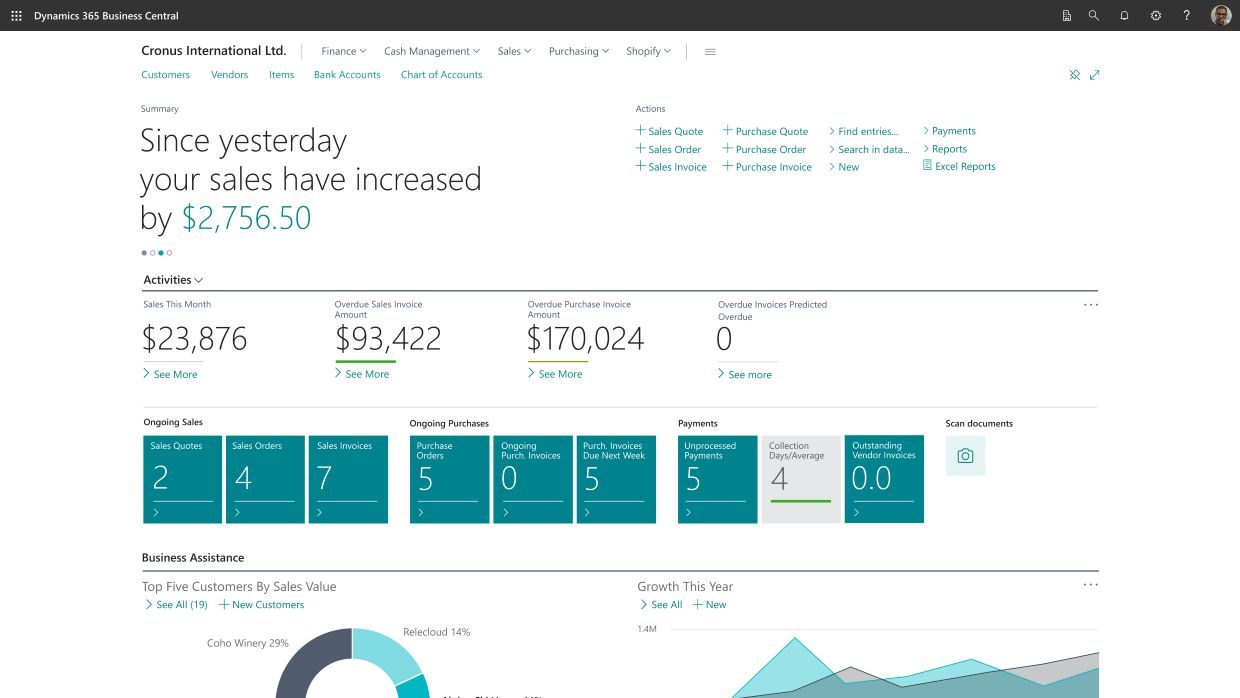
Before we look at how to choose one, here is a quick tour of what a modern small business ERP looks like day to day…
How to Choose the Right Small Business ERP for Your Team
The vendor list is the easy half of the decision. Choosing the right small business ERP for your team means separating the demo from the day-to-day reality, and separating what the software can do from what your team will actually use.
Seven Questions to Ask Before Any Small Business ERP Demo
Ask these questions before the salesperson opens the deck. The answers separate the fits from the sales pitches.
- Who exactly will implement this, and are they in Canada?
- What does Year 1 total cost look like in CAD, including licensing, implementation, migration, and training?
- How does the system handle GST, HST, PST, and QST out of the box?
- Does it produce T4 and T4A slips natively, or through a third-party add-on?
- What does the exit look like if we decide to leave in three years?
- Which of your current customers is closest to our operation, and can we speak to them?
- What is not included in the price we are being quoted?
If a vendor cannot answer any of these clearly in the first call, that is data.
Cloud vs. On-Premise: What Makes Sense for Small Teams
For most Canadian SMBs, cloud is the right answer. Lower upfront cost, automatic updates, and no server room to maintain. Our breakdown of cloud ERP benefits covers the full case.
On-premise still makes sense in narrow situations: strict data residency requirements, existing hardware you have already amortized, or a legacy integration that cannot be replaced. For everyone else, the IT overhead of running your own servers is not worth the incremental control.
Stress-Test Your Shortlist With an Expert
A short conversation with a Canadian ERP specialist helps you separate genuine fit from a good demo.
 Planifier une consultation gratuite
How Much Does a Small Business ERP Cost in Canada?
Real small business ERP numbers are the hardest thing to find in this market, and it is not an accident. Vendors quote lists in USD, partners quote implementation ranges without telling you what is missing, and total cost only becomes clear after you sign. Here is the honest picture in CAD.
Business Central Licensing in CAD (Essentials vs. Premium)
Two subscription tiers cover most small businesses:
- Essentials: approximately CAD $108.50/user/month. Covers finance, sales, purchasing, inventory, project management, and basic warehousing. Fits most Canadian SMBs.
- Premium: approximately CAD $149.20/user/month. Adds manufacturing and service management modules. Worth it if you actually make things or dispatch technicians.
The Hidden Costs Beyond Licensing
Licensing is an easy number. The costs that surprise buyers are the ones nobody quotes upfront:
- Implementation services: discovery, configuration, and go-live support from a partner. This is the largest single line item.
- Data migration: cleaning and moving your existing chart of accounts, customers, vendors, items, and history. Almost never as clean as expected.
- Integrations: connections to your bank, payroll provider, e-commerce platform, and shipping carriers. Each one is a mini-project.
- Training: the difference between a system your team uses and a system your team resents.
- Custom development: any workflow that does not match the standard configuration. Keep this small on purpose.
What Canadian SMBs Typically Pay in Year 1
For a small business ERP rollout at a Canadian team of 5 to 20 users, total Year 1 investment usually lands between CAD $30,000 and $120,000. Ongoing annual cost, once you are live, tends to run CAD $15,000 to $50,000 depending on user count and support level. Midsize teams (20 to 75 users) can move into the CAD $150,000 to $500,000 range for Year 1.
The range is wide because scope decisions drive it. A tight Phase 1 scoped around core finance, inventory, and sales usually comes in on the lower half. A broader initial rollout adding manufacturing, warehouse mobility, and heavy custom development pushes toward the top.

How Long Does a Small Business ERP Implementation Actually Take?
Timelines vary, but the honest answer for a well-scoped small business ERP project is shorter than most buyers fear. What kills projects is not the software; it is scope creep, weak decision-making, and unrealistic expectations set during the sales cycle. Our ERP consulting guide covers the process end to end.
A Realistic Small Business ERP Implementation Timeline (Weeks, Not Years)
For a Canadian SMB under 50 users, a tightly scoped Phase 1 rollout typically runs 3 to 6 months from kickoff to go-live. Here is roughly how that time breaks down:
- Weeks 1–4: discovery, requirements, and design decisions
- Weeks 5–10: configuration, data preparation, and initial integrations
- Weeks 11–16: user acceptance testing, training, and iteration
- Weeks 17–20: go-live, hypercare, and stabilization
Broader scope, more entities, or heavy customization pushes the timeline out. That is a choice, not a rule.
Three Roadblocks That Kill Projects (And How to Avoid Them)
Every ERP project that fails, fails in one of these three ways. Watching for them is the cheapest insurance you can buy.
Trying to Do Everything in Phase 1
The biggest mistake buyers make is asking for a full replacement of every tool from day one. Successful implementations split the work: core finance, inventory, and sales first, then advanced warehousing, manufacturing, and custom modules later.
No Internal Project Owner
If nobody on your side is empowered to make decisions in the next 48 hours, the project stops every time a question arises. This is not a partner problem. It is a governance problem.
Data You Assumed Was Clean
Nine times out of ten, the existing customer list, item master, or chart of accounts is messier than anyone admits. Budget time for cleanup or accept that you are migrating the mess.
Score Every ERP the Same Way
A checklist that walks through 10 criteria for scoring any ERP before you commit.

-
For most Canadian SMBs between 10 and 250 users, Microsoft Dynamics 365 Business Central is the most common pick. Native EN and FR support, direct Microsoft 365 integration, and the deepest Canadian partner network drive that choice. Acumatica and Odoo are strong alternatives depending on your budget and complexity.
Why Gestisoft Is the Small Business ERP Partner Canadian Teams Trust
Gestisoft has been implementing Microsoft business solutions across Canada since 1997, and a Microsoft Solutions Partner since 2004. Bilingual teams work with clients from Montréal, Toronto, Ottawa, and Québec. B Corp certified and Great Place to Work certified, we run projects the way we would want them run for our own team.
Every small business ERP rollout we take on is scoped around what your operation actually needs first, not what a template says you should buy. That is the difference between a system your team adopts and one that sits half-used.
Elemental Container, the North American distribution arm of Tournaire Group, is a recent example. They moved off Sage X3 to Business Central with our team. Warehouse efficiency climbed up to 50%, and the project went live on time and on budget.
You get a lot of implementation guys who are in their cubicle in front of their monitor and they do it based on what the monitor tells them to do. He really took the time to understand from a user what we needed.
Chris Miller, Director of Operations, Elemental Container
You can read the full story. And if you want the same kind of partner on your project, we should talk.
Start With a Conversation, Not a Sales Pitch
Bring your questions. Leave with clarity on what is actually right for your business.
 Planifier une consultation gratuite
Vous avez aimé ce que vous venez de lire? Partagez-le!

27 juillet 2026 par Muhammad Ali Iqbal par Muhammad Ali Iqbal SEO Content Strategist & Copywriter
Driven by a passion for search engine optimization, strategic content, and conversion-focused writing. A copywriter and content strategist who lives for content that ranks, engages, and delivers real business results.

